

 Jane Verdonk
Bergamo is located in Lombardy, just northeast of Milan. The city has approximately 120.000 inhabitants and has a low-lying part (Bergamo Bassa) and a high-lying part (Bergamo Alta). Especially the high part is very worthwhile.
In 2020, Bergamo was one of the cities hardest hit by the corona epidemic. Everyone probably remembers the horror images of coffins in army trucks.
Fortunately, those days are over and Bergamo is once again the city of the polenta and osei, stracciatella ice cream and, according to the writer Stendhal, even 'the most beautiful city I've ever seen'.
Together with Brescia, Bergamo has been declared the cultural capital of Italy in 2023.

History of Bergamo Alta
Bergamo Alta is one of the oldest cities in Lombardy. In 1200 BC. it was founded by the Ligurians. Then came the Etruscans, the Gauls and the Romans. The city was subsequently destroyed by Goths, Huns and Vandals. After that, the city was part of the Lombard Duchy.
In the 13th century there were bloody feuds between the Colleoni family, who belonged to the Welves, followers of the Pope, and the Suardi family, who supported the Emperor (Ghibellines).
The Viscontis tried to put an end to this. But only under the Venetians did peace return. After Napoleon it belonged to Austria and in 1861 it finally became part of the new Kingdom of Italy.
The Lion: symbol of Bergamo
The lion was the symbol of Venice and stood for power, majesty and for Saint Mark (San Marco in Italian). On the famous Piazza San Marco in Venice you can see a bronze lion high on one of the two pillars.

The Venetians took this symbol to Bergamo. If you pay close attention, you can see lions all over the city:
- For example at the Fontana Contarini.
- 2 lions guard the Santa Maria Maggiore.
- A lion is depicted on the gates of Bergamo.
- Lions are also often depicted on facades.
Below are a few tips for the best sights, the best food and the best places to stay in the high City from Bergamo.
Funicolare

From the lower part of town, near Porta Nuova, take the funicular (Funicolare) up to the upper town. This is a shuttle train that connects the low city with the high city.
It was built in 1887 after a project by a certain engineer Alessandro Ferretti. In the nineteenth century, the funicolare some adjustments and it was further modernized.
The difference in height that the funicolare bridges is 85 meters on a slope of maximum 52%. In the 2 carriages, 50 people can be transported per carriage, but then it is also very full! There are only a few seats but it is an experience in itself going up and down with this. Tickets are available at the tobacconist around the corner.

This funicolare goes right through the fortress wall. The ride ends at the Palazzo Rota-Soardi, dating back to the 14de century.

here is now California Bakery is located, where you have a beautiful view of the low-lying city and surroundings.
If you prefer to walk, that is also possible, left at the Funicolare are stairs (scorlazzini called) that you can take up. You will then arrive at the Porta San Giacomo, the beautiful white marble gate of Bergamo.

Here you walk further up to Piazza Mercato delle Scarpe. Long ago, this small square was the center of the shoemaker's quarter. This is also where the funicolare comes out.
Old Town Square

If you walk up from the funicolare to the right you will arrive at Piazza Vecchia. This is one of the most beautiful squares in Italy.
Piazza Vecchia is also a pleasant square with many restaurants and terraces. In the warm season it is wonderful to stay here between the Italians and the tourists.
It's great to stroll through the narrow streets with all kinds of shops from (brand) clothing to pastry shops, who have their typical Dolci Bergamaschi promotion in the shop windows. The temptation is great to succumb to such a delicious cake…
Here you will also find the Palazzo della Ragione, the Biblioteca Civica, the Palazzo del Podestà and the Torre Civica.

Under the porticoes of the Palazzo della Ragione you can see a sundial from the 18de century. The sun's rays shine through a seven-meter high perforated plate and indicate in which constellation we live.
Climb the Torre Civica, or take the elevator up. Here you have a beautiful view over Bergamo to the precursors of the Alps. This tower is also called Il Campanone. Every evening at 10 am the bells strike 100 times, this tradition dates back to when the city gates were closed for the night.

Also on the square is the Fontana Contarini, which is currently being restored. The fountain is octagonal and all around are statues of snakes, sphinxes and lions guarding the fountain. In the past, the fountain served as a water reserve during times of drought.
In 1870, the podestà (mayor) of Venice donated the fountain to the inhabitants of Bergamo. Later there was a statue of Garibaldi on this spot, but it was moved to the lower town and so the fountain could return.
Piazza del Duomo
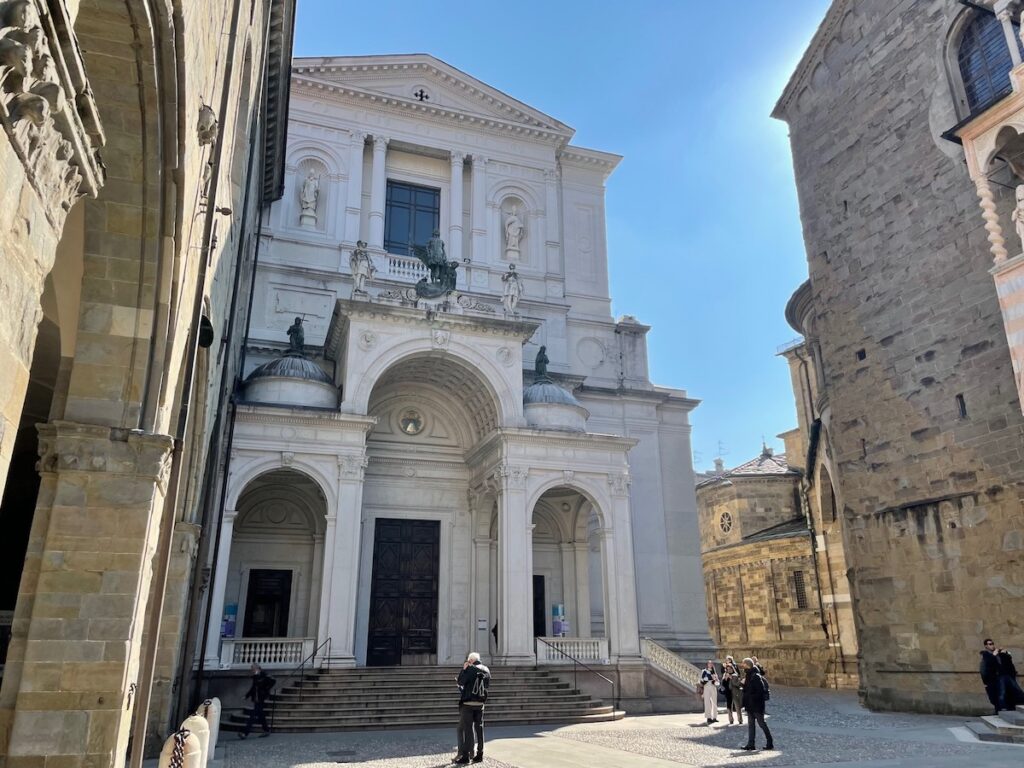
If you walk through the porticoes of the Palazzo della Ragione you will arrive at the Piazza del Duomo, with the Duomo, the Santa Maria Maggiore, the Capella Colleoni and the Battistero.

Cappella Colleoni and Santa Maria Maggiore Il Duomo 
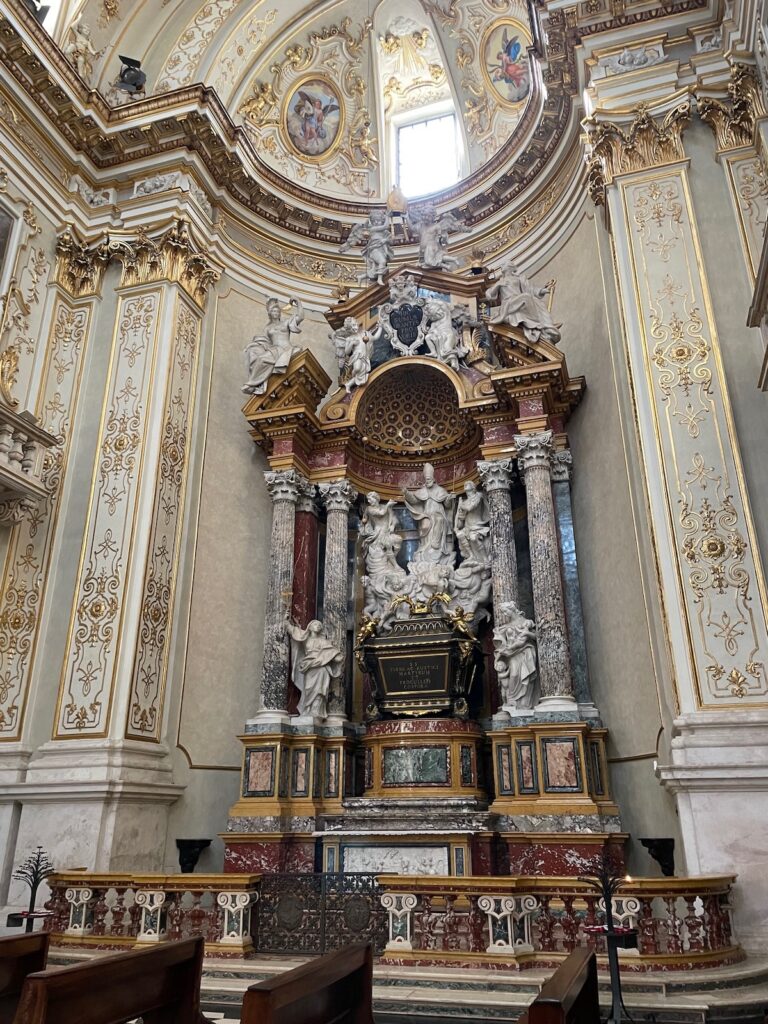
Interior Duomo Interior Santa Maria Maggiore

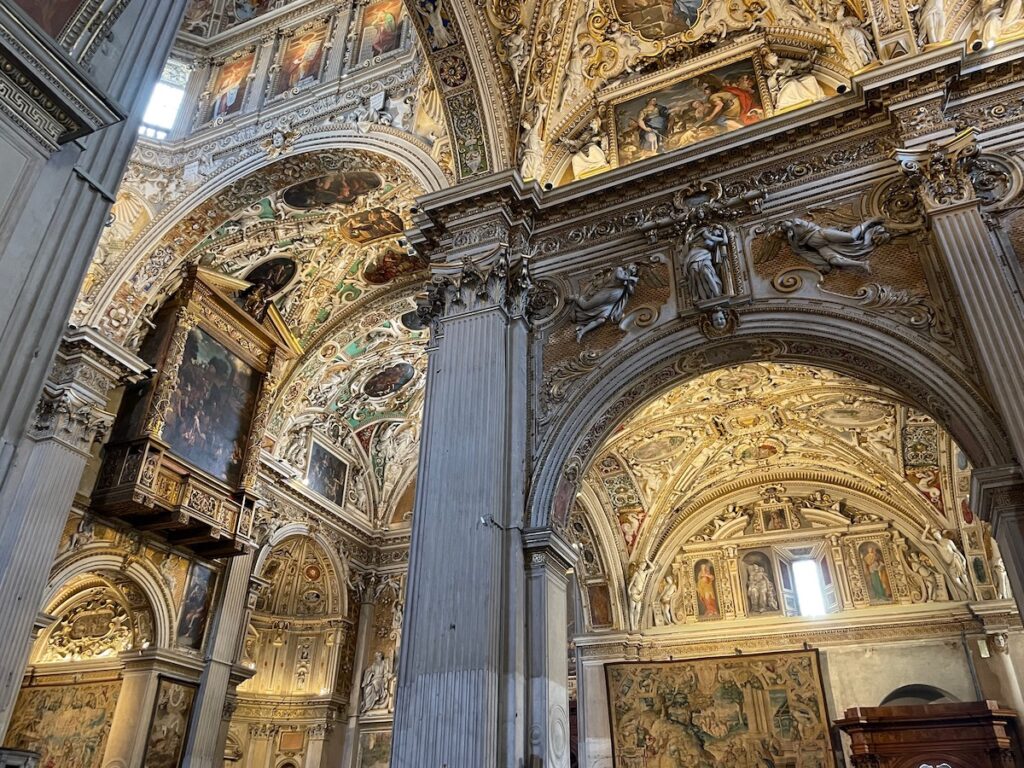
The Santa Maria Maggiore was built in the 12e century in Romanesque style with Gothic elements as well. The interior dates from the Baroque period, circa 1600-1700 and is overwhelming with many paintings, gobelins (tapestries) and old frescoes from the 14e century.

The famous opera composer Donizetti is buried in this church. Donizetti was very productive, sometimes composing 4 operas in a year, in total he has more than 70 operas to his name.
The Capella Bartolomeo Colleoni is one of the finest examples of the Renaissance in this area. Do what the old ladies of Bergamo recommend here: 'touch the balls of Colleoni'!
You will find these on the gate in front of the chapel, there are 3 of them and if you touch them you have a higher chance of getting pregnant. You will automatically see which balls are touched the most. The origin of this unusual weapon probably comes from the name Colleoni and the Italian translation of testicles: coglioni.

Then the question remains why there are 3. It was rumored that Bartolomeo was born with a rare defect that left him with three testicles and that's why these are on the coat of arms. A nice explanation, but the same weapon was already in use before Bartolomeo was born!

Next to the Santa Maria Maggiore is the Battistero from 1340 (temporarily closed) and opposite the Duomo.

This church has a 19th-century facade and a 17th-century interior with many precious paintings. Bergamo's bishops are buried in the cathedral and there is also a statue of Pope John XXIII (1914-1963) who was born in Bergamo and canonized in 2014.

Venetian walls
In the Venetian era, high city walls were built around Bergamo Alto, now the walls are on the UNESCO World Heritage List. The walls stretch for 5 km and you can walk over them.
Along the way you will pass the city gates, Porta San Lorenzo, Porta Sant'Agostino (where part of the university is located), Porta San Giacomo and the Porta Sant'Alessandro.
These gates were named after the churches that had to make way for the wall that was being built.
The Porta San Lorenzo is also known by the Bergamese as the Porta Garibaldi. This is where the army of Garibaldi entered Bergamo to liberate the city from the Austrians.
EXSA (Prison of Sant'Agata)

This building dates from the 14e century, was in the 18e century a monastery and in the 19e in 20e century prison.
It was then neglected until it was reopened for the first time in 2015 for exhibitions, meetings, workshops, events and so on.
Admission is free and you get a good impression of how terrible it was to be locked up here.
San Vigilio Castle
From the Porta di Sant'Alessandro, another funicular goes to the castle, which is 497 m above sea level. The rulers of Bergamo lived here for centuries. It is built in the shape of a star and has 4 towers.
A tunnel has also been found leading to the city walls. The caving society Le Nottole organizes guided tours of the tunnels. Also walk further to Belvedere di San Vigilio, from here you have a beautiful view.
Orto botanico di Bergamo (botanical garden)

This garden is near the Porta San Alessandro. This garden was created in 1972 and named after the botanist Lorenzo Rota.
The garden now belongs to the Museo di scienze naturali (Museum of Natural Sciences). Especially in the warm summer months it is nice to cool down here.
How do you get to Bergamo?
Bergamo is more than 11 hours away from Utrecht (almost 1.100 km).
It has its own airport: 'Orio al Serio'. Easyjet, Ryanair and also Transavia fly here from Amsterdam, Eindhoven and Rotterdam/The Hague respectively.
You travel climate-friendly via Basel and . by train Monza to Bergamo.
Staying overnight and eating out
There are plenty of accommodation options in Bergamo.

View the best B&Bs, hotels and holiday homes here.
There are also various options for camping with a camper around the city (Area Sosta Camper/Camper Parking Area).
Do you want to be on the campsite, in a tent or mobile home? Then is Campsite La Tartufaia on a lake just outside the city highly recommended.
If you want to stay overnight in the upper town, keep in mind that there are few parking spaces.

One of the real regional dishes is the sweet bird polenta, polenta and osei† This is a sweet variation on the age-old and traditional dish that did consist of real polenta and real birds with small beaks.
The bakers would lay these polenta and then people would eat them whole. Today this is only in use on the sweet polenta.

The tarts are made from 2 soft tart bases soaked in the rum.
It is spread with apricot jam with a filling of powdered sugar, beaten egg white, butter, flour and cocoa in between.

The cakes are then covered with a thin sheet of marzipan and then sprinkled with yellow sugar. Finally, on top of this, there are the cocoa-sprinkled marzipan birds. A high-calorie cake, but definitely worth enjoying!
Do you prefer the real polenta? Eat in Bergamo Alta especially in restaurant Polentone in Piazza Mercato delle Scarpe. Then you will taste why Bergamo is also called the capital of the polenta. Another tip: casoncelli alla bergamasca, which is ravioli with ham and butter.

The stracciatella ice cream was invented in 1961 by Enrico Panattoni, the then owner of The Marianna, near the Funicolare San Vigilio, so don't miss this one.








Comments