They do have a sense of drama, those Italians. They are pretty good at making tearjerkers. Zooming in on details: a hand on a child's head, drops on the windows. At times they are a bit predictable.
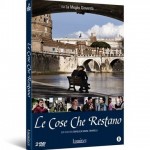
Still, it's a fun movie to watch: The remaining things. Actually made as a TV miniseries. With four episodes of approximately 1,5 hours, it can no longer be called a film. The film has a bit of the traits of The best youth. If you liked that movie, you will like this movie too. The miniseries appeared in Italy in 2010, but the Dutch version only recently became available.
Family drama with a historical approach
A family drama that simultaneously attempts to portray a time from the 90s to the first decade of this century. It tells about the flow of refugees in Sicily, for example, the Italian underworld or a returned disabled soldier from Afghanistan. The story is about a family with 4 almost grown and grown children who have to deal with a drama.
We then see how each of the family members deals with this and what the impact of the same event is on different people. You see the character development of the characters that makes you identify with them and their emotions.
It is a movie for middle aged viewers, the youth will not fall for this movie as there is not much action in it. It's an emotional story, but it's about mature, sane and sociable people like ourselves. It doesn't shock. And that's actually nice.
Poetry
Every now and then there is some poetry in the film, not in the form of poems, but in the director's staging or in the screenplay itself. That an overnight bus ride to nowhere is taken by two lovers who never seem to find each other.
An abandoned orphanage where poor children used to write texts on the walls that they missed their mothers so much. I then digress a bit from the super long film and go to get a coffee from the kitchen while dreaming. The pathetic piano music underneath helps with that. Certainly at the beginning, that kind of 'poetry' takes some getting used to, but during the course of the film my attention was better held.
The dialogues of the romantic Italians are also sometimes a bit poetic. Italians have a kind of cheerful zest for life, but often express it in the same way. A friend once told me that an Italian holiday friend once told her that her eyes reflected the light of the moon. That sort of thing, only an Italian can think of. I am a sober Dutch person, I have to laugh about that. But that aside.
The blended family
I find it striking that the Italian broken and yet composite family has the leading role. More than in The best youth it is about individuals who are not very good at marital fidelity, and who form a family in all kinds of creative compositions. Adopted child, gay father, single divorced sister and immigrant home help, all together in one house. In Italy it is all possible, and it also gives the appearance of being very cosy.
Bittersweet open ending
Some threads or storylines of the film do not really have an end. I like that at the end of the film, that things are still open so that you can still marvel at the future of the characters. Some storylines therefore seem a bit aimless, do not really have a point, except for the sketch of the time frame. So bittersweet, with all the suffering. If you fancy a night of marathon movie watching and tears, don't miss this Italian classic.
Lotje Lomme studied History in Bologna and Italian and didactics in Utrecht. She has been teaching Italian for 15 years, and has provided several online training courses for This is Italian and gives private lessons Italian and NT2 for Italians. Online and face-to-face in Schoonhoven.
She also baked Italian cakes for a Dutch café, interpreted for an Italian artist, translated poems by Alda Merini, made fresh lasagna for Stichting Thuisgekookt and guided Italian tourists through the Keukenhof.
We can only keep this site up and running with advertisements. Do you want to disable your Adblocker or add this website to your whitelist? Huge thanks for your support. Team This is Italy


 Lottie Lomme










Comments