

 Mariska Kromhout

It's late July when we cross over to Sardinia this summer. When we arrive at our cottage, a strong wind is blowing. Because we're a bit higher up in the hills, we're used to a breeze, and in hot weather, we're always happy with a bit of relief. But this time, the storm is much more intense, and it's also showerier and cooler than usual in July, around 24 degrees Celsius.
Forest fires
We like that for a few days (preferring this to the 35 plus of a few weeks earlier), but this maestrale (mistral) also has disadvantages: it worsens the annual fire (forest fires). Or rather, field fires, because it's not so much forest that's burning, but shrubs, weeds, and grass.
I mentioned earlier that we have to regularly trim the grass and weeds around our house. mow, to prevent any fire in the surrounding area from spreading to our property. (Building insurance is certainly a necessity here.) Now it's happening again, and we're seeing large black clouds appear, driven by the wind.
There we are, standing in front of our house, watching the firefighting helicopters and planes of the Fire fighters In the distance. How far away is it? What's the wind direction? Where does the source seem to be? People drive to the edge of the village and start calling. Some drive up "our" hill for a better view.
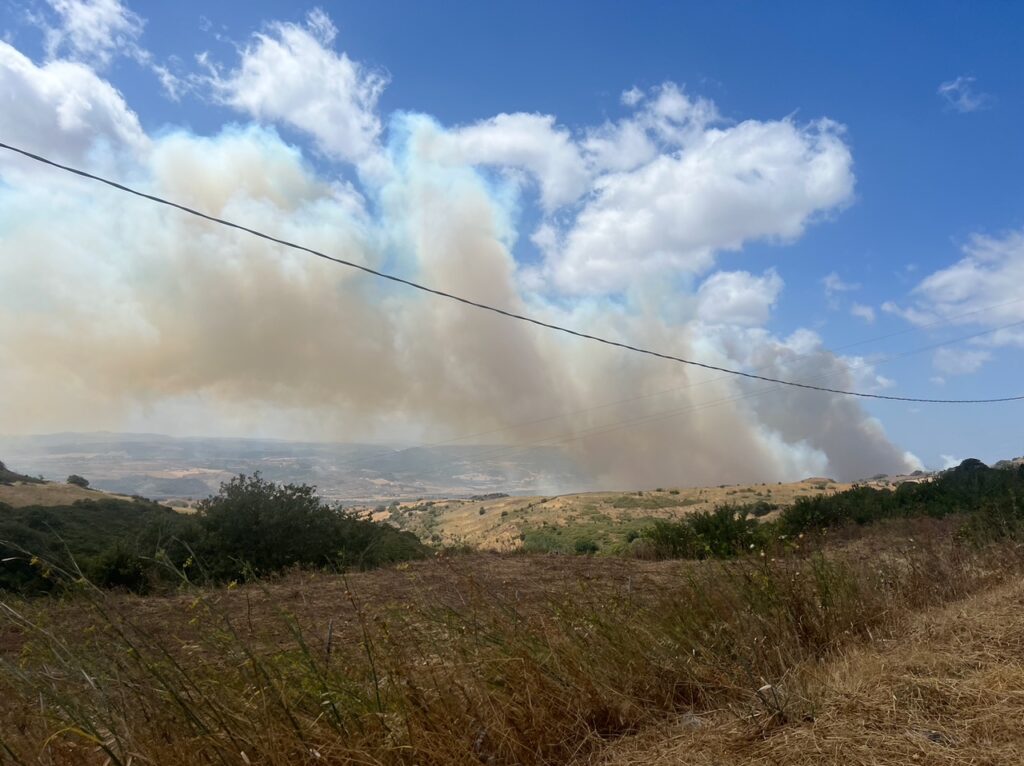
My husband, who's just gone grocery shopping, also drives around and tries to locate the fire. Fortunately, Daniela, who's just visiting us, agrees with my assessment: the source of the fire is behind the next ridge, and the northwesterly wind is blowing the smoke away from us. non è pericoloso (It's not dangerous, at least not for us.) That evening, everything is back under control.
The next day is gloriously sunny. The wind has completely died down, and there's not a cloud in the clear blue sky. La nuova sardegna of July 29, 2025, reports on the misery of the past few days, under the headline: Incendi. Isola devastata. “In fugue dalle fiamme” (Fires. Island devastated. "Fleeing the flames"). It turns out that more than 40 fires have raged in various parts of the island. A story that has also made an impression in our area is that of tourists in southern Sardinia. They had to be picked up from the beach by boat because of the fire.
At the end of the afternoon, the wind picks up again and the windmills start turning. We'll leave the barbecue off for a while.
Festivals and parties
A much nicer tradition in Sardinia in summer is the annual festivals and festivals (village festivals). Some revolve primarily around local products, such as mutton, which residents eat together at long tables. Others have a religious character and involve a procession.
During the same period (from late July to early September), there are also other activities. For example, a few years ago we attended a performance of traditional Sardinian dances in traditional costume, called ballo sotto le stelle (dance under the stars).
After people in traditional costumes from the local cultural association began dancing to the music of a small, traditional accordion, villagers in regular clothes joined in. Their footwork was inimitable.
A year later, it turned out that the residents of another village could also do this with pop music. That was another way to introduce Matia Bazars. You sento to experience. This song was a big hit in the Netherlands in 1986 and remains one of my favorite Italian songs.
This year we are visiting the Festival of Santa Maria del Mare In Bosa, on the west coast of Sardinia, a charming town with colorful houses and the ruins of a large medieval castle.
On the first Sunday of August, a Marian procession takes place there. According to the website eventi-italiani.it It begins at 8.00:XNUMX a.m. in Bosa Marina, at the mouth of the Temo River. From there, a statue of the Virgin Mary, flanked by the priests, is taken by boat to Bosa Cathedral. Dozens of boats with flags participate.
Fortunately, after inquiring at a local supermarket (after being persuaded by a customer who knows better than the cashier), we learn that the boats won't appear in Bosa until around 11:11.30 a.m. So, on that day, we can sleep in and leisurely stroll down to the water, joining the spectators gathered on the bridges and quays right on time (XNUMX:XNUMX a.m.) to welcome Mary.
At the historic bridge she comes ashore and the procession continues on foot, followed by a procession of believers, ending at the Cathedral.
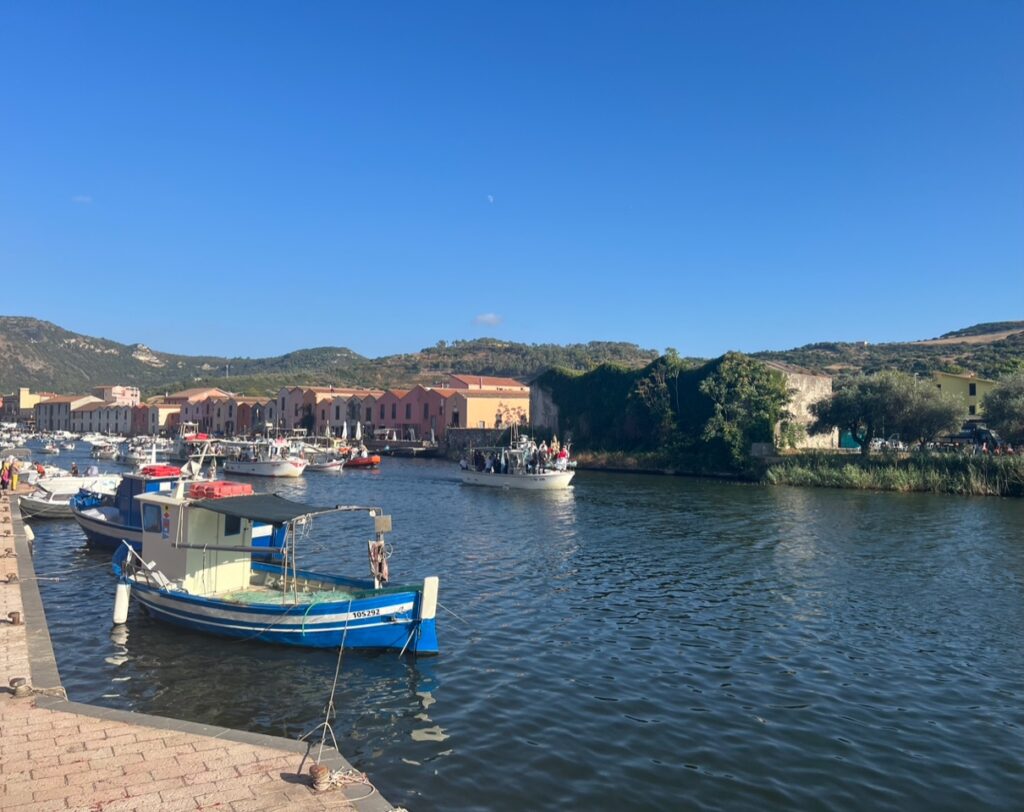
Tip: If you missed this late-morning ritual, you'll get another chance around 7:XNUMX PM. They'll repeat the entire procession in reverse order, and then bring the Virgin Mary back to Bosa Marina by boat.
Back in our cottage we can still visit our own village festival experience. Unfortunately, one of us is sick, so we decide not to go. Better luck next year.








Comments