

 Aart Heering
Around the year 1800 – when people still spoke of North and South Calabria – La Strada Regia delle Calabrie was the principal thoroughfare between Naples and Reggio di Calabria. After the Italian unification in 1860, which marked the end of the Southern Italian kingdom, its importance declined. With the construction of the Autostrada A2, from Salerno to Reggio di Calabria, in the 60s, the old road fell into oblivion.

However, over the past five years, architect Luca Esposito has managed to reconstruct the route. In doing so, he based his work on ancient maps, historical treatises, travel accounts, archaeological finds, and assistance from scientists, municipalities, regions, and local residents.

In the process, he stumbled upon all kinds of remains that no one had paid attention to for decades: milestones, ancient churches, overlaps with the Roman road from the 2e century BC, an ancient Roman bridge, former taverns and impressive feats of 18e-century engineers.
The road also passes through the city of Salerno, along the Pertosa Caves and the renowned Carthusian monastery of Padula. The intention is for the former Strada Regia to become a walk becomes a route for walkers and cyclists. I recently enjoyed a preview of the first part, from Naples to Casaletto Spartano in the far south of Campania.
The Golden Mile
The journey begins with the Golden Mile, in the Neapolitan suburb arcade between the fourth and fifth milestones of the Strada Regia. The 'Golden Mile' derives its name from the luxurious mansions that the Neapolitan nobility had built here in the years after 1738, when Southern Italy became an independent kingdom. (Before that, it was ruled by Spanish and Austrian viceroys.)

King Carlo di Borbone had a Reggia, a royal palace, built here, beneath which the Strada Regia ran. The newly crowned monarch did not want to be outdone by his wealthy counterparts in Vienna and Paris, and this is evident from the abundant painting of the walls. In doing so, liberal use was made of the trompe l'oeil with fictitious balustrades to make the halls appear another floor higher.
De Palace of Portici It lost its function with Italian unification and was subsequently used as a Higher Agricultural School for a century. However, in recent years it has been renovated and opened to the public, as has the accompanying beautiful botanical garden.
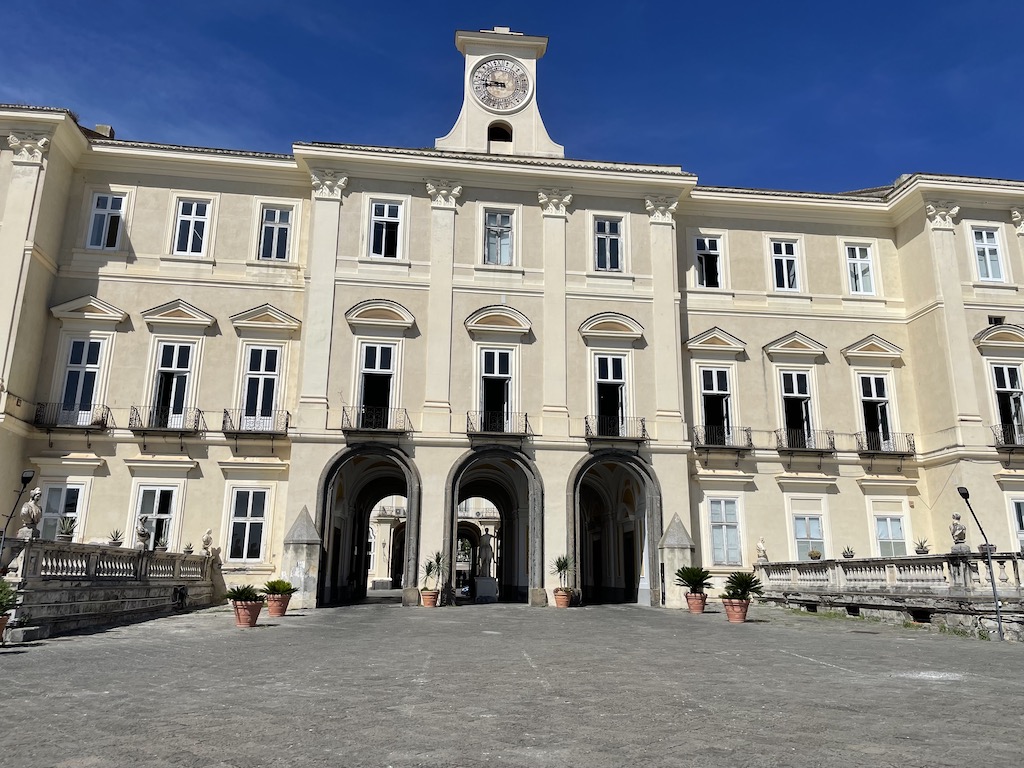

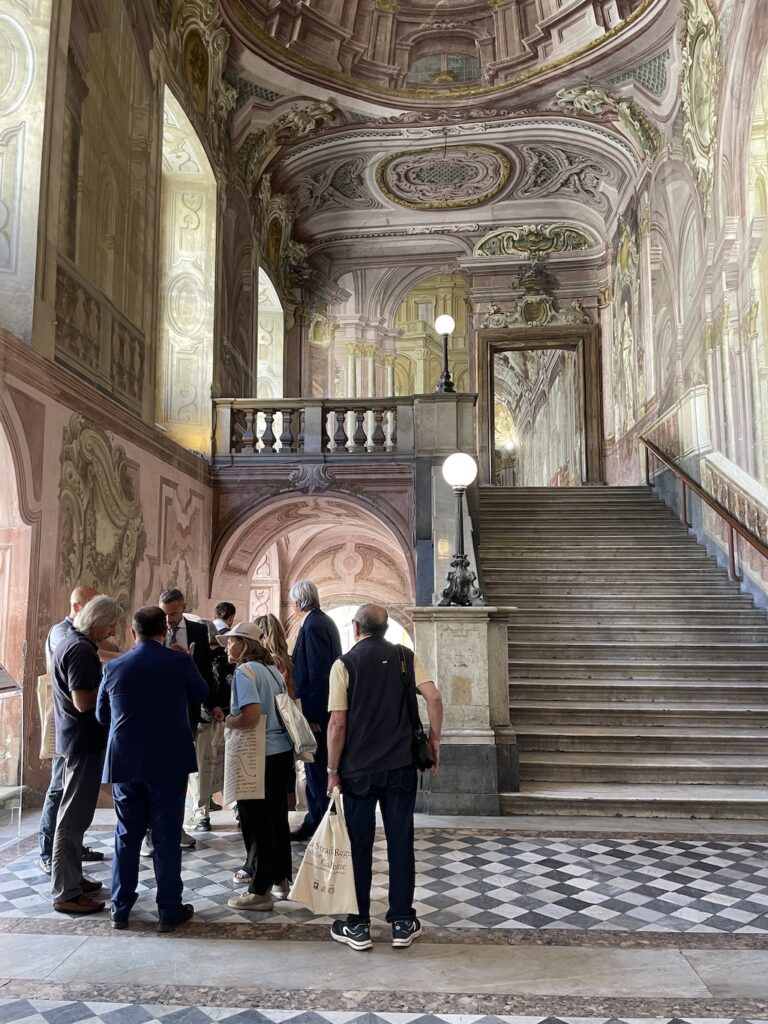


A practical point: the Reggia and nearby Herculaneum are easily accessible from the center of Naples via the Portici metro station or the Circumvesuviano, the local commuter train that also runs in Pompeii stops.
Of the so-called Ville delle DelizieOf the aristocratic pleasure estates, 122 have been preserved. Many are now in use as hotels, B&Bs, or offices, and 4 of them are open to the public.
The largest of them is the Villa Campolieto, which was built on the solidified lava flow of 1649 by architect Luigi Vanvitelli, the grandson of the painter from Amersfoort who became rich in Rome Kasper van Wittel.
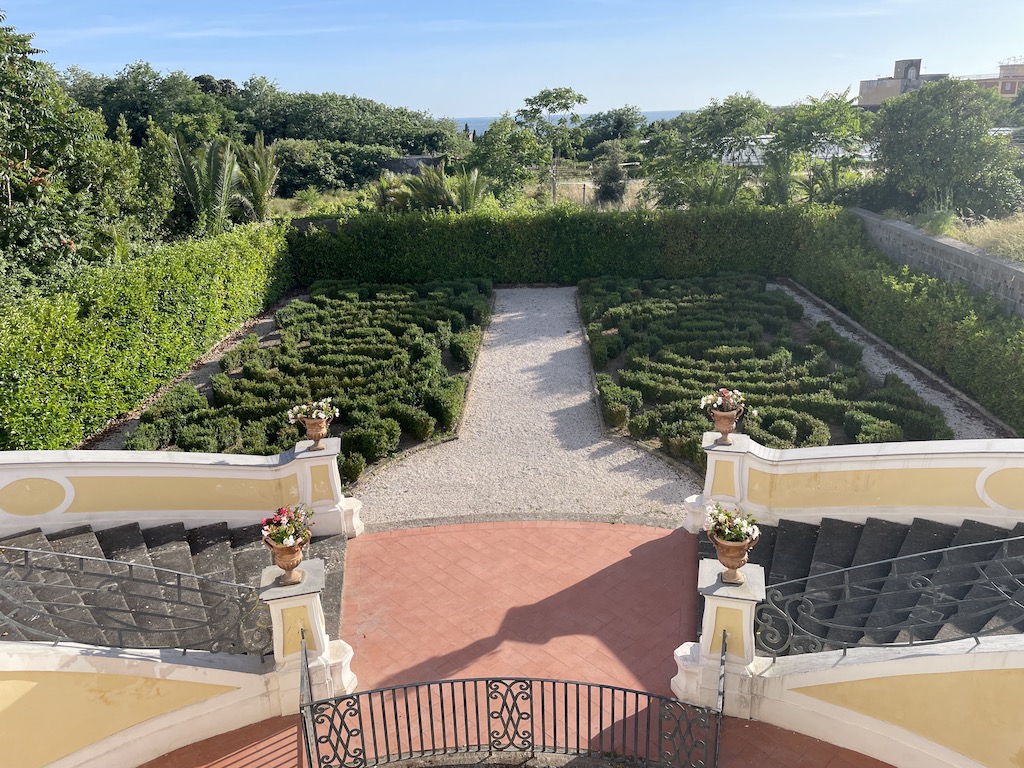


This villa, too, is richly furnished and offers a beautiful view of the Bay of Naples and of Mount Vesuvius, which always looks somewhat menacing. Inside the villa, a small museum has been set up with items from nearby Herculaneum and a 18th-century artifact.e century-old device developed to decipher charred but not burned scrolls. (Now that is done much faster with lasers and artificial intelligence.)
The first day concludes in the Trattoria Tubba Catubba, a dialect expression that can be translated as 'swaying drunkenly'. A waiter with a tattooed portrait of Maradona On his upper arm, he presents the local specialty to us: zitti allo scarpariello, a short pasta 'in the style of the cobbler', with basil, garlic, chili pepper and braised piennoli, small pointed tomatoes that are grown only on the slopes of Mount Vesuvius.
Herculaneum
lies against Portici Herculaneum, an in itself unattractive city built on the ancient Roman Herculaneum, which disappeared under waves of ash, debris, and lava in the year 79. Two years ago I have already dedicated an article to this to this 'little brother of Pompeii', so I thought there was little news for me to report.

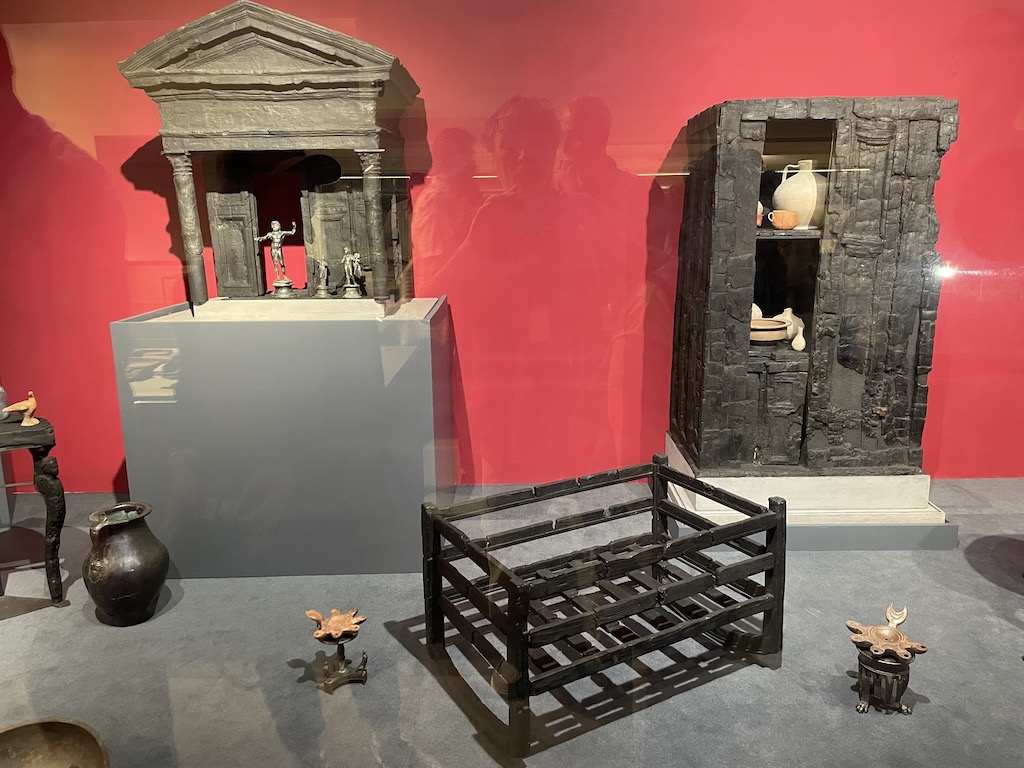
That turned out not to be the case. In Herculaneum, organic remains are better preserved than in Pompeii, so that wooden furniture, household goods, and food have been well preserved. In total, this involves some 5.000 objects, a small portion of which – including a double bed, a chest of drawers, and a household altar – has recently been put on display in the small museum next to the excavations.
These unique remains bring us close to the daily life of 2.000 years ago. To restore Herculaneum to the character of a living city, copies of the furniture are currently being made – the originals are not exposed to the outdoors or visitors – to furnish the now empty dwellings.

In short, Herculaneum is considerably smaller than Pompeii and attracted 600.000 visitors last year compared to Pompeii's 4 million, but it is perhaps just as much worth a visit.
Salerno
Further south, the 'royal road' leads through Salerno, which is the second largest city in the Campania region (after Naples). Unlike in villages that the Strada cuts straight through, in Salerno it winds its way through centuries-old streets and alleys.
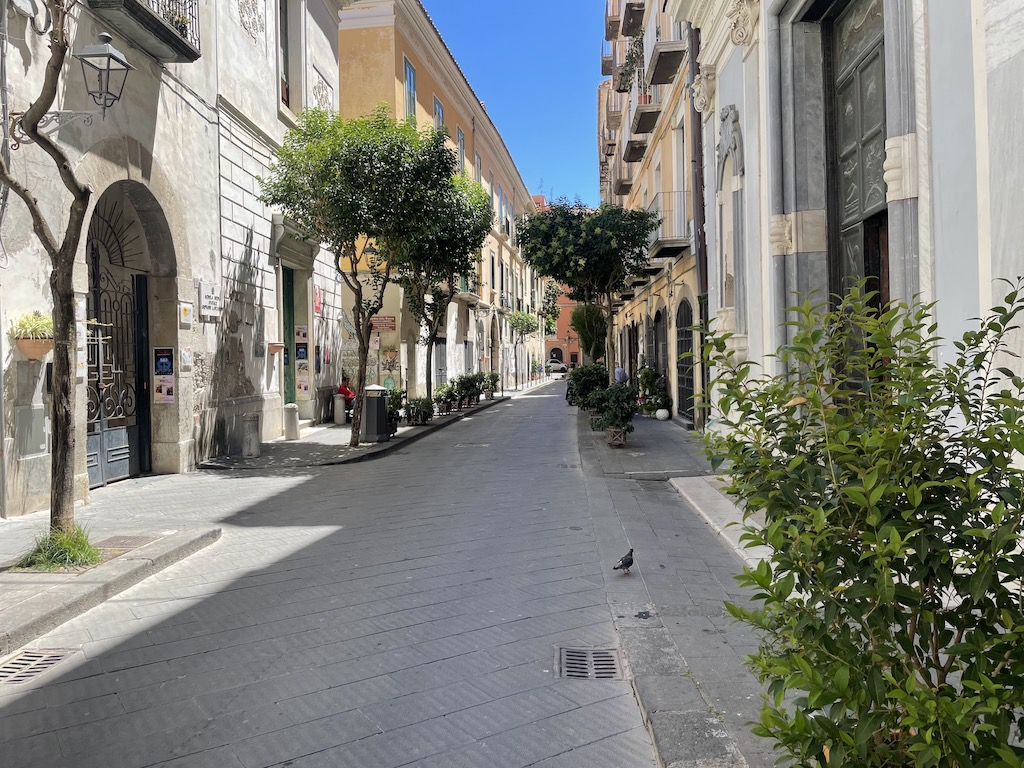
Like the Via Giovanni da Procida, where you can choose between a rich collection of seafood restaurants, and the Via Mercanti, with nice outdoor cafes. On the street, you can find brass commemorative plaques with the names of renowned doctors from the 10th century.e to the 12e century, when Salerno the most famous medical school in Europe was rich.

Restaurants and pastry shops offer Salernitan specialties as milza alla salernitana (spleen filled with herbs) and the cardinal's mess(cardinal's hat), a liqueur-enriched cake with strawberry glaze. All in all, Salerno makes a lively impression, with that touch of rustic neglect that the city absolutely must retain.

The highlight of every visit to Salerno is the cathedral, which was built between 1080-85 commissioned by the Norman duke Robert Guiscard who had shortly before conquered the city from the Lombards.


It is an impressive Romanesque structure with decorations pointing to Arab influences, including on the pulpit, which is not surprising for a port city that traded with North Africa at that time.


On the façade, an Armenian pilgrim has chiseled a supplication to the evangelist Matthew, whose remains now rest in the exuberantly painted crypt beneath the church. They are said to have arrived in Salerno around the year 950 by unfathomable paths.
Cava de 'Tirreni


We remain in the Middle Ages for a little while longer, as we follow the route of the Strada Regia along the coast on what is now the Strada Statale 19. If you turn off at Vietri, you emerge onto the renowned Amalfi Coast, but we head inland towards the Monti Lepini, where, hidden in green deciduous forest, the Abbazia territoriale della Santissima Trinità di Cava de' Terreni lies.

Quite a mouthful for an abbey complex that ruled the region for centuries, politically and economically as well. The monks even possessed their own merchant fleet. It all began humbly and simply with a pious nobleman, the H. Alferius, who withdrew here in 1011 into a cave for prayer and contemplation.
Fourteen years later, the then Lombard ruler granted him permission to build a church and found a religious community, which would become known as the Ordo Cavensis, the Order of the Cave, a congregation that numbered 170 abbeys, 300 churches, and thousands of monks in its peak years. Seven monks still live in the Abbazia today.
We enter the complex through the abbey church, where a small orchestra is preparing for a wedding. Behind that is a monastery courtyard under an overhanging rock face. It dates from the 13the century and the nice thing about it is that extensive use was made during the construction of material from demolished ancient Roman buildings, so that the various columns and capitals do not match at all.


Probably for decoration, there are also a few in the procession. antique sarcophagi placed. One floor down you find yourself in the 'Lombardian cemetery', a bare and therefore suggestive crypt with small columns from the 9e in 10e century.


The abbey also possesses a library with a unique collection of books and charters, including a Visigothic Bible from the 9e century and a notarial document from 792, in which the amount of the so-called is established morning gift, an amount that, according to Germanic law, a husband had to pay to his wife if the first wedding night had gone satisfactorily.

Cava de 'Tirreni (named after the Tirreni, or the Etruscans who once lived here) itself lies a kilometer from the abbey. The Strada Regia runs straight through the city again here, flanked by arcade, covered walkways. That is exceptional for Southern Italy, where it rains less often than in the north and a dry passage is therefore less necessary. But as a trading city, Cava had contacts with cities like Genoa and Venice and followed their example.
As it happened, we were in Cava de' Tirreni on the very day of the city's biggest festival. That is it. Montecastello Festival, on June 11, when the entire city, led by the mayor and bishop, celebrates the joyous occasion that on that day in 1657 the Blessed Sacrament delivered the city from the plague, to which half of the population had already succumbed. Thus, 1200 parade cavesi in historical costumes for just as many spectators, making for a remarkable spectacle.
To be continued








Comments