

 Myrtle Claus
'Ciao Myrthe, it's me. Are you having a nice vacation? I don't know if you've heard and I'm sorry to be the first to tell you, but I have some bad news. Giuseppe passed away…'
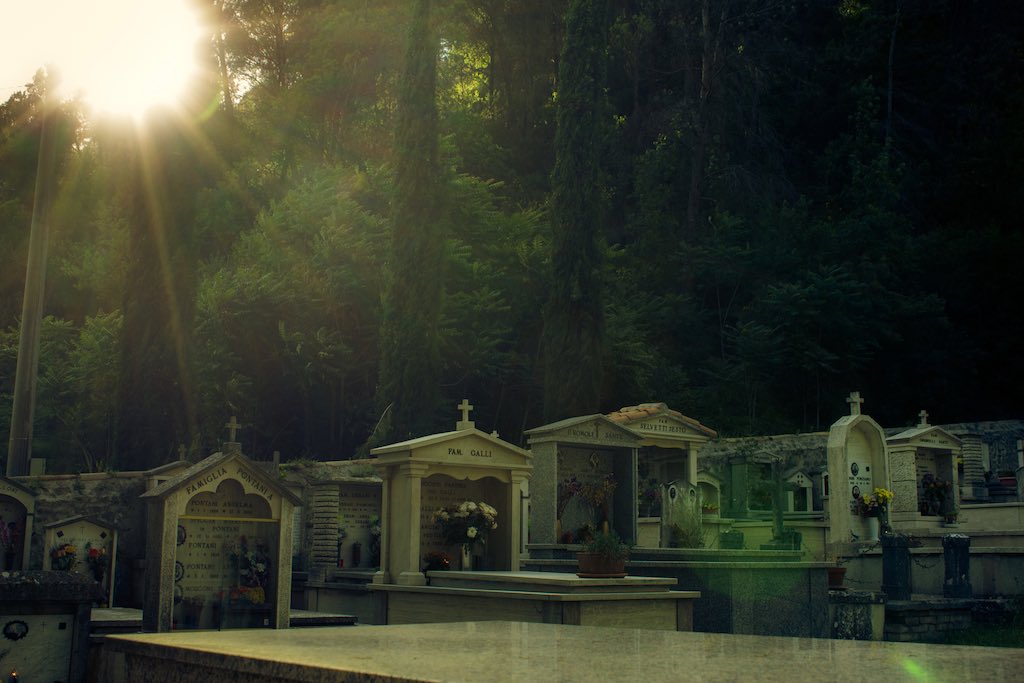
There you are, with the telephone receiver in your hand. Outside the sun is shining, you can hear someone laughing while people yell at each other. You would almost forget it because of all the cheerfulness around you, but people also die in Italy. Very often at a blessed age, after a time of illness, where everyone feels a little relief in addition to the sadness that the suffering is over.
Sometimes young and completely unexpected, leaving you in amazement. Like with Giuseppe. And wherever you are in the world, those emotions you have are more or less the same for everyone. It is the habits and rituals that often differ so much from each other that color the farewell.
fellow villager
If you didn't know better, you as a Dutch reader would think that Giuseppe is a close relative. In general, you will only be called with bad news if it concerns a loved one from your immediate family circle. But Giuseppe was just a fellow villager of mine. A very sympathetic man, always smiling and greeting cheerfully. Someone with whom I occasionally had a nice conversation, while waiting for our turn in the shop around the corner. Not more than that. We didn't even drink a cup of coffee together.
And yet the neighbor calls me. Because that's how it goes in Italy: everyone who knows the deceased is informed as soon as possible. The period between death and burial is in fact no longer than 48 hours and often even shorter, especially in the warm south. Fast communication is therefore the motto, so that everyone is quickly informed and can respond.
the manifesto
Hence those large white posters with a black border that you must have encountered during your holiday. In bold letters there is a name with some text, a date and a time. Whether or not accompanied by a portrait photo. And often you come across the same poster in all sorts of more or less strategic places. At the church. Along a busy road. Near the cemetery. Or even on a special board somewhere near a square.
Those posters ensure that everyone in the neighborhood is aware of the bad news in no time. Also people who live further away and knew the deceased: they receive, just like me, a phone call from someone who has read the message. And they then call the post to have a telegram with condolences delivered. Or get in the car to offer condolences in person.
The condolences
That condolences can just be at home where relatives watch next to the deceased. But also in a separate part of the hospital.. Or in a room near the cemetery. Or even the ambulance service. There is a good chance that you have to visit the dear deceased of others to get to the family you want to be with.
Or where due to a lack of space in 1 funeral home 2 or more families are with their respective loved one due to lack of space. Which I found quite baffling, the first time I experienced that. After all, saying goodbye is something intimate, something personal, where you wouldn't want any 'snoopers'. I thought. But I seemed to be the only one who felt that way. My Italian company behaved as if it were the most normal thing in the world. And gave a handkerchief to a visitor of the roommate laid out in state.

The Funeral Mass
The real goodbye soon follows. The funerals I've attended so far all started in the church. Not surprising, of course, in a free Catholic country. But just as we in the Netherlands add something personal even to a mass, by choosing the music or the speeches that are given, it is standard work in my area.
That struck me even more when on a sad afternoon we brought not 1 but 2 villagers to their final resting place, one after the other. No self-chosen music, no speech from a family member and/or good friend and, sadly at its worst, almost the same general terms to describe the deceased.
The only real difference between the masses was the name mentioned. As if we weren't bringing a unique person – in his or her way – to the final resting place, but just the next song in a long, long line.
A cremation
The feeling that lingered after that afternoon was reinforced at a cremation I attended later. There are not that many crematoria in Italy, so people come from far and wide and it is generally quite busy.
We therefore stood in a long line of families with coffins, all waiting for their turn. Where now and then a undertaker came in with his 'cargo' because he still had a long journey back ahead of him. His coffins were therefore given priority. Where people protested. Like we were at the post office or at the butcher's and someone was trying to push us.
The situation took on something absurd as a result and we almost forgot why we were there. Until the moment when we were admitted with our group in the vestibule of the crematorium and the sadness made itself felt when the coffin disappeared behind the doors for good. But the idea of just being the umpteenth song of that day still chafes me a bit.
An impersonal goodbye
It is the impersonality of parting that repulses me every time. Not to commemorate someone's life, but to put someone in a very disrespectful way, 'just a quick hoe under the sod'. While the grief and loss of the relatives is no less.
On the contrary, perhaps such an impersonal farewell makes it feel extra. So I'm secretly glad I'm far away and can't go to Giuseppe's funeral. Such a cold thing for such a warm person I would certainly not be able to bear in his case.
I take a deep breath, pick up the phone and call the telegram service to send a message. Without the usual Italian standard phrases, but one with a personal touch.









Comments