


 Aart Heering
Why are so many fascist monuments still standing in Italy? With this provocative question, used as the title of an essay in the magazine The New Yorker, Ruth Ben-Ghiat, lecturer in Italian language and history at New York University, ushered in a debate at the end of 2017 about the use and (re)appreciation of buildings from the fascist period (1922-45).

The American received virtually no support for her claim that these buildings, as blood-stained symbols of a pernicious regime, should actually be demolished. It was objected, especially from Italy itself, that the preserved constructions from the fascist period can also be regarded as architectural masterpieces apart from the ideology.
Table of contents
- 'The Colosseum is also fascist'
- More than 20 years of fascist architecture
- Two architectural schools
- 1. Como: Casa del Fascio
- 2.Florence: Stazione Santa Maria Novella
- 3.Capri: Villa Malaparte
- 4. Rome: Casa della GIL
- 5. Rome: Palazzo dei Marescialli
- 6. Rome: EUR
- 7. Rome: Two Fascist Squares
- 8. Palermo: Palazzo delle Poste
- 9. Naples: Casa del Mutilato
- 10. Milan: Palazzo di Giustizia
- 11. Latina: Palazzo M
- 12. Tirana: Casa del Fascio
- More fascist architecture
'The Colosseum is also fascist'
One commentator argued that if you reason like Ben-Ghiat, you don't just see the fascist'Square Colosseum' - see below, number 6 - should bring down, but also it Colosseum itself, as a result of oppression and violence. Its construction was finally financed by the sack of Jerusalem.

More than 20 years of fascist architecture
Apart from that, there is a very practical argument that argues against destruction, even immediately after the war. It would simply have been impossible. The regime has lasted for more than 20 years, during which time there has been a lot of construction in Italy, especially public buildings and offices of the Partito Nazionale Fascista and the fascist youth movement GIL.
Unlike in Germany, where the Nazis were only able to build for 10 years, the vast majority of it has not been bombed to the ground. Most of the fascist buildings were still in use and their demolition would therefore have meant a huge destruction of capital, which the penniless country could not afford after the war.
As a result, many government buildings from that time have retained their original function, after the removal of fascist symbols and portraits and sayings of the Duce. Even projects that were stopped during the war years were often completed afterwards without any visible break with the original 'fascist' design.

In Rome this applies to, for example:
- Stazione Termini (official opening in 1955).
- Palazzo della Farnesina, then and now the home of the Ministry of Foreign Affairs.
- The former Ministry of the Colonies, which now houses the FAO, the Food and Agriculture Organization of the UN.
Two architectural schools
Incidentally, the term "fascist style" is somewhat confusing. In the years of the regime, two architectural schools can be distinguished, which often clashed with each other: rationalism and the so-called silent littorio.
Rationalism
In the 20s and early XNUMXs, the Italian rationalists developed a modern, sober and austere style that fitted in well with the functionalist movements elsewhere in Europe, such as Bauhaus and De Stijl. This was also possible within the fascism of those years, which at that time still presented the appearance of a relatively mild dictatorship (at least within Italy itself), a kind of 'third way' between capitalism and socialism, which attracted fairly broad interest both at home and abroad. and sympathy.

silent littorio
Things changed in the 30s, when the regime hardened, conquered Ethiopia and established a colonial "empire". That imperial ambition is reflected in the silent littorio, a term taken from the lictoress, security agents in ancient Rome, who carried a bundle of branches (fasces) with ax, which became the symbol of fascism.)

From these years stem the monuments of what should have become the 'third Rome' (after that of Antiquity and Renaissance): stylized reprises of classical monuments, grand squares, broad staircases, immense halls, all executed in shining white marble and travertine, intended to impress and intimidate, but also pompous and often on the verge of Game of Thrones-ish kitsch.
The question posed in the preamble can therefore be answered as follows:
- Countless 'fascist' buildings from the XNUMXs are still in use.
- Three quarters of a century later, they are no longer directly regarded as fascist propaganda seen.
- And they often are not really ugly, can sometimes be called beautiful.
As may be seen from the following examples: 12 masterpieces of fascist architecture.
All but one of them are public buildings. That also makes sense. It is, after all, a government style.
1. Como: Casa del Fascio

In Como's central Piazza del Popolo stands the former office of the local branch of the fascist party. The rectangular building, divided into identical spaces, with a courtyard overlooking the surrounding mountains, was built in 1932-36 to a design by Giuseppe Terragni, the forerunner of Italian rationalism.
A short Italian film from the Casa del Fascio:
The construction of the Casa del Fascio in Como in pictures:
That makes it – in the words of an architectural historian Bruno Zevi – to a 'milestone in modern European architecture', and is also proof that in the early years of the regime modernist experiments were still quite possible in Italy. Today the Casa del Fascio in Como is the office of the local Guardia di Finanza, the financial police.

2.Florence: Stazione Santa Maria Novella

Many tourists have stumbled upon another masterpiece of Italian rationalism: the Santa Maria Novella station, dating from 1932-35 in Florence. Built as a rectangle, unadorned and in straight lines, the Florentine main station resembles a shoebox.
Pictures of the opening of the station in 1935:
It was the first station in Italy to be built based on its function: the simultaneous entry and exit of trains on rails coming in next to each other. (SMN is a terminus station.) The building has been kept relatively low, while the side facing the station forecourt is constructed in the same sandstone as the opposite medieval church of Santa Maria Novella, creating a degree of harmony.

When it was completed in 1935, the new station was controversial, precisely because of its deliberate austerity. Conservatives thought it was disgusting, young intellectuals beautiful.
3.Capri: Villa Malaparte

A late example of rationalism is the Villa that Curzio Malaparte built between 1938-40 on a rocky outcrop on the island Capri. House Myself he called it, and the eccentric writer, author of the war novels The shovel (The Skin) and kaputt, designed his house himself.
Vitruvio Virtual Museum offers the opportunity to view a virtual impression of the mysterious and fascinating Casa Malaparte:
Vitruvio Virtual Museum – Casa Malaparte from Vitruvian Virtual Museum on Vimeo.
The spacious villa has been built with the characteristic simplicity of the style: a large lounge with large windows offering views of the island and the sea from four sides, followed by a series of smaller rooms that slope down with the rock.

Even then, it would have been impossible for a normal citizen to build in a place like this. But Malaparte managed to get the necessary permits through influential friends: the foreign minister, Count Galeazzo Ciano, and his wife. EddaMussolini's daughter. The villa is now privately owned and cannot be visited, but is well worth a look from the elevated footpath.

4. Rome: Casa della GIL
Rome, the capital of il Duce, fascism and empire, is still full of public buildings from the fascist period, which are immediately recognizable as such. Ministries, post offices (two particularly beautiful ones are those in Piazza Bologna and opposite the Ostiense metro station), the Città Universitaria, now the seat of the Roman university La Sapienza, and other utilities.

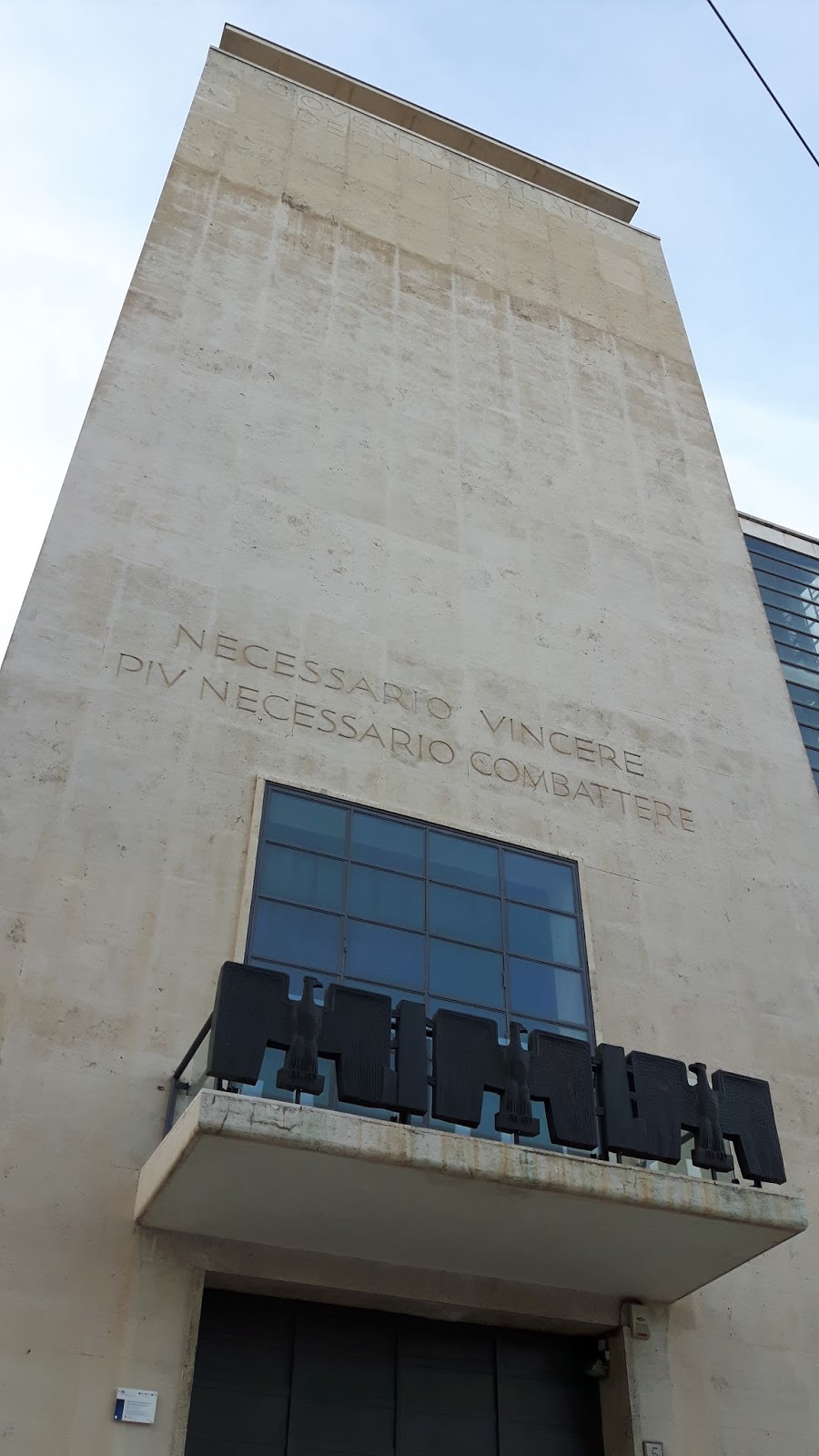
A good example is also the Casa della GIL, de Giovent Italiana del Littorio, or the Fascist Youth Storm, on Viale Adriatico in the northern neighborhood of Montesacro. This was built between 1934-36 as a gym, meeting and recreation room for the fascist youth (and almost all of them were obliged to do so at the time).

It is a typical product of its time, sober, stark and shiny white. But it is also so functional that it was restored last year after a long period of neglect and now houses a primary school and a sports hall.

Only Mussolini's motto credere obbedire combattere (believe obey fight) is chiseled off the wall. Another Casa della GIL in the Trastevere district was built slightly earlier, between 1933-35. This is considered a masterpiece of Italian rationalism, has also been thoroughly restored and now serves as a cultural center.
5. Rome: Palazzo dei Marescialli

A cubical structure of travertine and sandstone in Piazza dell'Indipendenza, near the Stazione Termini. It is now the office of the Consiglio Superiore della Magistratura, say the central administration of the Italian judiciary.

But when it was built in 1937-38 it was used as an office and meeting room for the 'Italian Marshals', senior soldiers who had made a name for themselves on the battlefield. This can also be seen in the decorations that adorn the outer walls: fat men's heads looking grimly at the world below from under war helmets.

It's pretty clear who modeled it and when I cycle past it I call it 'the house of the Mussolini's' in my mind. This relatively small monument gives a striking picture of the aggressive nature of fascism on the eve of the Second World War.
6. Rome: EUR
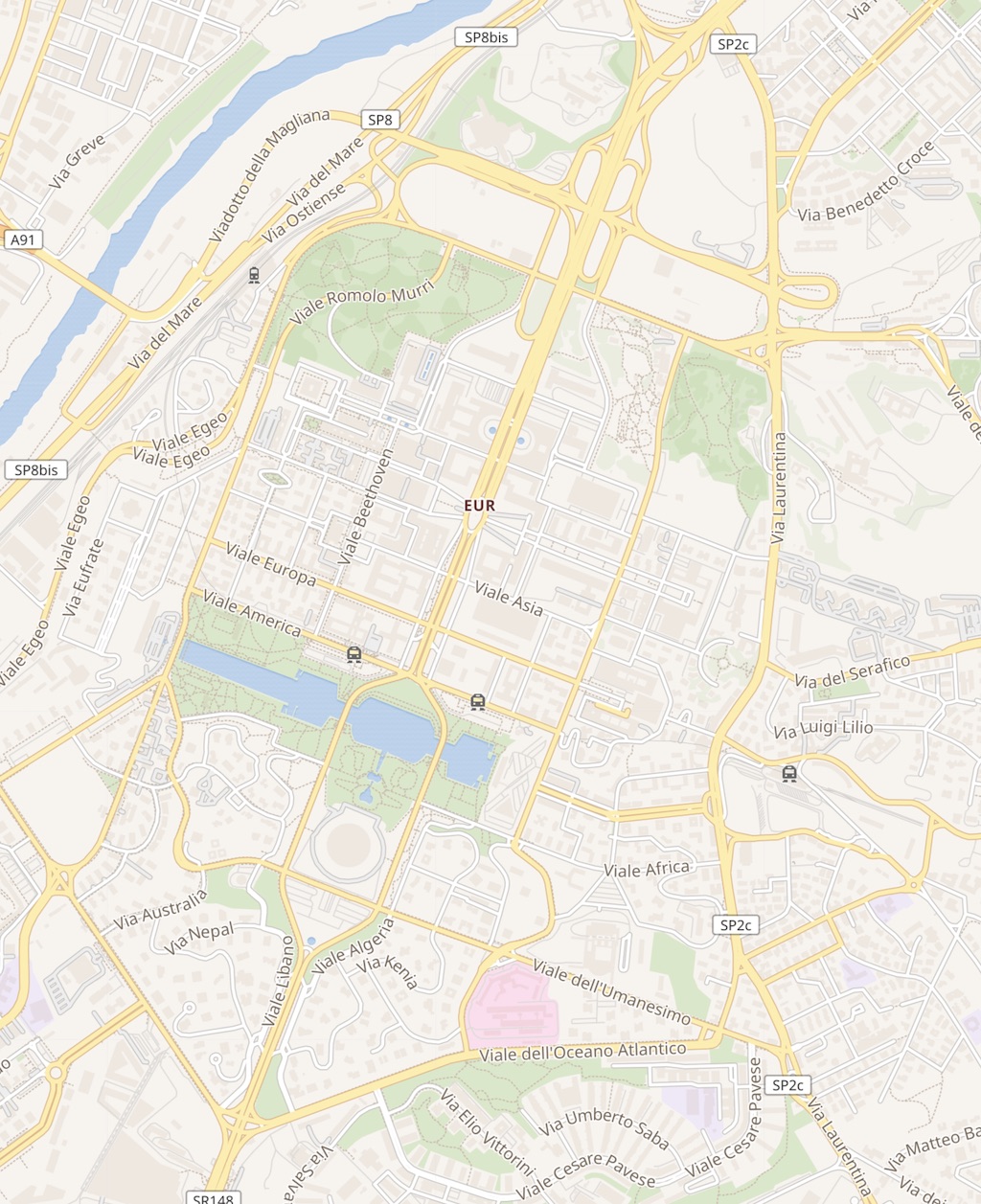
A fascist model city created from scratch, that should have been EUR. The current city district on the east side of Rome was planned for the 1942 World's Fair (Esposizione Universale di Roma: EUR), which was canceled due to the war.

Construction, which started in 1937-38, was well underway, but was discontinued in 1941 because of the war that had now broken out, to be completed in the 50s according to the original plans of Marcello Piacentini, the main exponent of the silent littorio.

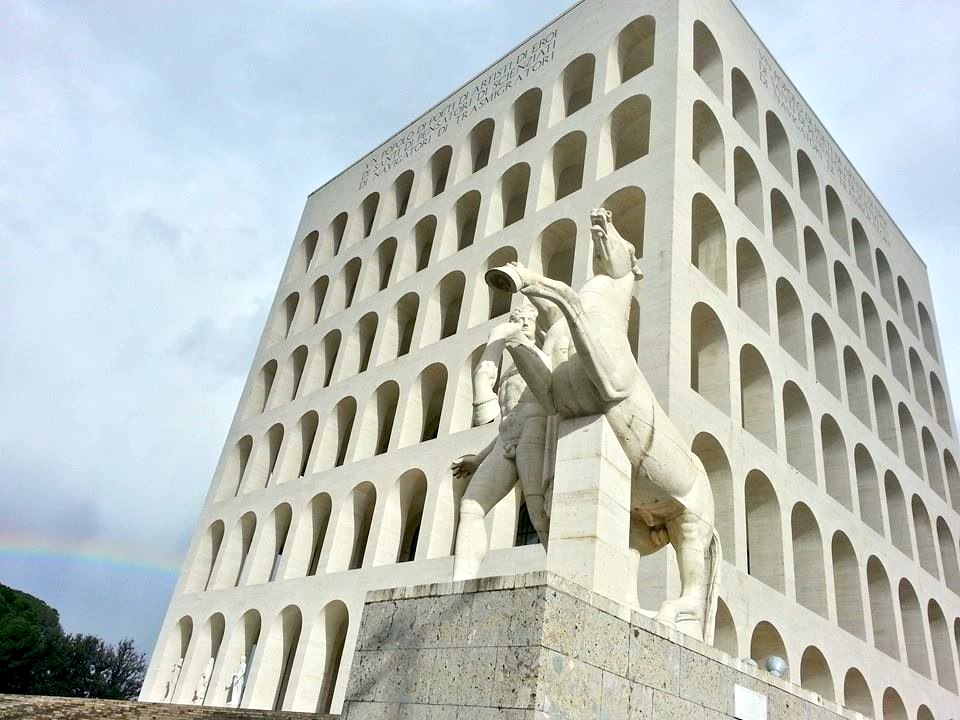
Towering above it all, and visible from far beyond Rome, is the Museo della Civiltà Romana, known as the Colosseo Quadrato, the Square Colosseum, but also popularly referred to as La Groviera, or Gatenkaas (Gruyère). In its imposing angularity and ancient Roman shapes, it was to be the epitome of the Italian virtues: ingenuity, enterprise, courage, genius and grandeur.
In Mussolini's roaring words, embossed on all four corners and never removed: A popolo di poeti, di artisti, di eroi, di santi, di pensatori, di scienziati, di navigatori, di trasmigratori. After the war, the building was used as an exhibition center and now as a head office of fashion house Fendi.
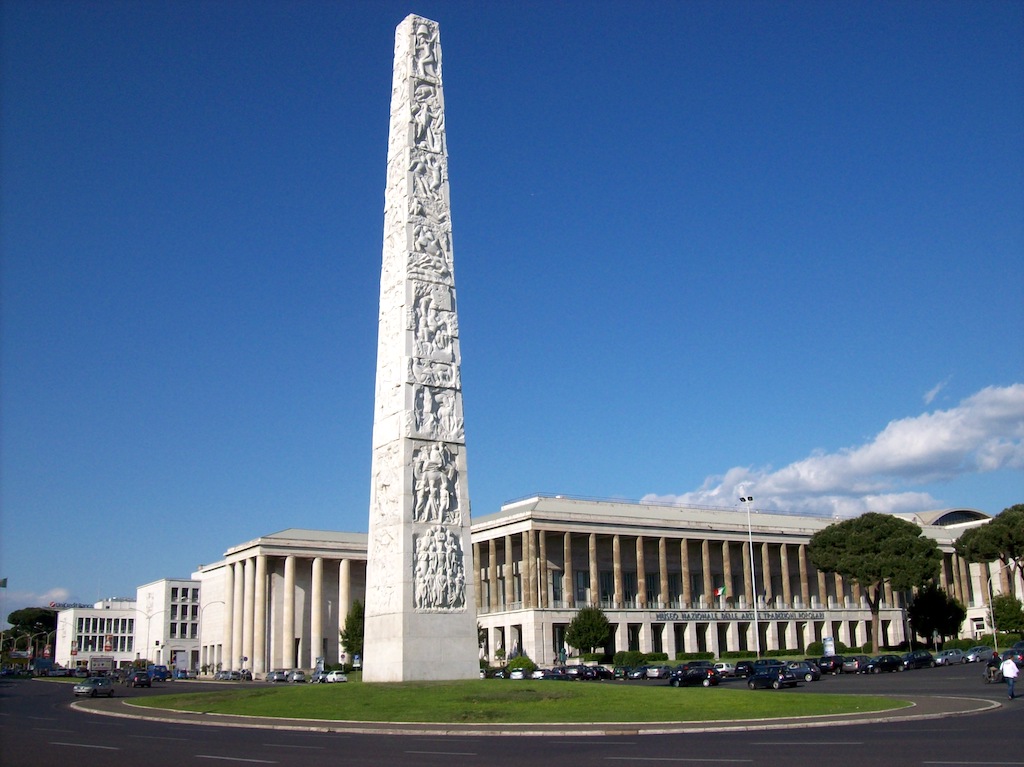
On EUR's broad, straight roads and spacious squares, there are monumental buildings that look like contemporary Roman temples, which house the Central State Archives, a congress center and three museums, as well as a massive office building and a basilica built in a stylized Renaissance style.
EUR from the air (drone shooting):
It is actually a pity that in later years the spaces between the original EUR constructions were filled with offices and housing. A walk through EUR is nevertheless always an intriguing – and for those sensitive to it, oppressive – experience. With the Metro B you are there in no time!
7. Rome: Two Fascist Squares
The most fascist square in Rome is not Piazza Venezia, where Mussolini used to roar at the people, but Piazza Augusto Imperatore in the middle of the city, between Via del Corso and the Tiber. This area is also known as the Campo Marzio, the fourth district of Rome, indicated by R. IV.

The Mausoleum of Emperor Augustus (27 BC-14 AD) and the new surrounding buildings here together form a conscious attempt to link the grandeur of ancient Rome with that of Fascist Rome.
Before that, all post-antiquity houses, as well as a concert hall on top of the imperial tomb, were demolished, as part of a wide-ranging propagandistic program, which also included the medieval houses in the Roman Forum and along the Way of Conciliation were destroyed. Mussolini himself inflicted the first blows in 1932 with a pickaxe.

Only three churches were allowed to remain: after all, five years earlier the regime had agreement reached with the Vatican and it's always better to keep that as a friend in Italy. Monumental offices arose on three sides of the mausoleum, two belonging to the INPS National Insurance and the third to the Croatian Priestly College, all in the most bombastic fascist style with ditto reliefs, mosaics and proverbs in which the praises of Roman tradition, army and people and of the Duce self.

On the fourth side was the Ara Pacis, a peace (and victory monument) of Augustus from the year 9. The relatively modest glass cube built around it in 1938 was replaced in 2006 by a much larger structure that now serves as a museum.

All in all, a political message of the highest order, but the result is actually quite fascinating. And under the colonnade of one of the fascist buildings, café-restaurant Gusto has grown into one of the hippest meeting places in Rome.

Another very political square is the Foro Italico, on the banks of the Tiber. When it was built in the 30s, it was still called Foro Mussolini, and a modern obelisk with the words MUSSOLINI DUX still stands above mosaics of tough workmen and peasant women, which – unfortunately – are poorly maintained.

Intended as a modern version of the forum of ancient Rome, it is surrounded by sporting grounds originally intended for the 1940 Olympics. They were canceled but could still be used at the 1960 Games.

The Olympic football stadium of that time has been thoroughly rebuilt for the 1990 World Cup, but the athletics track is still as it was when it was completed in 1932, surrounded by dozens of classical-looking statues of proud, naked athletes. And on the edge of the Foro, in all its white imposing massiveness, lies the Farnesina, the Ministry of Foreign Affairs, which also dates from the Imperial period.

8. Palermo: Palazzo delle Poste

Post offices from the fascist period still exist in several Italian cities. The post was also a form of public service in which the fascist state made itself visible. Palermo's main post office was built in the early 30s in a rationalist style.

Grand and white, like almost all of the regime's structures, with 30-foot (XNUMX-meter) columns and a flat frieze, it forms a modern version of a Roman temple, while the concrete arches within the building are reminiscent of a medieval crypt.
Also impressive is the conference room, which was recently opened to the public, and is decorated with murals that depict modern means of communication in an almost abstract futuristic style.

Inauguration of the state-of-the-art post office in 1934:
At the time, that was just not possible: in later years the regime would opt for a pontifical social realism. The building is still in its original state, with the exception of a towering littorio bundle, which was removed after the fall of the regime.

Another impressive and still used fascist building in Palermo is the Palazzo di Giustizia behind the Mercato del Capo.

9. Naples: Casa del Mutilato

The Casa del Mutilato in Naples was intended as a shelter for war invalids from World War I and the Italian Wars of Conquest in Libya and Ethiopia. But it is also a political manifesto at the same time. War and victory were a constant in the fascist propaganda, especially in the years 1938-40, when this monument was built.
It is therefore performed in the best silent littorio, like a concrete temple with immense spaces, towering ceilings and as entrance a grandiose staircase that leads to a statue of the Vittoria, a theme that was very popular during fascism as a reminder of the First and harbinger of the Second World War.
It is not for nothing that this fascist monument is located on Via Armando Diaz, named after the Chief of Staff of the Italian Army who announced the victory over the Austrians in 1918.

Opposite the Casa are two more government buildings from the same period (and style): the main post office and the building of the provincial government. Together they give the impression of a kind of fascist square that is a bit foreign body forms within the old city.
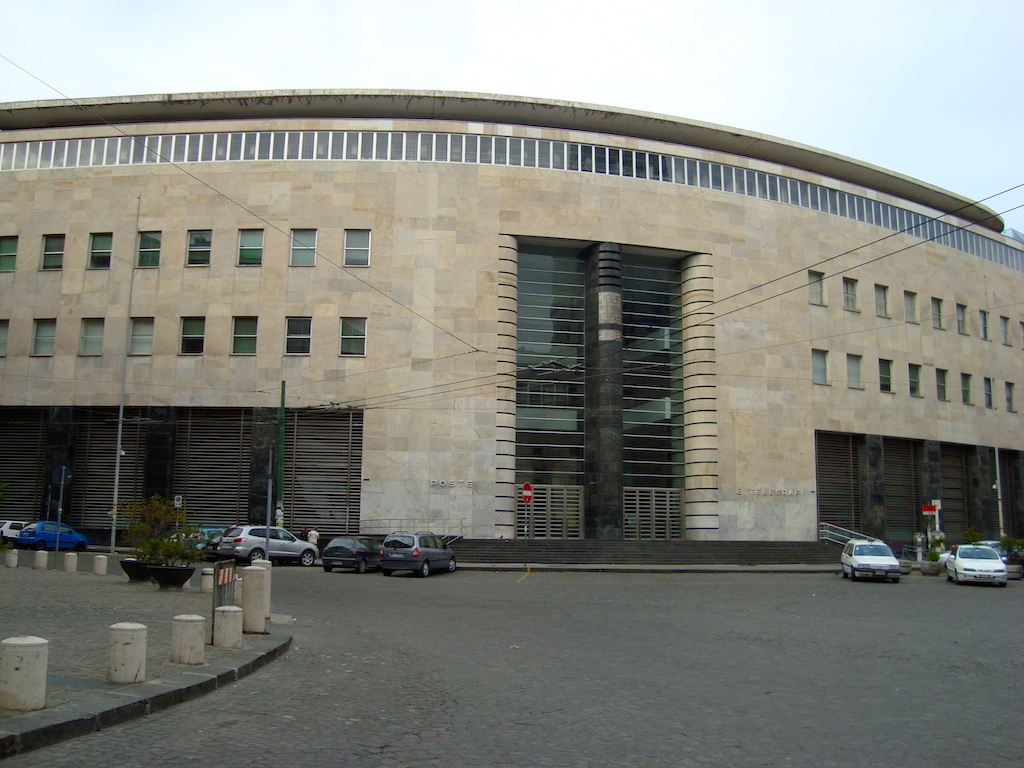

10. Milan: Palazzo di Giustizia
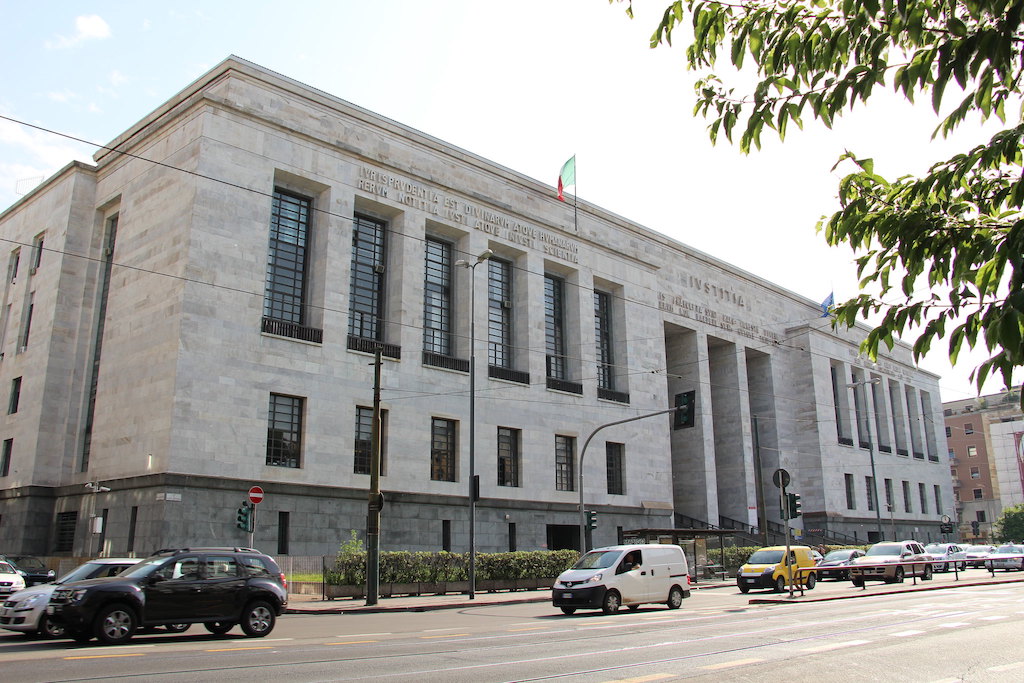
"You who enter here, abandon all hope." That line of Dante inevitably crosses your mind as you climb monumental stairs to the Milan courthouse. A court, and certainly a fascist court, should inspire awe and fear, and architect Marcello Piacentini has done a great job of that.

Everything about this shiny white building, constructed between 1932-40, is large, strict, angular and massive, with corridors, halls and offices that make an unforgettable impression just because of their five-meter high ceilings.

38 meters high, it towers above the surrounding buildings like an unapproachable fortress of justice. The slogans on the walls also contribute to this, which, however, contain not so much fascist propaganda as wise warnings about the need to administer justice and to respect the law. Which right, that is, of course, another matter.
Images of the outside of the building, after a shooting incident some time ago:
Regardless, for the past 30 years, Milan's Palazzo di Giustizia has been one of the most filmed courthouses in the world. First because of the Clean Hands corruption investigation and then Berlusconi's never-ending series of lawsuits. So not only a textbook example of authoritarian architecture, but also a historic place!
11. Latina: Palazzo M
A feat of the regime: this is how (not entirely wrongly, let's be honest) the reclamation of the malaria-infested Pontine Marshes south of Rome was presented.
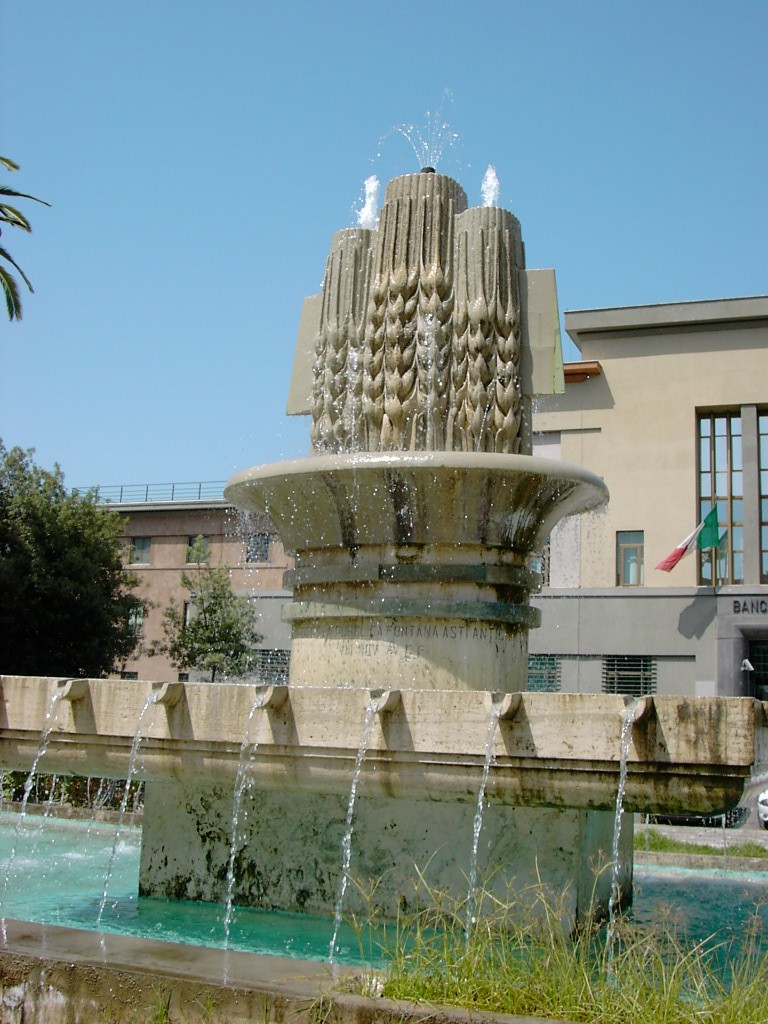
In the middle of the farmland reclaimed at the end of the 20s, the new town of Littoria (one of the youngest towns in Italy) arose from 1932, with a clear reference to the main symbol of fascism. That is why the name was changed to Latina in 1945, after the people of the Latini who lived here in Antiquity.
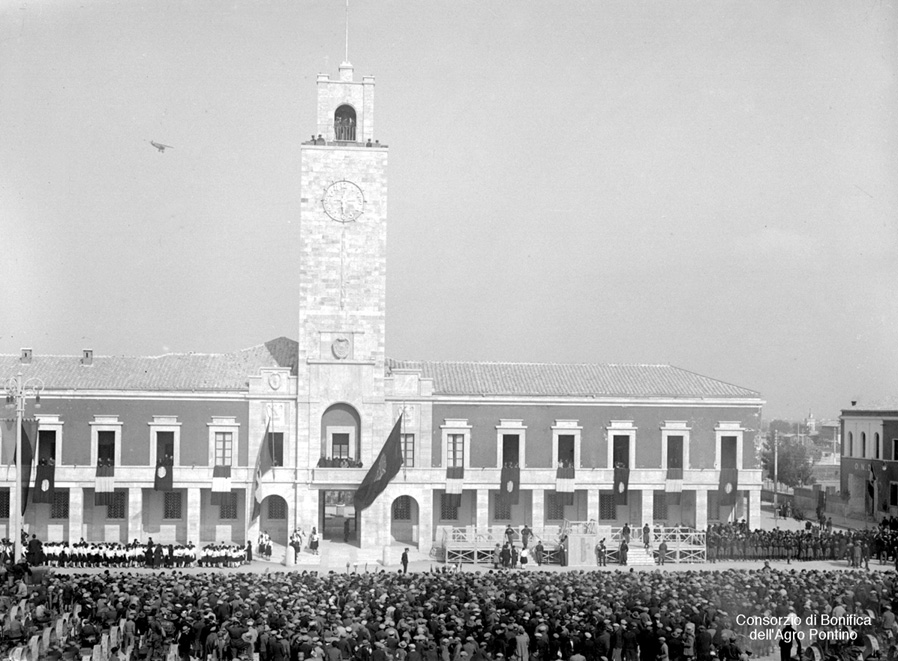
Latina is considered a textbook example of fascist rationalism that has been well preserved in the city center. Including the Palazzo del Popolo (originally Palazzo Littorio) with its imposing square clock tower, the post office and the station, which still reflects the revolutionary designs of the futuristic architects from just before the First World War.

The cathedral is a concrete (and much smaller) replica of the San Marco in Venice, which makes a lot of sense when you consider that most of the settlers in the newly reclaimed area came from Veneto en Friuli.

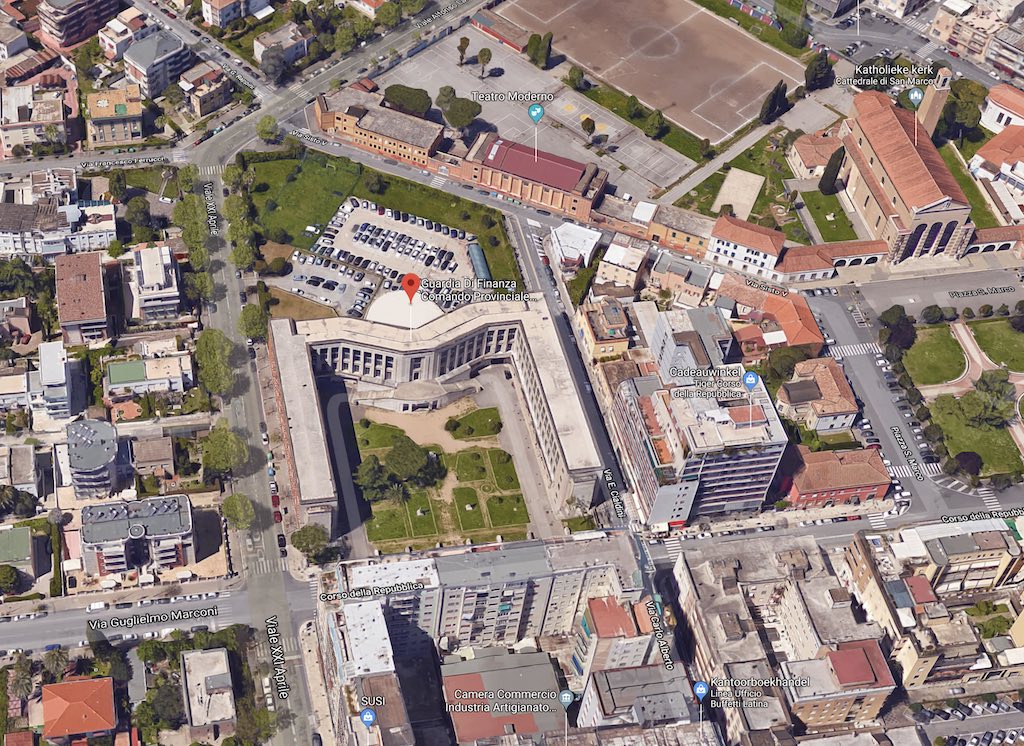
The most typical construction was completed in 1942 to accommodate the city council and the local fascist youth. (Now it is now in use as barracks of the Guardia di Finanza.)
It is an immense building in the classic bombastic style of those years. But the special thing is that it is laid out in the shape of an M, as a tribute to the Duce, which, incidentally, is still honored in Latina today. The first inhabitants owed their land and work to him and their grandchildren have not forgotten that either.

Mussolini graced the opening of new buildings in Littoria in 1936:
As a result, the city is still a stronghold of the far right. A visit to Latina is recommended as an experience of what you could see as a fascist counterpart to a city like Dronten.
12. Tirana: Casa del Fascio
The Italian occupation of Albania lasted only a short time, from 1939-43. But long enough to leave a lasting mark on the country's capital, as anyone visiting Tirana right now can see.
To demonstrate the civilizing influence and power of fascism, Mussolini personally commissioned architect Gherardo Bosio (who died of cancer in 1939) as early as 1941 to fill the city center with eye-catching fascist-style buildings.

In less than two years, the current Presidential Palace, the Prime Minister's Office, the Dajti luxury hotel and the wide Boulevard Deshmorët e Kombit (Martyrs of the Nation) were built.

Bosio's most impressive creation was the Casa del Fascio, the headquarters of the Italian and Albanian fascists. The building respected all the external aspects of the architecture of the regime: an immense square (now named Madre Teresa), a monumental entrance, clean lines, Romanesque vaults. But it is not ugly and the layout is so pragmatic that the building is still used as the seat of the University of Tirana.

More fascist architecture
They were. 12 highlights of fascist architecture. It has become a long article, but still far from complete. Also special fascist architecture in Turin, Bari, Fertilia and Eritrea is missing, just to name a few. But you can't do everything.
Do you have any photos or examples of buildings from the fascist period? Then we'd love to hear from you in a comment!








Comments