

 Ineke Spoorenberg
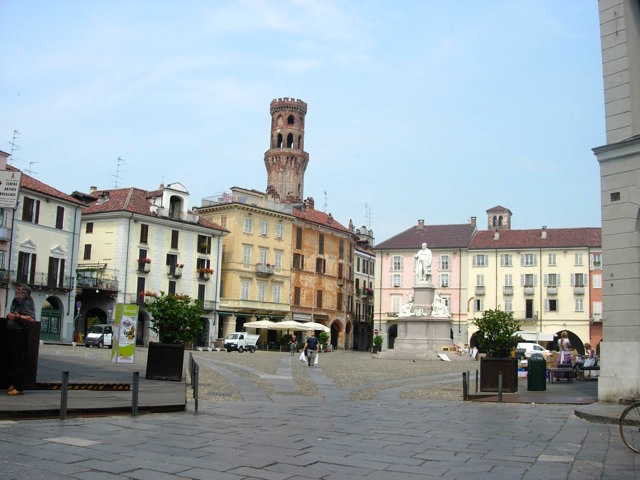
When I walk into Ivrea, I ask a jogger how I can get to the center as quickly as possible. He explains and then walks with me. As soon as we pass under a city gate, he says: 'Look ma'am, you have to go up these stairs if you want to visit our castle. Are you going to visit our castle? It's over a thousand years old!'
I say I just walked 20 kilometers and now I need a good trattoria more. 'Oh, but then I know a very good one near me, who makes regional dishes.' And I bump with him, uphill, up stairs, down another street and finally, I'm standing in front of the restaurant. 'Here they only have typical dishes, good food, signora.'
chocolate cake
In the evening I am in my hotel near the station. When the waitress asks, "Would you like another dessert?" I ask her if she can recommend anything. Yes, of course, the local chocolate cake, I really must have eaten it before I leave town. When I sit down to the indeed delicious cake, I get comments from all sides. "A good choice, ma'am!" shouts a couple at the table next to me. The hotel owner comes to my table for a moment and says: 'I see you are eating our chocolate cake, very good, there is nothing better.' The waitress will come and ask three times how I like the cake. They're all shining, I can't do anything wrong anymore.
These are just a few examples of the Italian's strong bond with his native soil, his bell tower, its church tower and how it manifests itself in daily life. A lot of Italians stay close to that one all their lives bell tower live. There is no better place than in Ivrea, Vercelli, Siena, you name it.
Rome.
In the meantime, I also enjoy Ivrea. The weather is beautiful and the city has a beautiful old center. I stay for a day and then continue on towards Vercelli. A lot is happening along the way. Suddenly a car drives past me at walking pace, the window opens and the driver yells: 'Are you going to Rome?' When I say 'yes', he continues: 'I am also a pilgrim, I walked to Santiago de Compostela five years ago.' Meanwhile, a queue of honking cars has formed behind him, but our pilgrim doesn't care: 'Where are you from?' He goes on like this for a while, before he finally picks up speed again.
It's busy on the road. It is not wise of me to follow this provincial road, but it is a lot shorter. Besides walkers, many cyclists also use the road. Two stop there: 'Are you going to Rome too?' It is Italians who cycle the Via Francigena. They left in Canterbury, they say. They take the time to talk to me from the other side of the road as the traffic rushes between us. In a village a lady gets off her bicycle. 'Where are you from?' The Netherlands? Oh, that's where her best friend comes from. Both recently lost their husbands and they have so much comfort in each other now. And so we talk for another ten minutes, then she shakes my hand warmly, wishes me strength and gets back on her bike.
mosquitoes
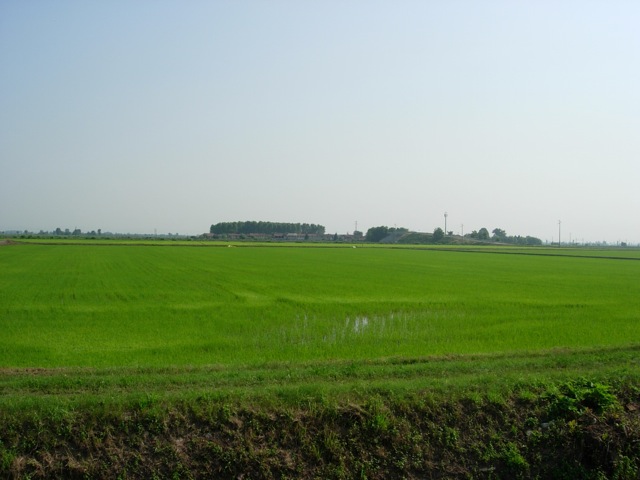
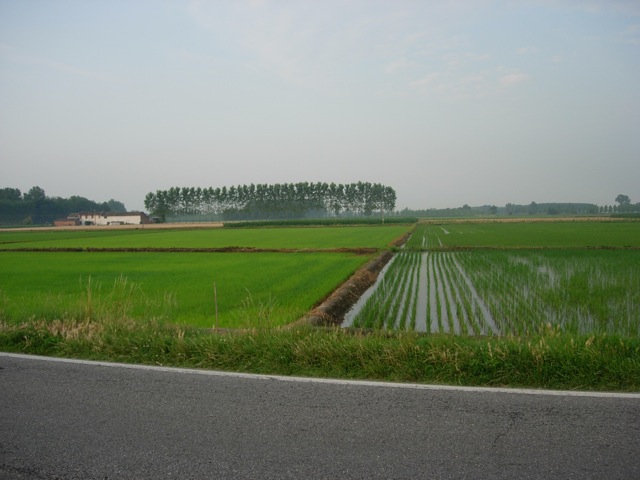
In Santhia I already notice that I am approaching the rice fields of Vercelli. It is suffocated by mosquitoes at night. This is where the arborio rice comes from, the rice used for risotto. When Italy was still a poor country, thousands of women from all over northern Italy came here every year to pick rice. All day long they stood in the water up to their thighs among the swarms of mosquitoes. In 1949, director Giupesse de Santis made a then famous film about it, Bitter Rice. In a cafe, a man tells how his aunt went there to pick rice for a month and then was paid one bag of rice.
I decide to leave Santhia early, at XNUMX:XNUMX am I am already walking through the rice fields. It heats up quickly. There is one long road to Vercelli. I arrive at about twelve o'clock, with a blister for the first time and somewhat exhausted. I quickly find a hotel, much too expensive, but when they hear that I am a pilgrim, mother and daughter take twenty euros off. A little later I lie on my bed like a dead bird, on my back with my feet up, because I have been smeared with cream, which I have to let it soak in for a while.
Football
And yes, then it is time to play football. What a drama. How the Italians cope with their decline? Talking, talking endlessly. Shortly after the game I see people standing in groups on the street everywhere. It's only about the match. At a barbershop where the door is wide open, things get intense. A gentleman with a half-cropped head listens to the hairdresser, who carries on a whole tirade, brandishing the scissors in his hands. The newspapers are relentless. Some headlines: the mediocrity of the team is a model for the mediocrity of all of Italy, Joaquinta who couldn't find the target, Cannavaro who should have been in the reporter's booth long ago, players crying in the photos.
This morning in Vercelli and all over Italy (I think Italian women collectively put their retired husbands out in the morning and are not allowed back in until dinnertime) older men group on terraces and squares. Some sit there in silence with a sad face, others get excited beyond measure. My hotel keeper, a chubby older lady who, according to herself, doesn't care about football, has an analysis ready. Lippi, she said, had only put players on the team with whom he was comfortable with himself. And she lists a couple of completely unknown names of players who, in her opinion, should definitely have been on the team.
And of course it's no coincidence that she only mentions players from clubs around here, such as Juventus. And so, after being united for a while and being behind as one country blue Italy has fallen apart again and everyone is once again turning their hopes on their own bell tower. This morning you saw guys walking around again wearing Juventus and AC Milan shirts. no, the blue do not expect a warm welcome on their return.
To be continued…








Comments