

 Lottie Lomme
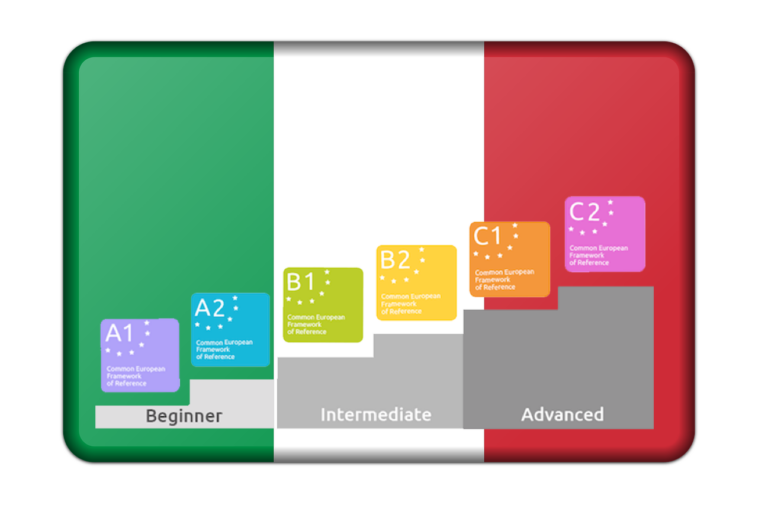
With the arrival of the European Framework of Reference (CEFR), it has become clearer what the different steps are in language proficiency.
Italian at A1 level
As a beginning student Italian you start with A1. At A you are a basic user of the language (A1 and A2). level A1 teaches you to survive abroad, should no one speak English.
- At this level you can do shopping, make contacts, make reservations.
- By the end of the course you will be able to understand and use familiar everyday expressions and basic sentences.
- You can read and write short, simple texts.
- If your interlocutor speaks clearly and slowly and helps you, you can communicate in a simple way.
Italian A1 testing
You can find a practice exam A1 under this link. This is an exam from a few years ago of the CILS, of the Università di Siena.
Italian at A2 level
Many students have A2 or B1 as their goal. Bee level A2 Do you have the language skills of a small child in Italy, so you can express yourself really nicely with that. By the end of the course you will be able to understand sentences related to yourself, your family, your work, and shopping.
Then you can also read and write short, simple texts. These are, for example, advertisements, menus or timetables.
In simple situations you can communicate about familiar and everyday topics.
Finally, you can describe your background in simple terms. You can think of talking about family, living conditions or education.
You can achieve Italian at A2 level after 2,5 years, but then you will always have to devote a lot of time and attention to the study. For many people it is nice to do the same course twice to get a better grip on the material, so it goes a bit slower.
Level A2 is the level for integrators in the Netherlands, by way of illustration. They also have 3 years to pass their civic integration exam.
Italian A2 testing
You can find a practice exam A2 under this link. This is an exam from a few years ago of the CILS, of the Università di Siena.
Tip: set achievable goals
I personally like to set clear goals when I want to learn something. Like: in the coming weeks I want to practice writing skills A1 and get better at this and then see if you can measure that.
When your progress becomes visible, it is a positive reinforcement of your efforts. If you're always working on small goals in the short term, I think it's easier to make progress than if you think: I want to speak Italian fluently.
A goal that is far away is easy to set aside if you find it to be a slow and difficult process. Then it won't work! When setting achievable goals you can look at our online training Italian for beginners. It also helps you to formulate your goals specifically and therefore comes closer to your reach.
Test your knowledge of Italian
Now if you want to know how your Italian learning progress is, where you are and where you still have to go, it is very wise to regularly test yourself and do self-assessments.
There are a few online. Most work with a progressive difficulty. So then you have to complete sentences grammatically and then it starts easy at A1 level and then it gets more and more difficult.
All online tests apply only to you grammatical level tests and not your listening or reading skills, your writing or speaking skills, while these skills are tested on the official exams of, for example, the CILS, PLIDA or CELI.
Online tests with CEFR reference
De test of WEP from Belgium tests your passive knowledge slightly more than your active knowledge. You will probably come out a little higher with your level as a result. Most people master passive skills (listening and reading) better than active skills (speaking and writing). The test goes up to level C2 and therefore only has a few questions at A1/A2 level. If you get this one wrong, it can therefore seem that your level is very low.
Wherever you get a CEFR result is at the test of ESL Language Studies. I did see that I had made a 'mistake' that could also be good, but anyway, the test is fairly reliable and also goes up to level C2.

Real practice exams and long-term success
If you have a teacher, it is a good idea to ask for practice exams. You then gain insight into what is required of you and you have a short-term goal that becomes achievable.
Online you can also find practice exams from previous years, such as here from the CILS exam from Siena. Here from the PLIDA of the Società Dante Alighieri and here from the CELIA from Perugia, under prove d'esame.
You can often quickly check multiple choice questions yourself and view the grading criteria. How much do you need to have for a pass? A teacher can assess your writing and oral skills.
I also wrote an extensive blog about what to expect from an Italian exam. By the way, prepare yourself for Italian situations during an Italian exam. It's also a cultural event, shall we say.









Nice blog. Done right away, of course. 64%. Luckily just A2. Had my doubts about a few questions. And so wrong haha. Just brush up on that Italian. But it's still so much fun!