

 Aart Heering
In the dark days before Christmas, the center of Naples is bustling with citizens and tourists searching diligently in front of brightly lit shop windows for suitable gifts to put under the Christmas tree. Unique is the spectacle around Via di San Gregorio Armeno, where the nativity scenes from all over Italy come from. But you won't be bored in the rest of the city either. Here are some suggestions for a city walk.
Table of contents
- 1. Giorgia Meloni in the nativity scene
- 2. The Castle of the Egg and the Bay of Naples
- 3. From Piazza del Plebiscito to Via Toledo
- 4. The Spanish Quarters
- 5. Spaccanapoli and San Diego
- 6. Aperitif and antique erotica
- 7. Pizza in the centro storico
- 8. Underground and Wonderful Naples
- Discover Naples for yourself
1. Giorgia Meloni in the nativity scene
Nowhere in Naples, and probably nowhere in Europe, will it be as busy in the coming weeks as in Via di San Gregorio Armeno. Dozens of workshops are located in this short narrow street that specialize in the manufacture of cribs, nativity scenes.

There is a storm because millions of Italian families in Advent their crib take it out of the closet and supplement it with new figures where necessary. Thousands of stables, children, wise men and angels, hand-made from cork and plaster, are displayed in the shop windows and in the street, alongside less traditional Christmas figures such as Pulcinella (the Neapolitan Tijl Uilenspiegel) and folk comedian Totò.
In addition, the owners like to supplement their collection with more or less current figures such as Berlusconi and Maradona. The most popular newcomer this year is of course the brand new prime minister Giorgia Meloni, not depicted as H. Mother, but in a politically correct blue or pink suit. That alone makes San Gregorio a must for every visitor these days.
2. The Castle of the Egg and the Bay of Naples
A good start for an exploration of the unofficial capital of southern Italy is the Castel dell'Ovo. (Literally the Castle of the Egg: legend has it that the poet Virgil had an egg laid in the foundations and that disaster would come upon the city if this egg broke. Whether that ever happened is not clear, but given the dramatic history of Naples it should have cracked at the very least.)

The Castle of the Egg View from Castel dell'Ovo on the lungomare of Naples

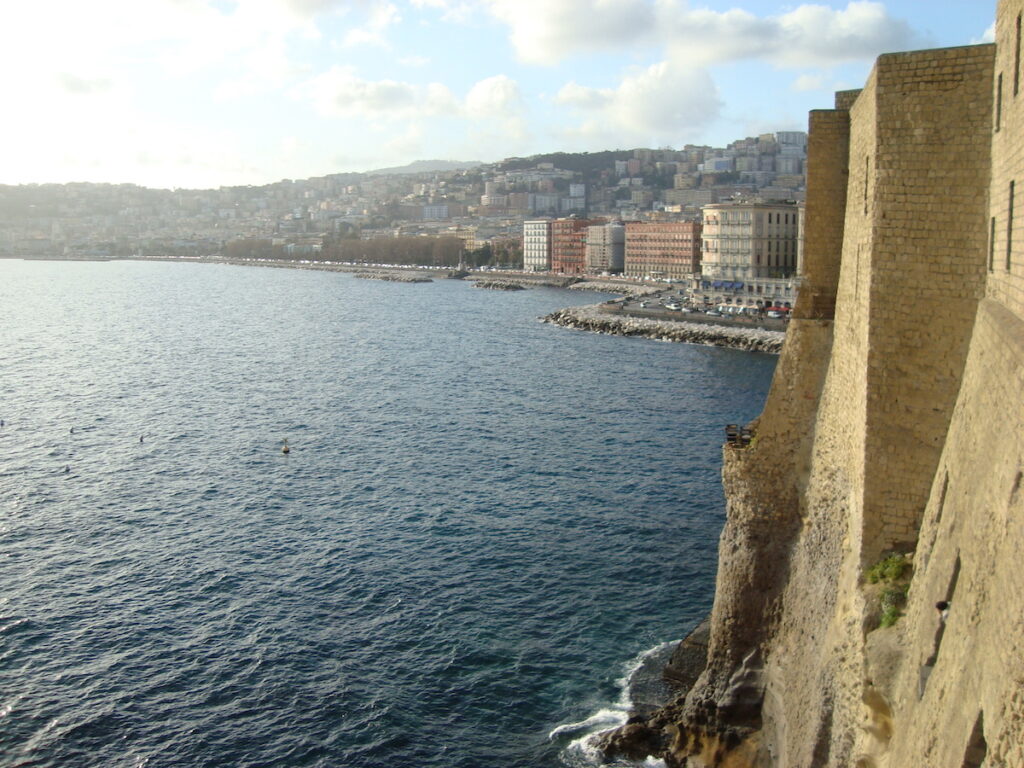
This tuff fortress - freely accessible from 9 am to 17 pm - is located on a peninsula in the Bay of Naples that was already in the 7th century.e century BC was inhabited by Greek settlers. It was built by a Roman patrician, the renowned gourmand Lucullus, expanded in the Middle Ages by Norman and French rulers and in the 17e century converted into a dungeon by the then Spanish viceroys.
From the parapets you have a beautiful view to the right of the city, with Vesuvius in the background. On the left you look out on the elegant Via Partenope, on which the most luxurious hotels are located, and the Via Caracciolo, the boulevard lying between the sea and the swaying palms of the city park.

Further west is the hill of Posillipo, where it is good to eat fish with a view of the Bay and the 'heavenly sunsets' that Goethe already sang about here. Next to the castle is the Borgo Marinaro, an old port complex that has been transformed into a nightlife center of hotels and cafes. Especially in good weather, and it can be in Naples in December, it is popular with city dwellers, tourists and visitors to the adjacent marina.
3. From Piazza del Plebiscito to Via Toledo
A short walk north leads to the city's largest square, Piazza del Plebiscito. (Named after the popular vote with which the Neapolitans chose to join the fledgling Kingdom of Italy on October 21, 1860.)

On one side this is embraced by a colonnade reminiscent of that of Saint Peter's and on the other the square is closed by the Royal Palace, the baroque palace of the kings of Naples, which is now a museum.
A little further on, in Piazza Municipio, opposite the monumental town hall, is the Maschio Angioino, a floppy, from the 13e century dating stronghold with huge bastions of black volcanic stone.

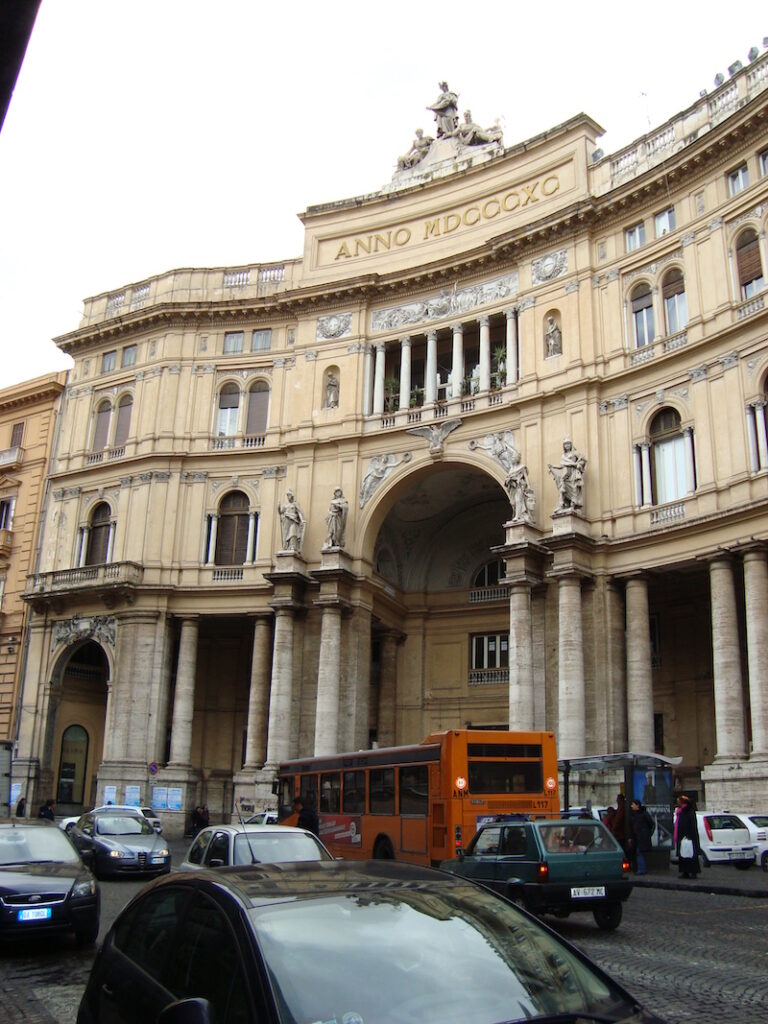
From Piazza del Plebiscito northwards runs Naples' most elegant shopping street, Via Toledo, where the great names of Italian fashion are represented. On the right is the Galleria Umberto I, a cast iron and glass-roofed shopping arcade from the late 19th century.e century, slightly later than the Milan Galleria Vittorio Emanuele II.

The entrance to Galleria Umberto I Galleria Umberto I interior

4. The Spanish Quarters
To the left is a very typical part of Naples, the Quartieri Spagnoli, which date back to when Naples was ruled by a Spanish viceroy.
In these dozens of narrow streets with high 16ecentury-old flats, you can still taste the atmosphere of the old-fashioned working-class neighbourhood. With simple eateries, tiny shops, hanging laundry, the elderly in stuffy ground floor flats, street urchins (street boys) and now and then a somewhat dilapidated baroque church or chapel.

All very rustic and nice to wander around for a while to soak up the atmosphere. But don't do that with jewellery, designer bags or iPhones of the latest model and preferably dress simply.
Naples has long ceased to be the unsafe city it was 20 or 30 years ago, but the streets are still a popular hunting ground for scippatori, purse snatchers who usually operate in pairs on mopeds: one drives, the other grabs. If you don't have anything of value with you, you're not an interesting prey, simple as that.
5. Spaccanapoli and San Diego
Halfway through Via Toledo on the right you come to a series of streets that are in line with each other that cross the old center and are therefore known together as Spaccanapoli (split Naples).

The Via Benedetto Croce and the Via San Biagio dei Librai are flanked by characteristic shops selling pasta in all colors, buffalo mozzarella, old books, amulets, antiques and pizza and chip shops.
A must-see is the medieval monastery complex of Santa Chiara, whose courtyard is renowned for its brightly colored majolica tiles. A little further on, opposite the Caffè Nilo, is an altar dedicated to Diego Armando Maradona, the man who helped Napoli Calcio win the national title in 1990 and is still worshiped as a demigod for that.

At the end of Spaccanapoli, not far from Piazza Garibaldi, the modern station square, Via Forcella leads into the working-class district of the same name, with a chaotic and fascinating collection of eateries, shops and stalls selling counterfeit branded goods, in flat Neapolitan style. neomelodic music and sometimes even cheap contraband cigarettes.
For those interested in crime history, number 2 has traditionally been the headquarters of the Giuliano family, the camorraclan that ruled the neighborhood for decades, but has since been decimated by regrets, arrests, and settlements. That's why Forcella hasn't been around for a long time either no-go area .
6. Aperitif and antique erotica
Parallel to Spaccanapoli is Via dei Tribunali, once the main road of the original Greek settlement, but now best known as the mecca of pizza.
The road starts in Piazza Dante, a grand square at the head of Via Toledo that was built in the second half of the 18e century was designed by court architect Luigi Vanvitelli, grandson of the Amersfoort painter Kasper van Wittel who immigrated 100 years earlier.
It is recommended to descend on this square in the metro station that opened 10 years ago, which is just like the others art stations of the Neapolitan underground has brightened up with intriguing modern art.

At the start of the road you pass the palm-fringed Piazza Bellini, a cozy square with trendy cafes where students, artists and tourists enjoy the aperitif on terraces between bookshops and remains of the Greek city wall from the 4e century BC.
From there the Via di Santa Maria a Costantinopoli leads to the Museo Archeologico Nazionale, with its vast wealth of artifacts mainly from nearby Pompeii and Herculaneum.
The most popular rooms are those of the Gabinetto Segreto (Secret Cabinet: it was not or hardly accessible until 2000), where the collection of erotic art has been brought together.

7. Pizza in it Old Town
In Via dei Tribunali, which is the whole Old Town you will find what is believed to be the highest concentration of pizzerie in Europe, with well-known names such as Di Matteo, Sorbino and the Pizzeria del Presidente, which has been so named since Bill Clinton had a Neapolitan pizza there in 1994. For the enthusiast, every kind of pizza is available here, from the luxury gourmet pizza to the small street pizza that you consume while walking folded folded in half.
The prices in this student and tourist district are low – 4 euros for a Margherita and 3 for a Marinara at Antonio Sorbillo at number 38 -, but for that you have to accept a Spartan ambiance.

If you want to eat chic pizza, you can go to Brandi on the Salita di Sant'Anna di Palazzo, near the Piazza del Plebiscito, where the Pizza Margherita was created in 1889 in honor of the then Queen. In style, a drink at Gambrinus, diagonally opposite, is the intellectual café from the 20s that still looks just as it did back then.

The road ends at the medieval bastion of Castel Capuano, which for 400 years housed the court from which the street takes its name. Until the entire legal circus (which has quite a bit to do in Naples) moved to the gigantic Nuovo Palazzo di Giustizia outside the center.

8. Underground and Wonderful Naples
Between Via dei Tribunali and Via di San Biagio dei Librai, at the corner of the Nativity scene street, the Church of San Lorenzo Maggiore offers access to an even older Naples. Below the Medieval Almshouse, steps lead down to an entire quarter of ancient Roman Naples.
Diagonally opposite the church is the entrance to an even deeper system of corridors. 30 to 40 meters below the surface lie the tuff caves excavated by the ancient Greeks for the walls and houses of their 4e century BC Nea Polis (New Town). The Romans later used the artificial passages and caverns as water reservoirs and during the Second World War they housed people in hiding.
The Napoli Sotterranea Foundation (www.napolisoterranea.org) organized tours of underground Naples are a fascinating experience, but not if you are claustrophobic.
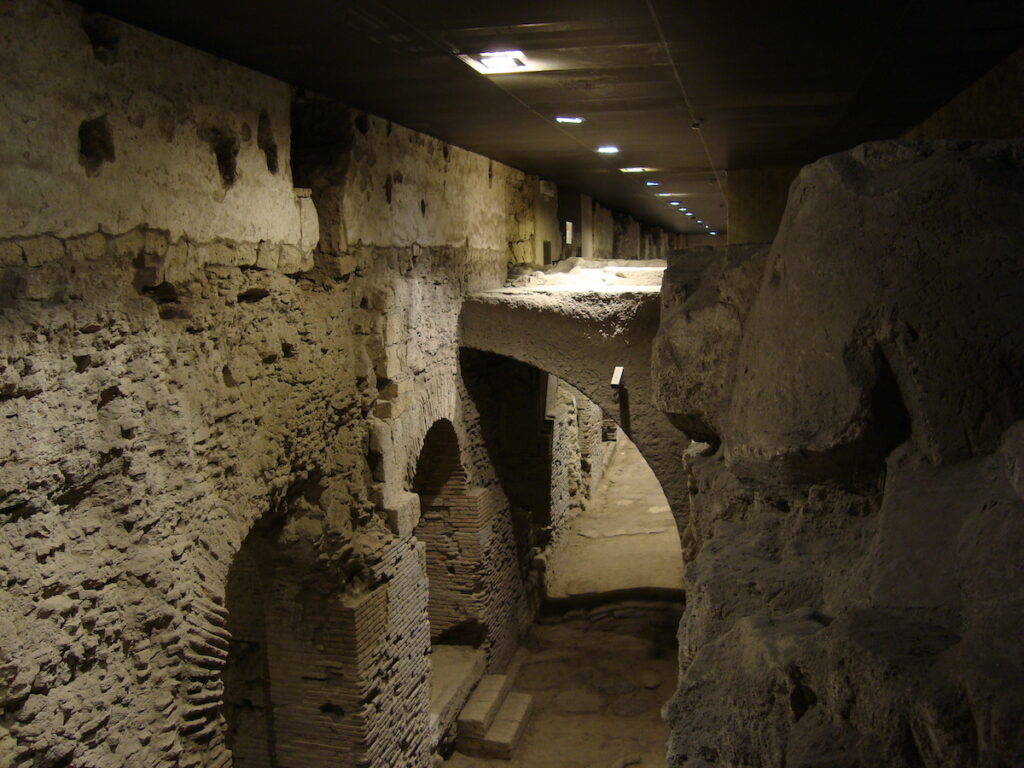
A little further, at the intersection of Via dei Tribunali and Via Duomo, you look out over the elaborately decorated Cathedral of Naples.
A high point in the city's social and religious life takes place here, when the coagulated blood of the patron saint of San Gennaro, Januarius, preserved in an airtight ampoule, is shown to the people by the city's cardinal archbishop. If the contents of the ampoule liquefy in the process, then that is a miracle and Naples will be fine.

If the miracle does not take place, and that happens once in a while, then misfortune threatens. A miracle on demand, so to speak, or a chemical reaction evoked by shaking before use, as science judges.
In any case, the Neapolitans firmly believe in it and anxiously await the outcome inside and outside the cathedral. This happens three times a year: on the Saturday before the first Sunday in May, on September 19 and December 16. If you are in Naples on one of those days, don't miss the spectacle!
Discover Naples for yourself
You see: in Naples you can go in all directions. That is why it is such a beautiful destination for the winter. You can fly directly to Naples (Aeroporto di Napoli-Capodichino). You can also fly (cheap) to Rome and then take the fast train to Naples.
You can easily find accommodation in Naples. There are plenty of hotel rooms, apartments and holiday homes for rent. View the range of affordable, well-reviewed stays now on booking.com.

Have you ever been to Naples yourself? Do you have any tips for others traveling in the winter months? Let me know!








Comments