

 Edward Hendriks
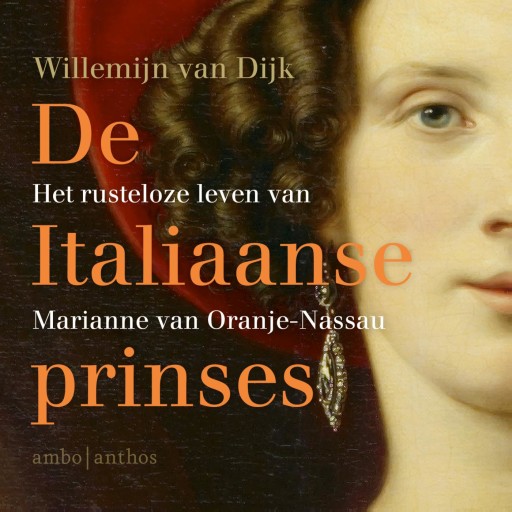
The Italian Princess is the recorded life story of Princess Marianne van Oranje-Nassau (1810-1883), the only daughter of King William I. Little is known about this Orange scion to the general public.
Not so strange, because the royal family has done everything possible to erase Marianne's shame as much as possible.
For example, in 1883, when she died, she was buried in Erbach, Germany, instead of with the rest of the royal family in Delft. Willem the Third, the nephew who sat on the throne at her death, preferred to forget Marianne's existence.
But his successor Queen Wilhelmina admired the courage of the princess. She had a portrait of Marianne in her study until her death.
What exactly was that shame? After much hassle, she divorced her husband, the Prussian soldier Albert. Very unusual for that time. She made up with a married man, Johannes van Rossum, had a child from him, and fled to her beloved Italy.
Johannes van Rossum died 10 years before Marianne was buried in Erbach. When Marianne died, the tombstone was replaced by her children with only her name on it.
You already understand: Marianne was not a princess who danced to the tune of the elite in the 19th century. And that made it so interesting for Willemijn van Dijk to dedicate a biography to her.

In the preface she describes how she studied the history of Rome as an antiquarian and thus ended up on Celio Hill, where Villa Celimontana is located. She found the list of names of former residents of the villa and discovered the name in it Marianna d'Orange Nassau.
Unfortunately, no one was able to tell much more about her history and her connection with Rome, so Van Dijk decided to investigate herself.
The story of Marianne turns out to be a story of a woman who fought to conquer her place in the world, instead of acquiescing to her fate: marrying a first cousin to strengthen the power of the House of Orange-Nassau, children give birth and continue to lead a colorless and inconspicuous life.
Van Dijk's book has not become an ordinary biography. It reads like a novel and the author also admits that she made things up to make it an enjoyable read. That does not alter the fact that major events in Marianne's life are based on facts from source research.
It is certain that at the age of 18 Marianne entered into an unhappy marriage with her cousin Albert, and subsequently went to live in Berlin. She soon sees her life there as a life in prison.
A servant even keeps track of Marianne's cycle and signals her husband when he should sleep with her in order to have offspring. The rest of the nights she doesn't see him because he has several mistresses and actually hates his legal wife.
But Marianne is not the woman to waste in her golden cage. After a few years she leaves her husband and children (they have 5, 2 of whom die very young) to flee to Italy, where she Ischia, Rome and Lake Como and be enchanted by the sweet life

From an early age Marianne is intrigued by Italy, after visiting the studio of painter Josephus Knip, where a painting of an island in soft yellow light under a serene sky caught her attention.
Marianne wanted to know where he had painted it. If it really existed.
'This is the land of the golden light, this is Italy,' replied the painter. For a moment, Marianne glimpsed a world she yearned for, but could never reach.

After 3 months she returns from her 'vacation' because her father is dying and after that the atmosphere at home is even more icy than before. She wants a divorce, but her family won't let her.
Marianne's life becomes even more complicated when she becomes pregnant by Johannes, the new love in her life. She is forced to undertake a pilgrimage to the Holy Land by ship in order to give birth to her bastard son on the way in Sicily, whom she then has to leave behind with a foster mother.
Willemijn van Dijk writes everything down in a beautiful way, so that the reader is effortlessly transported to the 19th century, in which very different rules applied to the elite than in our time.
The writer also makes it clear why Italy already had such an attraction for the Dutch back then. In the sun on Celio Hill, surrounded by artists in her cultural salon, the princess is having the happiest time of her life.
This is rightfully a special story about a strong woman who managed to escape from her chains, but had to pay a heavy price for it. Because what does it do to a mother to see her children die or have to leave them behind?
I would have liked to have read a bit more about the latter, but of course there are also limits to what you can come up with in such a biographical novel.
The Italian Princess – The restless life of Marianne van Oranje-Nassau (reading excerpt)
by: Willemijn van Dijk
320 pp.
€ 22,99 (also available as an e-book for € 5,99)
Ambo|Anthos, October 2021
ISBN 9789026352188








Comments