

 Steve Smulders
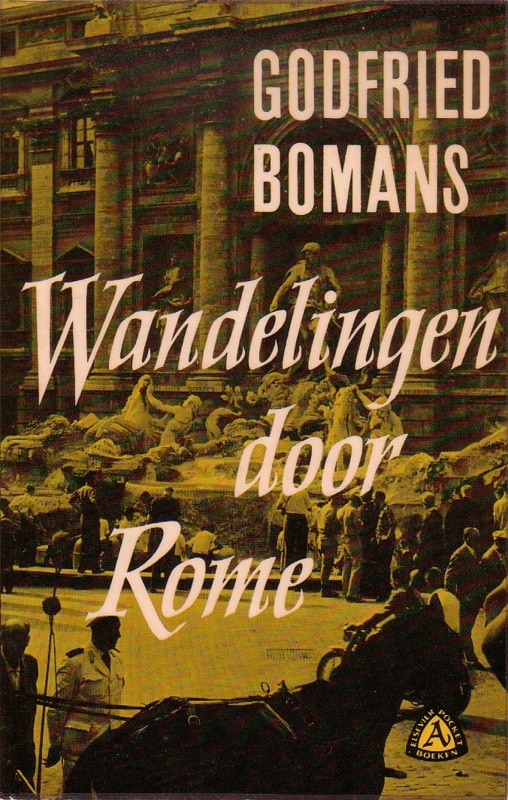
In the early 50s, the writer stayed Godfrey Bomans (1913-1971) spent a short year in Rome and reported on it in a collection of stories in 1956. Even after 60 years, Bomans' texts are still fresh, as I noticed earlier when reading his famous Erik, or the little insect book and its many fairy tales and other stories. It made me curious about the Walking tours of Rome, unfortunately only second-hand or as part of the collected work is available.
Bomans' talent for storytelling did not disappoint me in the 'Walks' either. Within the more than 20 stories, the author smoothly varies his style from contemplative to ironic or satirical, to then again testify to self-mockery or compassion.

The understatement is also a favorite figure of speech of Bomans, the narrator who was strongly inspired by Charles Dickens. As a result, it is sometimes difficult for the reader to separate fact from fiction, as is the case with the real Dutch guide Felix Rutten, of whom Bomans paints a hilarious but caricatured portrait.
Thoughts on Italians
Of course, as a Dutchman who emigrated to Italy, I am mainly interested in Bomans' thoughts about the Italians and their customs, also to see whether people looked at things differently half a century ago. However, the latter hardly appears to be the case: apparently cultural characteristics change and differ only very slowly. In the chapter 'Wonders in Italy' Bomans describes the course of a procession and notes:
'Strange, the total absence of any organizational capacity. For a year it was known that the procession would take place on this Sunday and at this hour, and nothing, literally nothing, is ready.'
in my book Italian Conditions I could almost describe the same scene in 2014.
Fortunately, Bomans also adds his own, often astute and excellently formulated insights to the clichéd observations:
'There is no focus on the final performance. There is life, and from that comes the achievement. Therefore, as with us, the result does not leave a void to be filled by a new plan. Life remains full even after the achieved, because all the moments leading to the achieved were considered in themselves and the result is only one of those moments, no more or less than the previous ones. Life goes on after that, full and warm-blooded, because there is no division in time, no hierarchy in the order of moments.'
Or, about the unsociableness of Italian establishments such as cafes, bars and restaurants:
'That is why all places where an Italian sits, stands or lies are highly unsociable. They are not calculated for the state of residence, but for the glorious moment of springing up and doing something else. ... A Dutch cafe presupposes the intention to settle, an Italian the idea to go again. ... The mysterious bond ..., which we describe as "cozy", would hinder him (the Italian) in his freedom to suddenly turn around and smoke a cigarette outside on a sidewalk. That possibility must be kept open at all times.'
Attempted robbery
In addition to these kinds of real travel reports, the collection also contains very other pieces, such as the purely satirical 'The club of the silent' and the ironic 'Truths as cows'. Also in the report 'Roman scoundrels' about the swindling tricks of some inhabitants of Rome, the description of a robbery attempt that seems to fit Boman's fictitious stories rather than an objective one. Or not?
Catholicism
Catholicism is of course discussed extensively (Whether he wanted to or not, Bomans was a figurehead of the Catholic pillar in the Netherlands) such as in the beautiful, compassionate biography of Pius X. Remarkably often Bomans finds it necessary to cover himself. against possible criticism from the Dutch Catholic community by stating that he does not take a position but only reflects what he sees.
He does this, for example, when describing the miracle of the weeping Madonna of Syracuse, which happened to take place at the time of Bomans' stay in Italy. The author went to investigate on the spot and even asked the local archbishop for his opinion. The church eventually recognized the miracle and in 1966 a shrine was erected in honor of the one and only weeping Madonna recognized by the Catholic Church.
But the veracity of the miracle becomes still researched and contested. The sensitivity to criticism of these matters has become a lot less (visible) after the depillarization. A modern Bomans would really no longer have to defend himself against his critical eye and his doubts.

Of course, the typical Bomansian jokes with which he became such a famous TV personality (the first real Dutch celebrity!), are not missing:
"First the maidens of the village pass, modestly in black, eyes cast down, palm twig in hand, unloved, never embraced and yet standing."
'… the ceiling, which over a length of 55 meters showed a large number of unclothed persons, who moved about in a state of extreme agitation. Among them were the three hundred congressmen, clothed, bespectacled and determined to prevent a repeat of these scenes in the future.'
Suffice it here to say that this man is serious about the Gospel and consequently by it Vatican is watched with astonishment.'
'... the existence of a Dutch painter's colony... which was called the 'vogelbent'... The name points to a certain joviality of outlook, which is confirmed by the preserved police reports.'
Finally, Bomans also devotes some interesting considerations to the foreigner/tourist who visits Italy for a short time or who is going to live there for a longer period of time:
'That's the way to see a country: to enjoy it, by not feeling at home there. Anyone who really only feels at home in his own street is the true cosmopolitan, the traveler par excellence. He has been given the gift of wonder. He is given what is withheld from the knower: surprise.'
'When I want to relive my first surprise, I pick up a Dutchman from the station who still knows how to blow his butt. I humbly walk beside him, for he is my guide. He thinks everything is weird… It's the first phase.'
'… the second phase. The astonishment remains, but it has another object. He's going to be amazed at home. ... He's getting overly Italian. '
'… the next stage, which is the ideal one. It can be described as the condition of the stranger, who is aware of this quality and yet feels at home. … Who closely follows Italian events and is also a loyal subscriber to his Dutch personal magazine.'

Unfortunately, the collection does not contain a report of the hilarious performance of Bomans as Sinterklaas, to the dismay of the Roman police and authorities, in which he rode through Rome on horseback, leaving behind some completely incomprehensible to the inhabitants of the Italian capital. black-painted figures.
Ultimately, Bomans left Rome in 1954 on his own terms. On a Wasp, the moped he so detested in the first chapter but already considered a miracle in a later report. His wife was left surprised: she knew nothing of his plans to leave. On closer inspection, the Dutch are also sometimes very strange fellows.
 Want to read more fun stories about life in Italy? You can find it in the three parts 'Italiaanse Status' by Stef Smulders, available at bol.com.








Comments