

 Aart Heering
It's time! The RIVM has (finally) decided that the corona threat in Italy and some other European countries is no longer so serious that tourist trips should be discouraged.

That was also allowed, because the covid situation in Italy can no longer be compared with that of just a few weeks ago. To date, 40 million doses of vaccine have been distributed and more than half a million are added every day.
As a result, 45% of the population has been vaccinated at least once and the number of infections is declining rapidly, to less than 1.000 per day. The same applies to the numbers of covid patients in hospitals. In the IC there are only 700, while 2 months ago the 3.000 was still exceeded. The number of deaths is also decreasing rapidly, albeit with a (logical) delay of several weeks compared to infections and hospital admissions.
Italian color codes
According to the Italian color code, in the country there are no rode en Orange regions more. A total of 13 regions have been up since 7 June yellow and the remaining 7 – Abruzzo, Friuli-Venezia Giulia, Liguria, Molise, Sardinia, Umbria and Veneto – even on white (or with hardly any limitations).

Reason enough for the Dutch authorities to stop Italy Orange (only necessary trips) to color, but yellow (tourism is possible, but keep an eye out). The Foreign Affairs Travel Advice says it clearly:
“Italy's color code will be yellow from June 10, 2021. After a stay in Italy, you do not have to submit a negative test when you return to the Netherlands and you do not have to go into (home) quarantine. Until then, this applies (except for Sardinia). The test obligation for travel from the Netherlands to Italy continues to apply. On arrival in Italy, you still have to show a negative test result (a molecular or antigen test), which must not be older than 48 hours.”
Ministry of Foreign Affairs, netherlandsworldwide.nl
Mandatory negative test for travelers for the time being
The test remains mandatory for the time being, even if you have already been vaccinated once or twice. The obligation applies to everyone from the age of 2 years. There is no longer a quarantine obligation. Negative tests are also checked at the airports, while the chance of checking at the other borders is, of course, small.
But if it somehow turns out that you entered the country without a test, you could be fined 400 to 3.000 euros.
Code white in most regions
As of June 14, Lombardy, Piedmont, Emilia-Romagna, Lazio, Apulia and the province of Trento will also become white. For 28 million Italians (almost half) the curfew and other restrictions are lifted.
Only remains: no more than 6 people per table in the restaurant, no gatherings, no disco, but mouth caps.
On June 21, Tuscany, Sicily, The Marches, Basilicata, Campania, Calabria and the province of Bolzano will follow. Closing the race is the Val d'Aosta on 28 June. In short, normalization is rapidly approaching!
If everything goes according to plan, the situation will change again as of July 1, with the introduction of the Digital Covid Certificate, or a European greenpass for vaccinated, which Italy, among others, has been urging for months. (Italy already has such a document, but that only applies domestically.)
Once you're in Italy, you still have to adhere to a few restrictions:
- That's how it stays face mask mandatory for everyone above 6 years old for the time being, also in the open air. The cap is not necessary when practicing sports and sitting at the table in restaurants. When you get up you have to do it again. (In practice you see more and more people walking with the hood on their chin.)
- The mouth mask obligation also applies to guests of hotels and campsites, when they are outside their room or property.
- There is still one curfew, which takes effect at midnight on June 7 and lasts until 5 a.m. So cafes and restaurants close at 12 noon. This restriction is also planned to be lifted on June 21, when all of Italy is expected to be 'white'.
- Discos remain closed until further notice. (The media is talking about sometime in July.)
- Museums and Cultural Institutions are accessible again, but on weekends and public holidays only after reservation online or by phone. Cinemas and theaters are in operation, but with no more than 50% of their recording capacity.
- Op guarded and free beaches maximum numbers of visitors have been set and no more than one parasol per 10 square meters may be set up. Furthermore, everyone is expected to keep at least one meter away from others.
- De latest updates van the travel restrictions can always be found here.
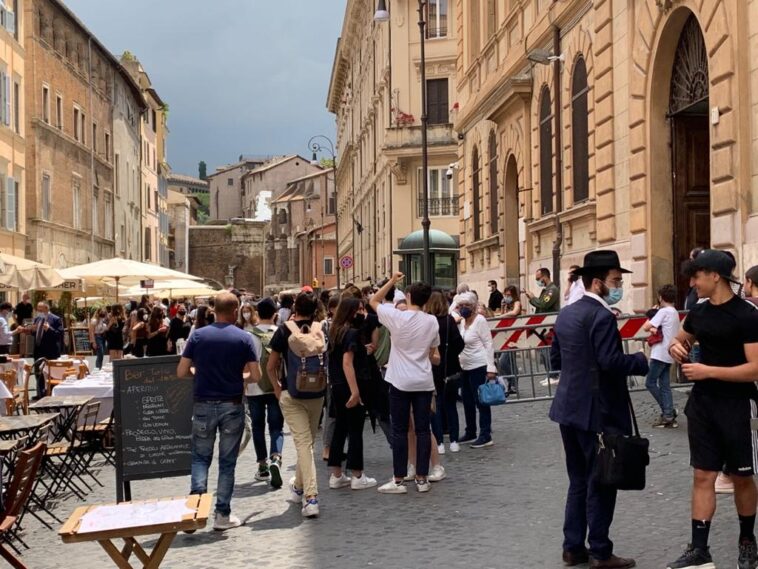
In Rome, after long months of total abandonment, the number of foreign visitors is gradually increasing again. In the ghetto of Rome, one of the most popular destinations of the capital, no Dutch could be heard on 8 June. That will soon change now.








Comments