

 This Is Italy
Once a Roman city, Florence (Firenze in Italian) developed into a thriving medieval community. Now this beautiful city is full of sights that exert a magical attraction on tourists from all over the world.
By train to Florence
With its well-developed rail network, Florence is easily accessible by train from other cities to the north or south.
For example, are you staying in Pisa? Then easily and cheaply take the train and you will be at the Central Station of Florence in no time. That saves a lot of parking stress and you end up in exactly the right place.
The best sights of Florence are almost all within walking distance of each other. A tram has recently started running and you can of course always take the bus if you want.

Firenze Santa Maria Novella Station, Firenze SMN for short, is the Central Station of Florence.
SMN is a terminal station and forms a junction between the northern railway line from Bologna and the southern one from Rome. At the same time, this is one of those special buildings from the fascist period.

Florence: rich in history
Florence is a prime example of an Italian city rich in history. And that's the understatement of the century.
It's no wonder this is the birthplace of the renaissance used to be. Any time of the day you can stroll through the narrow streets to get a glimpse of what life must have been like centuries ago.
In the Palazzo Vecchio visitors can step back in time and admire priceless classical art, eerie torture chambers, and beautifully painted ceilings. But the outside is also special!
Walking through the streets of Florence makes you feel like you have stepped into a whole new world. Its winding alleys and old buildings attract visitors from all over the world who long to feel its charm. Get lost in Italy's past with ease with plenty of beautiful Italian monuments close by.
This captivating city is also known for its Gothic architecture, ceramics production, and art treasures such as Michelangelo's David and Botticelli's paintings that capture your imagination with their beauty and history.
One of the most famous representatives is Michelangelo, who, among other things, created the statue "David". The statue, over 5 meters high, originally stood in front of the Palazzo Vecchio in Florence, but can now be seen in the Galleria dell'Accademia.
That Palazzo Vecchio is in Piazza della Signoria. It is the heart of the city, with a distinct medieval character. On the same square is the famous art museum Uffizi.
Many bridges over the Arno were destroyed in World War II, but the Ponte Vecchio from 1345 was spared. Above the shops on this bridge is a passageway built in 1565 for the exclusive use of the powerful De' Medici family. This way this family did not have to mingle with the common people!
In March, the culinary festival Firenze a Tavola ('Florence at the Table') is held. You can enjoy specialties from the city and the region.
The importance of Florence as a trading city in earlier centuries is apparent from the naming of other coins. The Hungarian forint takes its name from the florin, and the Dutch guilder was initially called guilder (= gold) florin. Hence the abbreviation for the guilder f. or fl. wash.
In short, Florence has many important sights such as the Duomo. Then Palazzo Pitti, Uffizi, the world famous Old Bridge, Boboli Gardens and numerous museums that you should not miss during a city trip to one of the largest (with a capital letter) Italian cities.
The main sights of Florence are close to each other:
In short, it's time to discover all the beauty that makes this city so attractive to tourists!
1. Ponte Vecchio

The Ponte Vecchio connects the western end of Piazza della Signoria with Lungarno Torrigiani at the eastern end of Via dell'Arnolfo. This place has been a permanent center of Florentine life for centuries. You see that and you feel it when you are there.
Walk up the fantastic structure and make your way to the center in an adventurous way. For a view over the Arno and Florence that no one can take away from you.
The bridge is considered by many to be an architectural masterpiece. It has been well preserved over time. Due to the intervention of the German diplomat Gerhard Wolf, the Ponte Vecchio even survived WWII unscathed.
In addition to all the other sights on the Ponte Vecchio, you will find several shops, art dealers and souvenir shops.
2. Giotto's Campanile

The Campanile di Giotto (a bell tower separate from the church) is a masterpiece. Built in the Gothic period, it displays graceful proportions and attention to detail found nowhere else in Florence.
This makes it just as much an icon on the Piazza del Duomo as the Duomo itself. The tower has gone through many changes over the years, but we are sure you will find this glimpse into history very special.
You'll find the perfect perspective on all the beauty of Florence with an ascent to Giotto's Campanile. Or you can view it from the top of the Duomo, that's also possible.
From the top floor of it you'll have a bird's eye view of both the Duomo and Piazza del Granduca from one side, or from the other side you can see just how far away that statue you thought was too high.
An ingenious design that lasts to this day makes the Campanile one of the city's most remarkable and high-profile landmarks.
The Campanile was built as a separate structure from the Duomo, in Gothic style with intricate marble decorations and levels serving as an outer detail. A must for any visitor passing through Florence!
3. Palazzo Vecchio

Another Italian gem of the Renaissance, the Palazzo Vecchio in Piazza della Signoria is one of Florence's most beautiful buildings with its majestic architecture, palatial exterior and rich history.
With an eye for architectural detail, Palazzo Vecchio offers a space that evokes a sense of grandeur while remaining tasteful.
There are many different authentic rooms filled with precious treasures, which will make the time any visitor spend inside worthwhile.
The Palazzo Vecchio is also close to the best shops and restaurants in the city. This palace has stood for centuries as an important symbol of Florentine civilian life.

The Palazzo Vecchio has been left to us as a visible link to the Florentine Republic and its history.
The iconic building stands here as a testament to Florence's ingenuity, determination and innovative nature.
And the good thing is: today it is still used for its intended purpose: for public functions, such as meetings of ministers or councils from other cities.
4. Palazzo degli Uffizi

The Palazzo degli Uffizi is the perfect place to take a journey through the past. With Renaissance art by artists such as Botticelli, Da Vinci, Titian and Raphael on display, if you are a lover of art, culture and history, you can be sure that this museum will delight you.
The building itself is near Piazza della Signoria, which also houses the Palazzo Vecchio. Take the time to stroll around the courtyard with its intricate columns and arches, decorated with marble statues.
The Uffizi is a place filled with historic, incredible art and some of the best Renaissance artists. The building itself has many features that visitors won't want to miss: frescoes on one wall and coffered ceilings plastering walls with geometric motifs.
This awe-inspiring edifice used to be an episcopal palace before Cosimo I de' Medici converted it into a permanent exhibit for his priceless collection of artwork from around the world.
Nearly 550 years later, this old castle converted into a museum still houses thousands of exclusive paintings, sculptures, drawings and other such pieces that amaze viewers every day with their beauty and fantastic craftsmanship.
5. Florence Duomo

When you say 'Duomo', you usually mean the cathedral of Milan or that of Florence.
If you're visiting Florence for the first time, the Duomo is an absolute must-see (you can't really miss it, by the way).
The real name is Santa Maria del Fiore. The first opening of this impressive cathedral was as far back as 1436, but its stunning facade was not completed until the 19th century.
Tourists from all over the world flock to see this architectural masterpiece, which stands out for miles among its medieval surroundings. For example, from the Gardens of Boboli (see below), you can see how absurdly large the dome is in its environment.
The Duomo is a stunning spectacle of Florence's rich history and architecture. It was originally designed by one of the most illustrious architects of the time, Brunelleschi; however, the plans for the facade were not ready until 1864.
With its stunning design and gigantic size, nothing beats this cathedral.
The exterior consists of white marble and polychrome patterns that share an aesthetic with Michelangelo's art; while the interior is spacious and sober despite its beauty. Inside the church you will find a large clock face and the fresco of the Last Judgment to admire.
The Duomo is one of the highlights of Florence and can be found on almost every postcard, fridge magnet, bag and other souvenirs you can get in Florence.
Do you dare climb the more than 400 steps to the top of the dome?
6. Boboli Gardens

Looking for a short break from the urban chaos? Walk through the gates of the serene Boboli Gardens behind Palazzo Pitti across the Arno (in the Oltrarno district).
Relaxing water features, soothing hedges and statues, and an atmosphere just perfect for strolling are just what you need to recharge your batteries.
The expansive gardens of tens of thousands of square meters offer visitors an abundance of serenity during their trip to Florence. Take your time to stroll and marvel at the sweeping views.
The beautiful Boboli Gardens are a must-see for all travelers to Florence.
7. Pitti Palace

Located directly in front of the Boboli Gardens in the Oltrarno district, the Palazzo Pitti is also not to be missed. The facade of this gigantic Renaissance palace alone is 200 meters wide.
The palace was built 400 years ago, but was never really finished. Over the centuries, it has been repeatedly modified and expanded.
It was originally built for the banker Luca Pitti. He wanted a building that was bigger and more beautiful than all the other palaces and – it must be said – he succeeded.
But Pitti himself could not enjoy it for long, as he went bankrupt and had to sell the palazzo and its gardens and so it fell into the hands of De' Medici, the powerful family who were the archenemies of the Pittis.
The Medici made good use of it. No less than 6 generations of words here and they expanded the Palazzo Pitti considerably during that time. The Habsburgs and the royal family of Savoy also lived here.
When Florence became the capital of the newly united Italy between 1860 and 1865, King Victor Emmanuel II took up residence in the palace.
Today you will find a number of different museums here such as the Galleria Palatina, the Galleria del Costume, the Museo degli Argenti, the Museo delle Carozze and the Galleria dell'Arte Moderna.
Here you will find a large part of the art collection of the De' Medici, with works by Titian, Caravaggio and Raphael, among others.
8. Basilica of Santa Croce

For a breather from the bustling streets and bustling tourist attractions of Florence, head to the Basilica of Santa Croce.
Although this church is located in the center of the city, it offers a special serenity. From ancient mosaics to carved marble statues, visitors will be charmed by its beauty.
The Basilica of Santa Croce is rightfully one of the most iconic monuments of Florence.
Tourists can now enjoy a guided tour of this already impressive space. Walk through the inviting gates of the Basilica and marvel at all the beautiful details.
The unique ceilings are painted with golden accents reminiscent of heavenly light. No wonder Frederico talked about this basilica for days after attending mass here!
9. Baptistery
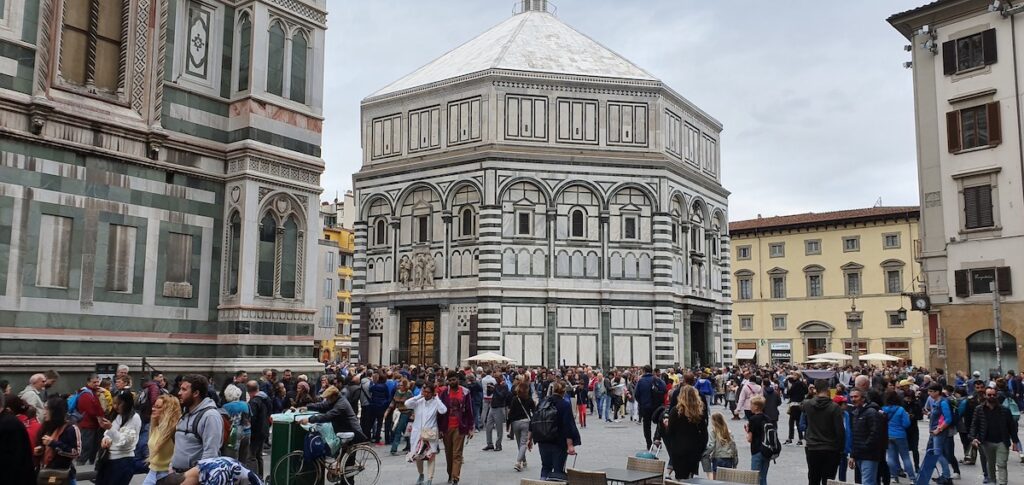
The Baptistery was built in 1246 to complete the trio of buildings of the Duomo (along with the Campanile) and as a 'witness to the faith' for all who enter it.
The exterior follows the royal Florentine pattern, which speaks volumes about its beauty and value to the city. The interior may be less known to tourists, but it is nationally acclaimed by experts as one of Italy's finest works from before 1300.
The Baptistery is still regularly used to baptize believers from all corners of the world.
Particularly interesting are the 3 sets of bronze doors, depicting various religious scenes and human virtues. Inside the Baptistery, a beautiful golden Byzantine-style fresco covers the ceiling and upper walls.
It depicts the Last Judgment and other stories from the Bible. (Those doors have recently been completely restored.)
10. Forte di Belvedere

The Forte di Belvedere is an extravagant monument that represents the power and wealth of Florence during the Renaissance. This huge castle stands proudly on the banks of the Arno. It reminds visitors that the Florentines were once in charge.
Now you can admire the grand architecture and design here and learn about its military history. Or you can simply take in the view over Florence's historic landscape from the terraces of the fortress.
As soon as you step inside this magnificent fortress, the world around you feels much smaller and closer together. The domed ceiling is tens of meters in diameter and features a series of large paintings depicting events from Roman history.
Take a stroll through the halls and explore each room to discover even more treasures hidden behind doors, stairs or statues.
11. Piazza della Signoria

The Piazza della Signoria – we've mentioned it a few times before – is a breathtaking place to take in the atmosphere of the city.
In the center is the Neptune Fountain with beautiful statues on each side commemorating some of Florence's best citizens. Soak up the sun as you stroll around this beautiful piazza, take photos and enjoy an ice cream.
The square contains a number of buildings and statues belonging to the classical art, making it convenient for visitors who want to see everything in one place. The most important building is the Palazzo Vecchio with its huge bell tower and fantastic statues of David and Hercules.
Piazza della Signoria contains all the charm and history that Florence has to offer in one central place. On the edge of this famous square, you'll find artists, vendors and restaurants ready to feast your eyes, ears and tongue with their art and the city's delicacies.
As you explore the bustling streets around the piazza, you will be bombarded by a range of activity from all directions. Whether you're shopping in chic Via Ricasoli or visiting the world-famous museums in the Uffizi – there's something for everyone here!
12. Piazzale Michelangelo

In the fashionable district of Oltrarno we find Piazzale Michelangelo, a beautiful square that offers atmospheric views of Florence and its cathedral.
On the piazza (city) you can see what's on offer in one of the most beautiful cities in the world: shopping, delicious food, and the best views.
Find a spot for an evening meal or treat yourself to dessert at La Camelia Café and watch the sun set over Florence and its iconic buildings, bathed in golden light. Magic!
Perched on a Tuscan hilltop overlooking Florence, complete with Eiffel-inspired arches, lush trees, and steep descents to the verdant valleys below. Any time is a good time to sit back here and admire the city in all its glory.
All these beautiful sights and the unique atmosphere give Piazzale Michelangelo its own charm!
13. Church of Santa Maria Novella

Nowhere in Florence will you experience such a complete and encompassing work of art as the Church of Santa Maria Novella. The combination of Renaissance architecture, Florentine history, beautiful Italian frescoes, and important works of art; this church is unlike any other.
The outside and the surrounding piazza are beautiful in their own right, but what really makes this place special is that the inside is just as inspiring.
The church contains a large number of chapels dedicated to several wealthy and prominent Florentine families of the Renaissance.
Also the walls and ceilings are covered with detailed frescoes by famous artists, including Botticelli and Ghirlandaio, among many others.
Lovers of art and history can therefore not skip the Santa Maria Novella.
14.Piazza del Duomo

How could it be otherwise, this central square is located in the center of Florence and is a great place to start your tour. From here you can't miss Florence's magnificent Duomo and Giotto's Campanile and Baptistery are also present.
In addition to these special sights, you will of course also find plenty of shops, restaurants and cafes, plus souvenir stalls and sellers. Together they also make up one of its busiest areas in the city. So you might want to eat that cup of coffee with that sandwich somewhere else.
This lively square is naturally overflowing with tourists and features a large open-air stage where concerts are held every summer. Whether you're looking for souvenirs or just want to watch people having a wonderful time under umbrellas, gelato eat this the place to be.
But don't forget to look beyond this main square and the streets immediately surrounding it, as that would be a waste of your visit to Florence.
Enjoy a little more virtual Florence with these beautiful video images:
Looking for more unknown places in Florence?
Are you not so into mass tourism and do you long for a little more authenticity? Be sure to check it out these 6 hidden spots in Florence.
Would you like to discover the most beautiful places in Florence for yourself?
Are you already eager to discover that Duomo, the art, the churches, the squares, the culture and the vibrancy of Florence itself? Book your stay in time, because Florence is extremely popular with tourists from all over the world throughout the year.
If you are only staying in the city for a few days, it is also useful to book tickets for major attractions in advance. Then you won't stand in line for long or in vain.
Here you will find the best and cheapest accommodations in Florence.
Have you ever been to Florence yourself? Do you know more beautiful places that should not be missing from this list? Let us know by commenting below.








Comments