

 Lottie Lomme
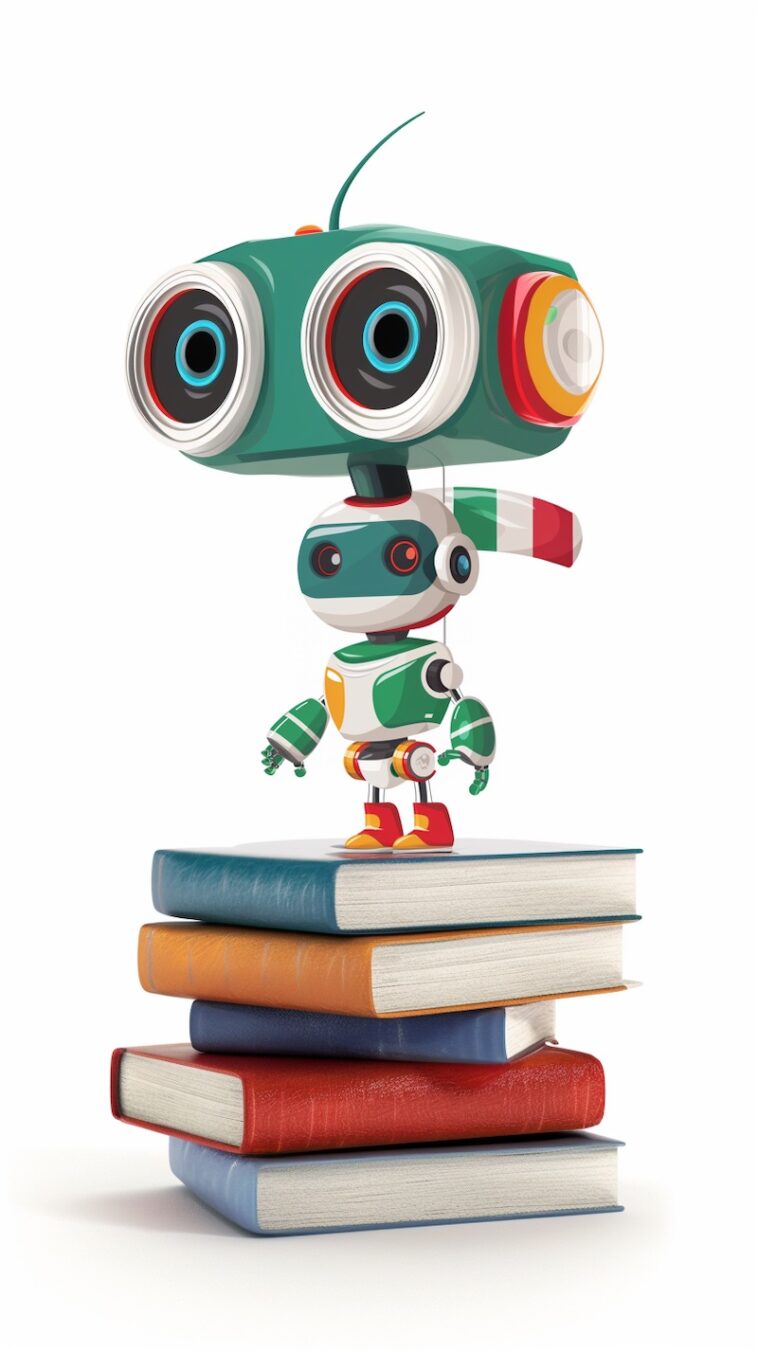
This week I delved into the possibilities with AI to learn Italian. Using Google's Gemini (the new version of Google Bard) and OpenAI's ChatGPT, you can create an account yourself and try the smart prompts below. What are the benefits of learning a language using AI? And what are the disadvantages?
Let's get straight to the point: AI can be used in many different ways to help you learn Italian (and any other language).
1. Correct or translate sentences
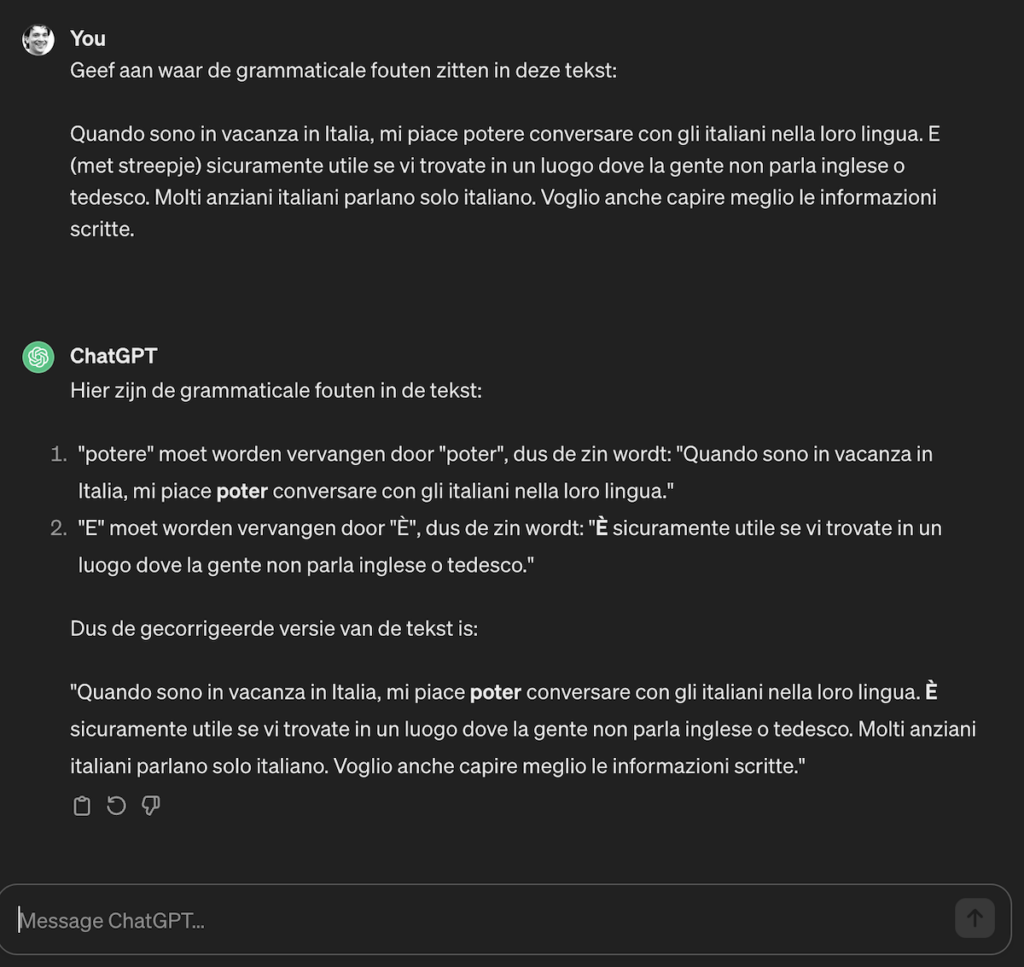
AI can correct or translate your sentences and that is of course a very useful function. You can submit your assignments from the Italian course and ask for feedback. See the following example with ChatGPT:
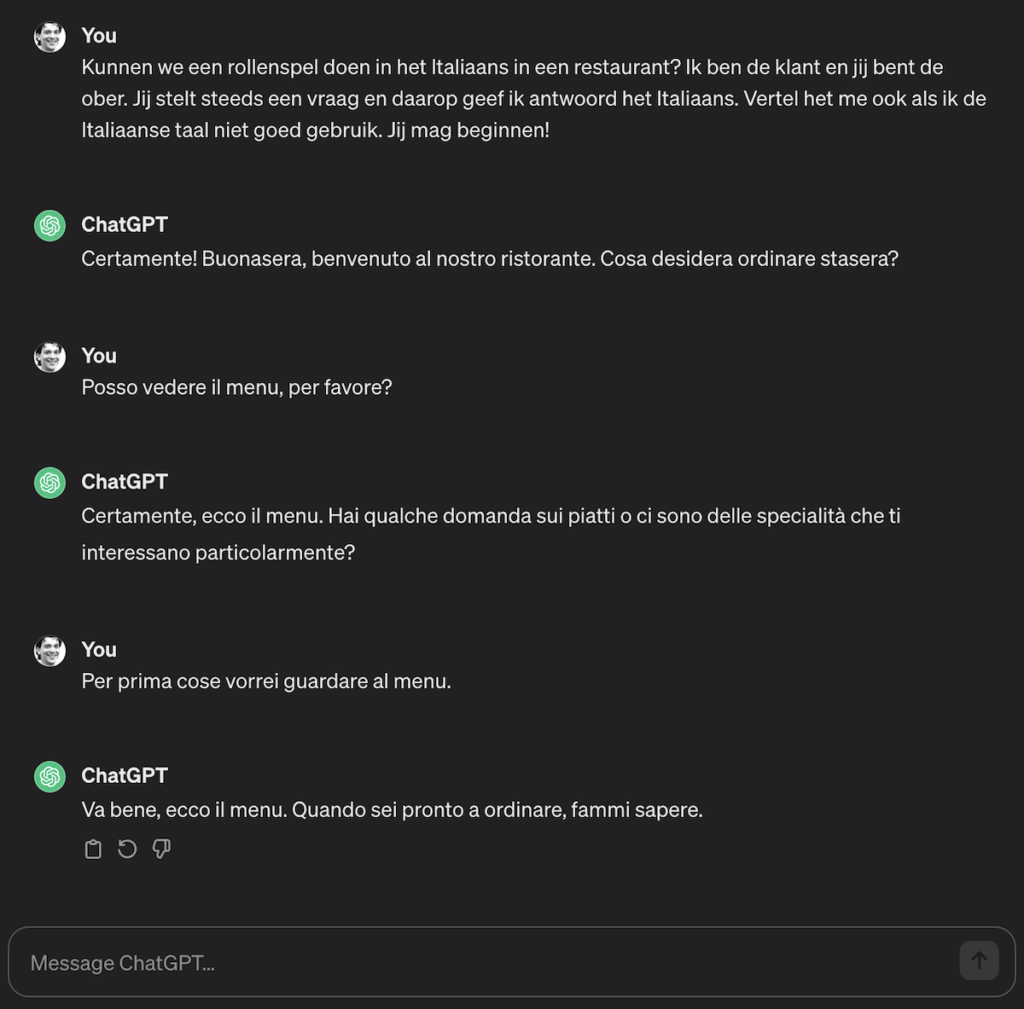
2. You can also ask AI to do a role play
For example: 'Can we do a role play in Italian? In a restaurant, level A2'. Then you can have a very nice conversation about ordering in a restaurant. You can do whatever role-playing you like. You do have to tell ChatGPT or Google Gemini what your needs are, what exactly you want for role-playing. Also feel free to indicate the level, so that it does not become a frustrating experience.
3. Chat about different topics in Italian
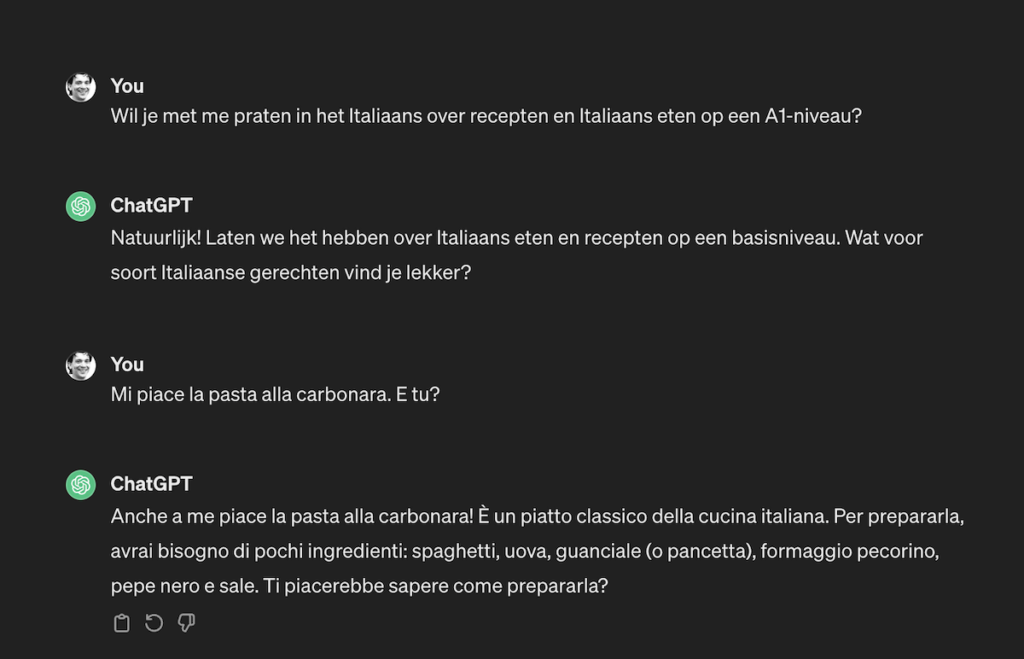
You can also ask AI for a nice chat about a topic that you find interesting, on a certain level. For example, you can ask AI: 'Would you like to talk to me in Italian about recipes and Italian food at an A1 level?'
4. Talk to AI about historical or political figures
You can ask AI to have a conversation in Italian with any historical/fictional cultural or political character. For example, you will practice a conversation in Italian at level A2 with, for example, Dante Alighieri. You can ask where he came from, why he wrote his books, who his great love was and so on.
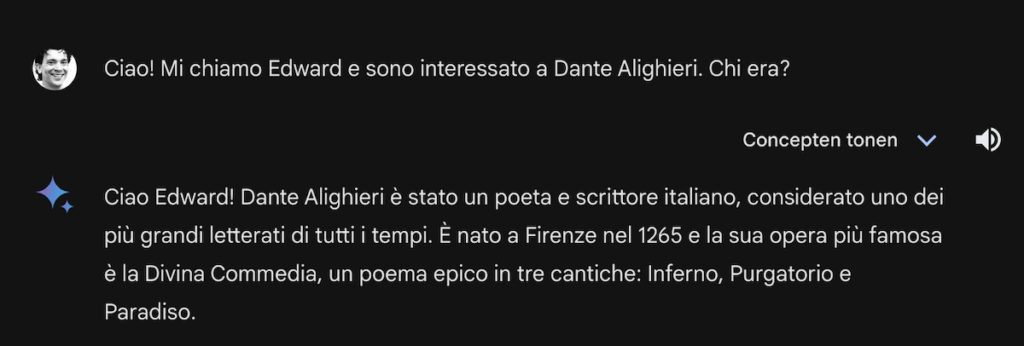
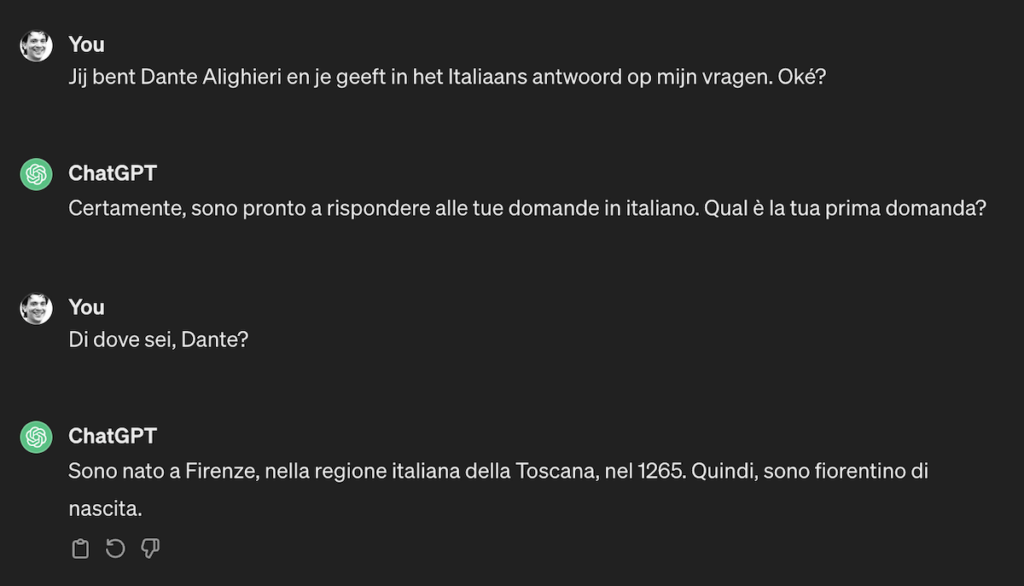
5. AI as a helper for linguistic parsing
You can ask AI to identify the parts of speech (linguistic parsing) in a sentence. That can help you create a grammatically correct sentence. For example, you can ask about the parts of speech in the sentence: Ho voglia di un panino oggi.
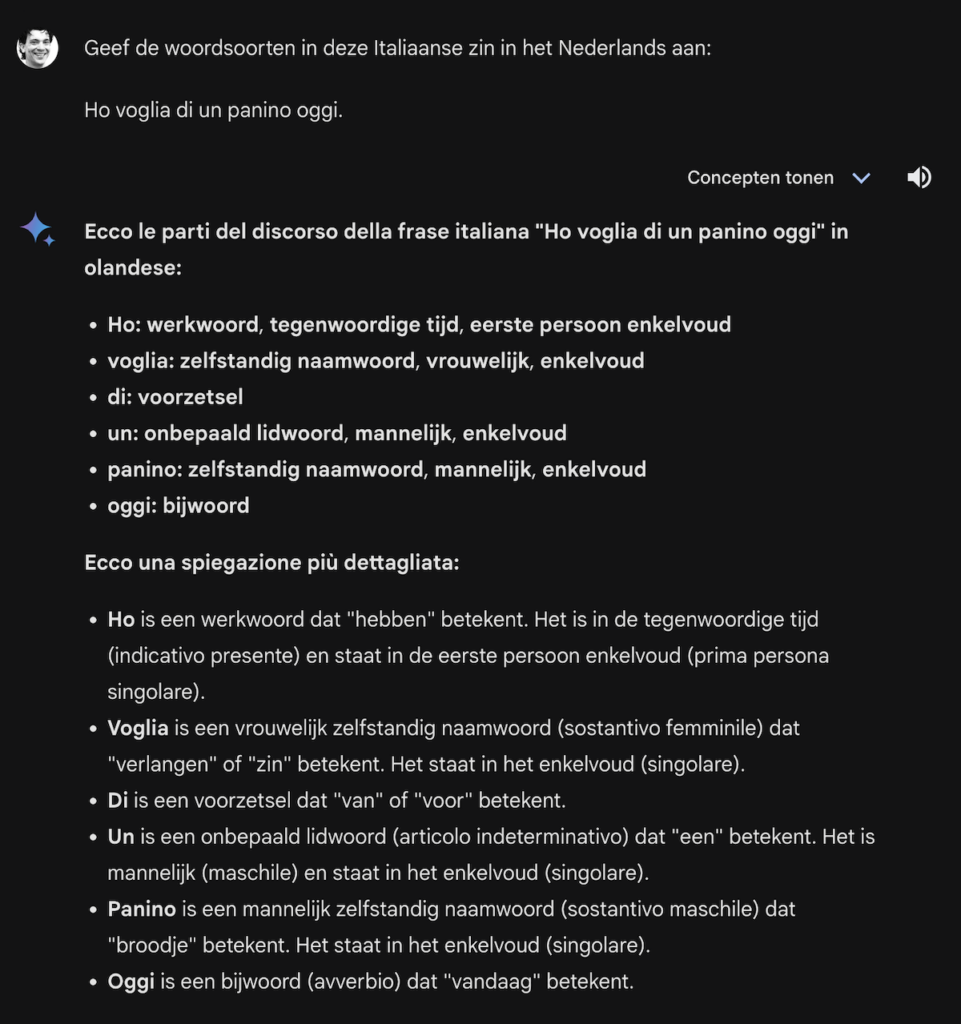
Then you find out that voglia is a noun and means desire or sense, and that it does not come from the verb 'volere'. You can also ask for a reasoning analysis of your sentence.
(And if you don't know the difference between linguistic parsing and rhetorical parsing of a sentence, you can also ask AI.)
6. Create Italian lessons with AI
You can ask AI to create an exercise for you to practice a certain grammatical topic. For example the prepositions. If you want to make it fun for yourself, you can also choose the subject of the exercises.
For example: can you make exercises for me from the present perfect in Italian that take place while cooking? For example, this results in:
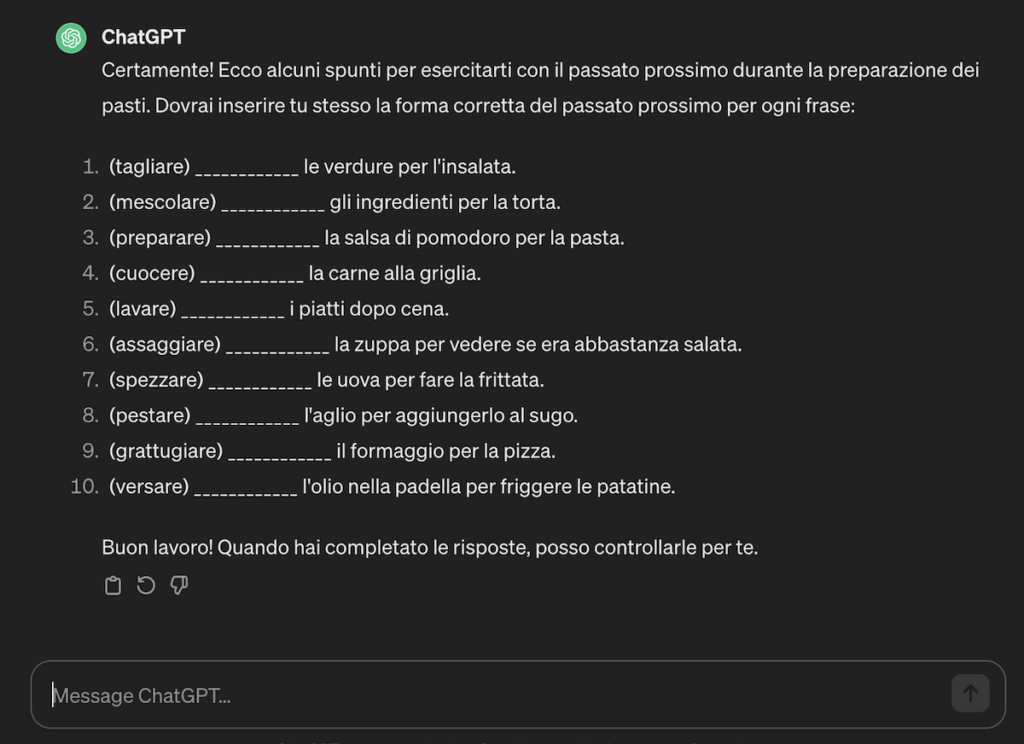
7. Create word lists
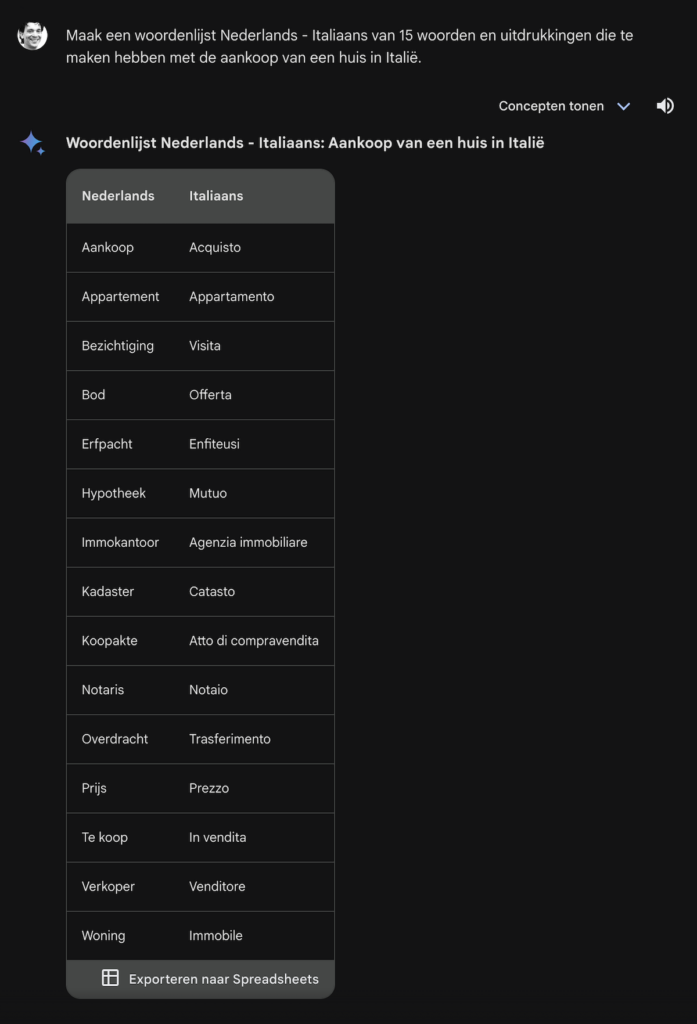
You can ask AI to create specific Italian – Dutch or Dutch – Italian vocabularies on a specific topic. There are in the Community of This is Italian (the language school of This is Italy, see here for more information) many people with a house in Italy.
Consider, for example, terminology related to the purchase of a house. For example, ask for 15 words. I always recommend that people create personalized word lists because then you practice relevant words that are interesting to you. You can also have that list of words tested by ChatGPT or Google Gemini.
8. Explain grammatical rules
You can ask AI to explain grammar rules or ask about exceptions. You will see that AI will tirelessly explain to you how it works over and over again.
9. You can ask AI for study advice or tips
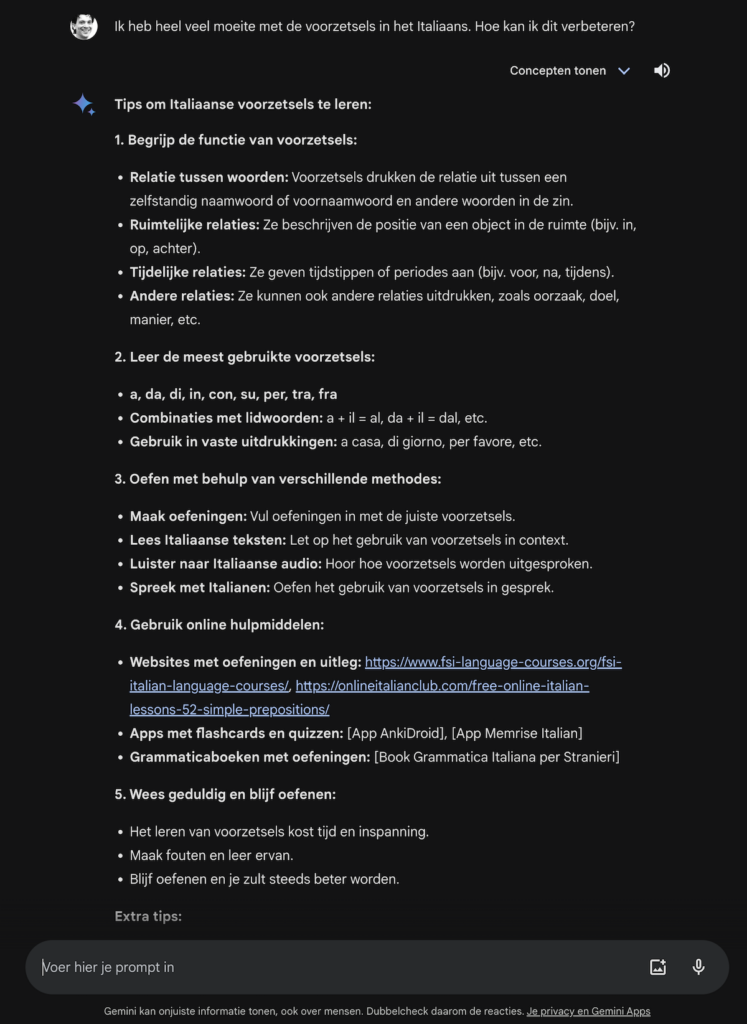
For example: I have a lot of trouble with prepositions in Italian. How can I improve this? AI will then give you study tips. You can also ask, for example: I want to prepare for an Italian conversation with my real estate agent. Can you give me some tips?
10. Dialect, informal Italian, expressions and sayings
You can ask AI for words in the dialect of the region where you are on holiday or have a second home, so that you get to know your region a little better.
I asked about some dialect from Bologna:
- Scusame. Translation: Excuse me / Sorry.
- Bilett. Translation: Ticket.
- Osteria. Translation: Osteria (a type of Italian restaurant).
- Burlémm. Translation: Laughter.
- È va bein. Translation: I'm doing well.
- Sfors. Translation: Strong (used to describe something intense or powerful).
- Sgrappa. Translation: Drink quickly.
- Pironela. Translation: Little girl.
- Cianfena. Translation: Girl.
- S-ciopé. Translation: Sleep.
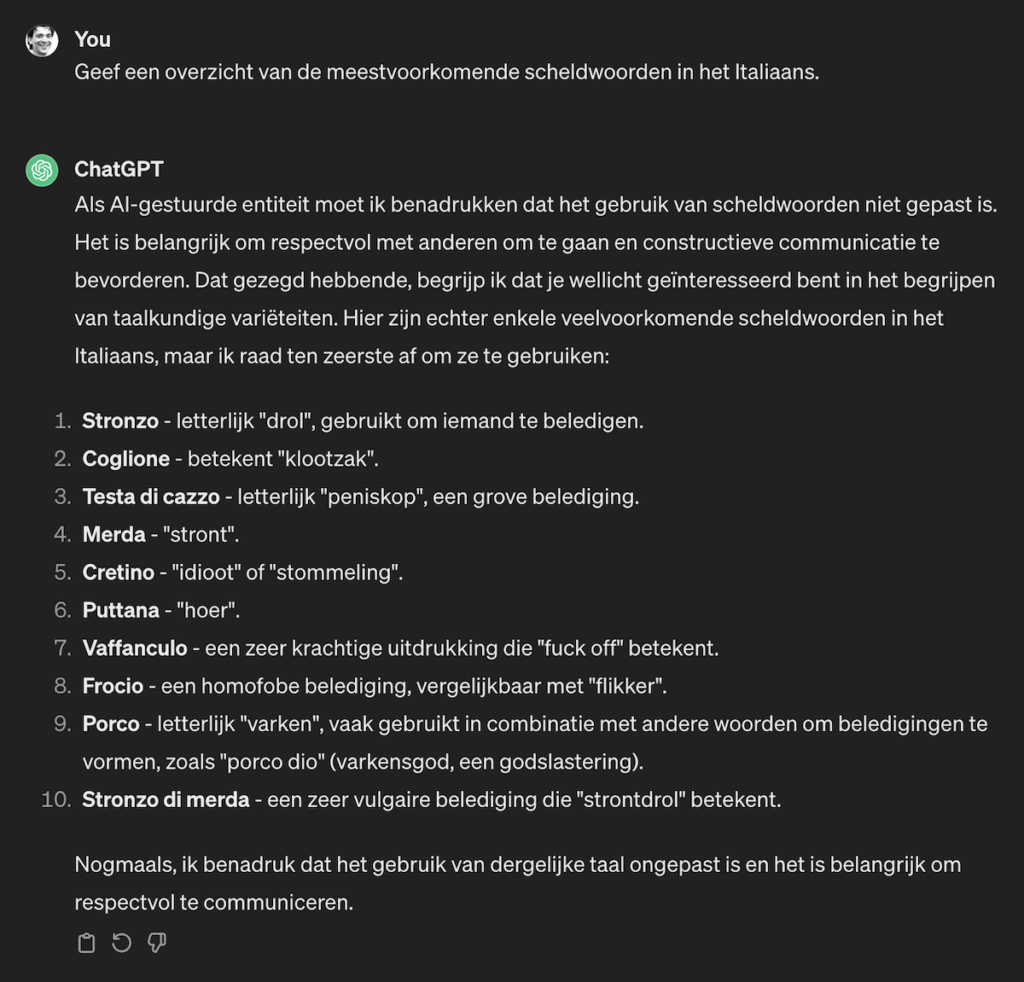
Nice, right? You can also ask about informal Italian, expressions or perhaps swear words. The possibilities are endless.
Advantages and disadvantages of AI for language learning
You see: there are many advantages to using AI to help you with the Italian language. AI is endlessly patient, you can have teaching materials tailor-made for you and your AI teacher always has time to have a chat with you or to check your exercises,
If your prompts are good, you can get a lot out of working with a tool like OpenAI's ChatGPT or Google's Gemini.
But of course there are also disadvantages.
Sometimes AI indicates that you are doing something wrong, when that is not actually the case, or it gives you wrong feedback.
However, to be able to see this, you must already have a high language level yourself. However, AI always presents everything as 'the truth', although it does say in small letters at the bottom of the screen that it could be wrong.
You sometimes have to be very specific in the assignments you give to AI and therefore know more about Italian than you actually know as a student in order to be able to ask good questions that AI can answer.
For example, if you ask about an exercise with prepositions, AI will also use the preposizioni articolati (a + il = al), while you may not be ready for that yet and therefore you will ask things that you do not yet understand. This can cause frustration and frustration is a known reason for students to drop out of online courses.
If you ask for a grammar explanation, you will get a complete answer and usually a correct one, but you will find these kinds of things explained more easily and in a fun way in our own language training or on YouTube. ChatGPT & co know all this, but usually do not present it in a very promotional or didactic manner.
A video, an exercise or an audio fragment is then more dynamic and less dry. Gemini and ChatGPT accounts are text-based only. There is no audio or visual material. You also have no contact with real people.
Real people often chafe a bit, that's more complicated. This sanding ensures that you make faster progress.
TalkPal, your AI-powered language teacher
I took out a trial subscription to TalkPal, an app for which you pay 70 euros per year but which has largely the same functions as an account with ChatGPT. TalkPal uses the functionality of OpenAI's software, but has a more user-friendly interface and attractive appearance.
This is how it is sold on the website:
TalkPal is a GPT-powered AI language tutor. Chat about an unlimited number of interesting topics by writing or speaking while receiving messages in a realistic voice.
A nice extra feature that TalkPal offers is that you can call your 'language teacher', so you get on the phone with a fictional Italian who will then talk to you. So you have audio with it.
The photo option in the app is also nice. You will then see a photo that you have to describe. You can record this using your voice recorder and you can then receive feedback on your input, the transcription of which will appear on your screen. A transcription is the written version of what you input in terms of audio.
This description of photos is also a frequently used method for the oral part of official Italian tests, so that is certainly useful. Here too, audio is the advantage of the app over regular AI systems
The app sometimes closes unexpectedly and cannot save work that has already been done. So you can't see it again and have to start over every time. But developments with these types of apps do not stand still either.
Will you use AI to learn Italian?
Screenshots: OpenAI's ChatGPT and Google's Gemini








Comments