

 Aart Heering

De spaghetti carbonara originated from the rations of American soldiers stationed in Rome in 1944. Their dried bacon and eggs were mixed with local pasta and oil, thus creating the foundation for the world's most popular pasta dish. This interpretation has been generally accepted in gastronomic circles until now, and I myself have experienced it in an earlier article on This is Italy also written.
Also because the term carbonara—more on that later—was only first documented in 1950. That whole story now needs to be rethought, after a pre-war source was found, no less, in a Dutch East Indies newspaper!
On January 3rd of this year, culinary journalist Janneke Vreugdenhil wrote an article about carbonara in the NRC, in which she also featured the "American" version. But shortly thereafter, she received an email from a reader, enclosing a copy of De Koerier, a Catholic newspaper published in Batavia, now Jakarta.
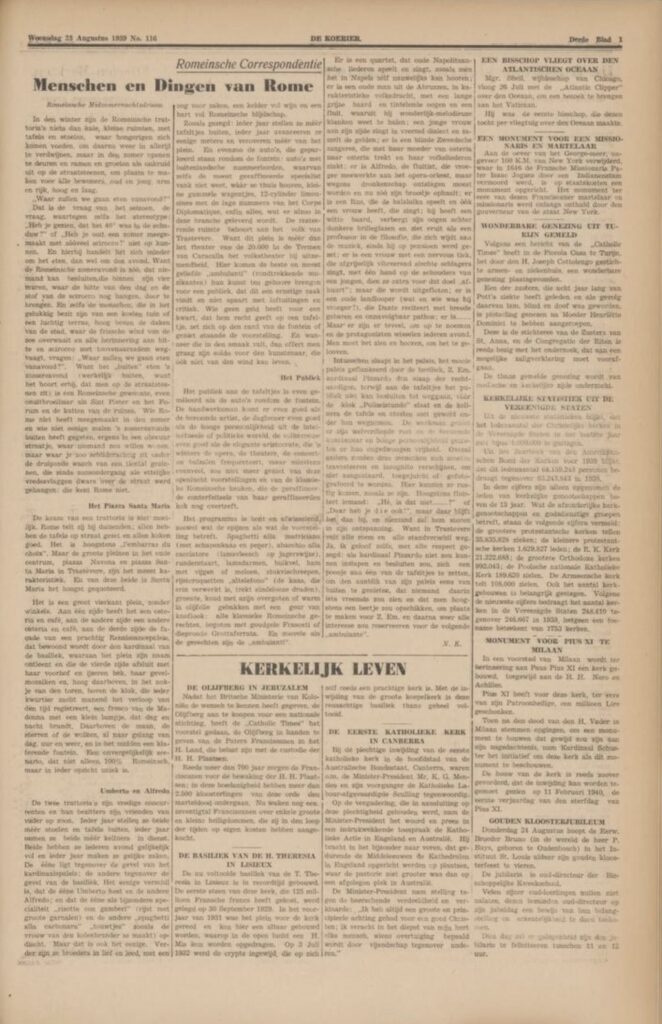
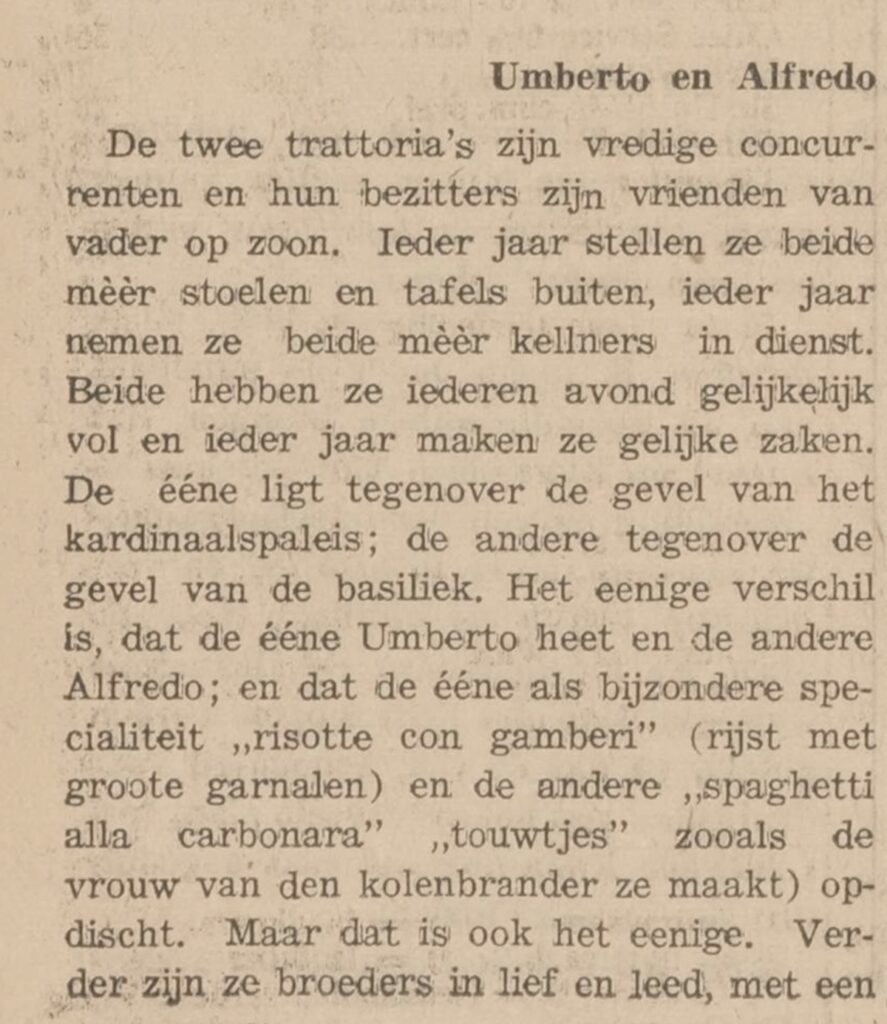
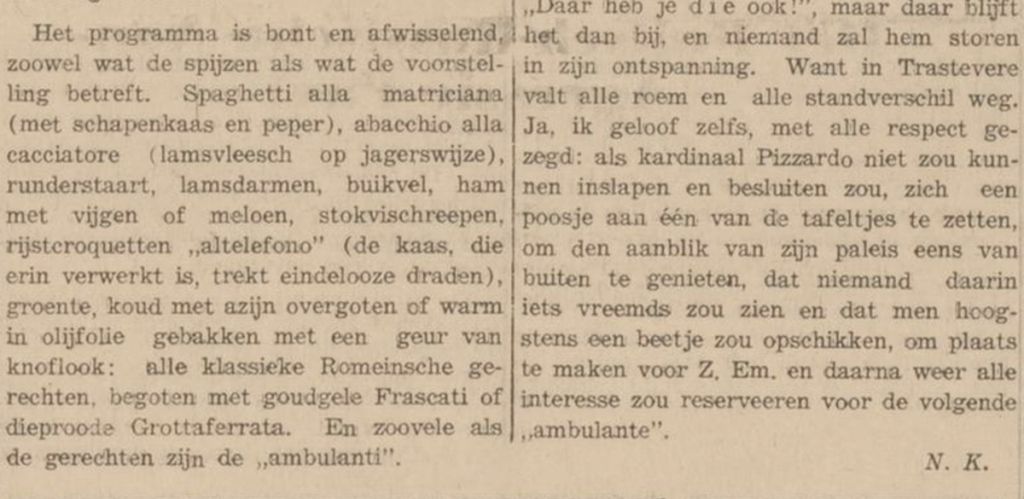
Under the title People and things of Rome A certain NK described an evening on Piazza Santa Maria in Trastevere, where two trattorias were doing a brisk business. One, Umberto, had shrimp risotto as his specialty, and the other, Alfredo, "spaghetti alla carbonara, 'strings' like the charcoal burner's wife makes them." This was on August 23, 1939, when there were certainly no Americans stationed in Rome yet.
'Everything must be revised'
This set back the history of carbonara by more than 10 years, rendering the rationing narrative obsolete. It was a first, Janneke wrote in a later article, and indeed it was, especially for Italy, where gastronomic history is a valued academic discipline.
"The appearance of a previously unknown historical source forces us to revise everything and formulate new hypotheses," wrote Luca Cesari, the hastily informed author of a standard work on carbonara, on February 4 in the monthly magazine Red shrimp, the bible of Italian gastronomy.
The 1939 article doesn't mention how carbonara was prepared at the time, but suggests that the term, used by a well-known restaurant, was already commonplace in Rome at the time. And that, in turn, leaves room for all sorts of speculation:
- Did carbonara originate much earlier?
- Is the story that it was the typical dish of the charcoal burners true after all?
- Or was it a fabrication by a cunning owner of trattoria Alfredo (which no longer exists)?
In short, there is still plenty of room for debate, also because not all Italians had come to terms with their American origins. The newspaper, for example, La Repubblica 2 years ago the recipe for a carbonara that originated in Umbria in 1931 was served, but was not yet called that.
Who was NK?
One question remained: who was this NK member who had written the report from Rome? To find out, I went searching in Rome at the request of fellow journalist Edwin Winkels, an old acquaintance of mine and Janneke's boyfriend.
I went on a quest in the Annual (Yearbooks) of the Associazione della Stampa Estera in Italia, the foreign press association. And sure enough, in the 1942 one, I found "Norah Koch Berkhuijsen" as a correspondent for De Koerier in Botavia (sic).
The 1942 membership list was the same as the 1939 one (with British and American names crossed out and Germans added), so she was already active as a journalist in Rome in 1939. From 1950 onwards, she appears again in the (unfortunately incomplete series) Yearbooks under her maiden name Norah Berkhuijsen, and according to the 1954 Yearbook, she had been a member since 1935.
Browsing through the digital archive revealed that Norah wrote the column "People and Things in Rome" for De Koerier in 1938-39. These articles, pointed and original observations from daily life in Rome and elsewhere in Italy, are still worth reading today.
Her first contribution in the series is a still-relevant description of the decay of Naples. After the war, she was registered as a correspondent for De Volkskrant, for which she worked from 1948-58.


Refuge for Dutch people in Rome
Thanks to the carbonara, I stumbled upon a famous predecessor as a Rome correspondent. Various archives revealed that Norah Berkhuijsen was born in 1907 in Penang, then Malacca (which might explain her colonial contacts).
In 1929, she married journalist Otto Paul Koch in Rotterdam, whom she had met in the editorial office of the Maasbode newspaper. The following year, the couple embarked on a world tour in a caravan, along with their friend, painter-sculptor Wim Nijs and his wife.
The plan was to cover the costs by writing short letters, but that backfired. Nijs soon returned to work in the Netherlands, and Norah stayed in Rome, divorcing Koch in 1938. (Not in Italy, of course, where divorce didn't become legal until 1974, but in Rotterdam.)
In the 1950s, her home on the central Corso Vittorio Emanuele was a beloved refuge for journalists, writers, and scholars visiting Rome. Upon her death in 1960, laudatory and moving obituaries of the woman who had guided her compatriots in Rome for years appeared not only in her own newspaper but in every major Dutch newspaper.
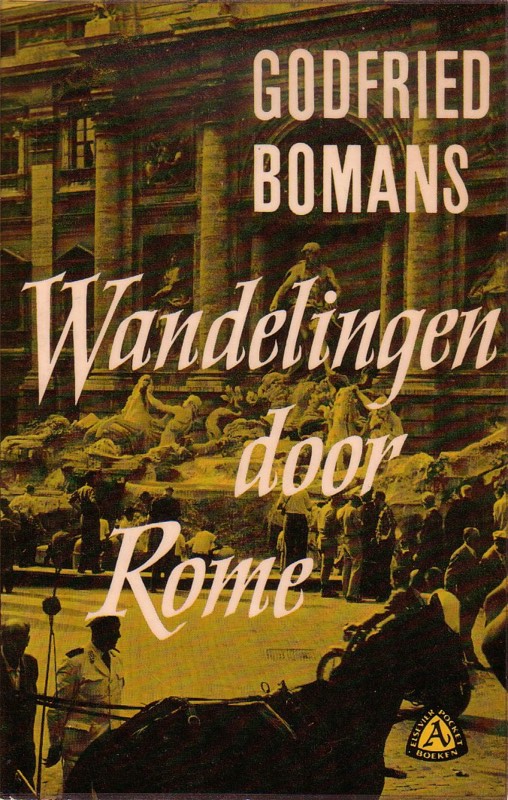
One of her contacts was the writer Godfrey Bomans, who lived in Rome for a year in 1953-54. In an episode of the Godfried Bomans Journal, titled "Rome I," Norah is featured extensively. This excerpt, which provides a glimpse into the (Catholic) Dutch intelligentsia in Rome during those years, is reproduced below.
What does 'alla carbonara' actually mean?
But first, back to the question of where carbonara gets its name. Norah (and others after her) translate the term as "as the charcoal burner's wife makes them," but that's incorrect. The word refers to the carbonari or carbonai (charcoal burners) as a profession.
The feminine form carbonara is not a noun in this case, but an adjective in the term "alla maniera carbonara" (charcoal-fired style), with the "maniera" omitted. This is done similarly with dishes like "fegato alla (maniera) veneziana" (Venetian-style liver) and "trippa alla romana" (Roman-style tripe).
And then there's also "pasta alla francescana," which can hardly be referring to pasta prepared by "the Franciscan's wife." What would be the correct translation then? "Charcoal burner pasta" or "charcoal burner spaghetti" doesn't seem right to me, so I'd leave it untranslated.
Norah Berkhuijsen and Godfried Bomans
Once a week, the Dutch journalists based in Rome gathered in a trattoria for a good meal and a glass of wine. They were Norah Berkhuijsen of de Volkskrant, Jan Schiphorst van From Tijd, Jan Dijkgraaf van The Maasbode, Frits Visser and Adriaan Luijdjens from the General trade magazine and Bomans for Elseviers WeeklyThey were joined by poets and writers: Felix Rutten, Bertus Aafjes, Anton van Duinkerken, Jan Engelman, Jacques Bloem and others.
On one of those evenings something remarkable happened which Norah Berkhuijsen wrote about de Volkskrant of October 19, 1953. It is reproduced here in its entirety:
An event took place in Rome's Piazza Navona that will long give the Romans living there food for thought. A large crowd gathered around the central fountain, exuberantly expressing their delight with repeated cries of "Viva l'Olanda!" What was there to see? There, in the cool of midnight, swam Pa Pinkelman's father, stately and fully dressed, his bespectacled head gently above the water's surface, a mischievous twinkle in his writer's eye.
Godfried Bomans circled the giant pool three times, each time with a different stroke, and then, with a swirling leg movement that sent the water flying, he performed a backstroke that did his country proud. What did this mean? Nothing? A whim of nature, a quirk of the human heart, or an outburst of universal joie de vivre?
No. It was more than that. Here's the story. Prof. Dr. L. Schlichting, a professor in Nijmegen; Felix Rutten, the indestructible Roman from Limburg; and Godfried Bomans, an equally indestructible Roman from Haarlem, were sitting with the VOLKSKRANT correspondent drinking wine at the edge of this fountain when the conversation took a philosophical turn. It was claimed that everything that happened happened according to plan, that chance was excluded, and that once convinced of this, nothing was surprising anymore.
Bomans disappeared unnoticed, and lo and behold, a moment later he swam past the stunned diners, smiling, as if to contradict their words. The neighbors who had rushed over from all sides, unaware of the deeper meaning of the event, considered it a joke. But we, his friends, grasped the underlying meaning and rejoiced in the meaningful spectacle and the generosity with which Bomans reinforced his arguments.
That generosity proved to be considerably greater than initially suspected. When Bomans emerged from the water, his keys, wallet, passport, and other papers were gone. It was impossible to distinguish these items at the bottom of the bubbling, gushing water.
Only through the intervention of a local waterworks employee, who turned off the water supply, did all these possessions become visible, lying peacefully in the crystal-clear depths. They were dragged to the fountain's edge with a rake. The bystanders retreated thoughtfully, contemplating that distant watery land and its energetic inhabitants.
A fully clothed man swimming in a fountain—yes, that must have appealed to the Romans present, especially considering that swimming in the fountain's pools was strictly forbidden. With his graphic proof that coincidences exist, Bomans was far ahead of Anita Ekberg, the movie star and sex bomb who appeared in the film. The Dolce Vita (1960) Fellini waded through the Trevi Fountain.
Norah Berkhuijsen, the writer of the night swim, was Rome correspondent of de Volkskrant. Therefore, Bomans no longer needed to write for that newspaper, to which he had been affiliated since 1945. Berkhuijsen had lived in Rome for 20 years, spoke the language, and was an expert on the country and its inhabitants.
Many Dutch writers and artists visited her when they were in Rome. Her door was open to everyone, including Bomans. They became friends. This would remain so until her death in 1960. Fred Berendse further wrote: "Together with her, Godfried took many evening 'archaeological' walks, as they themselves called their journeys through Rome."








Comments