


 Aart Heering
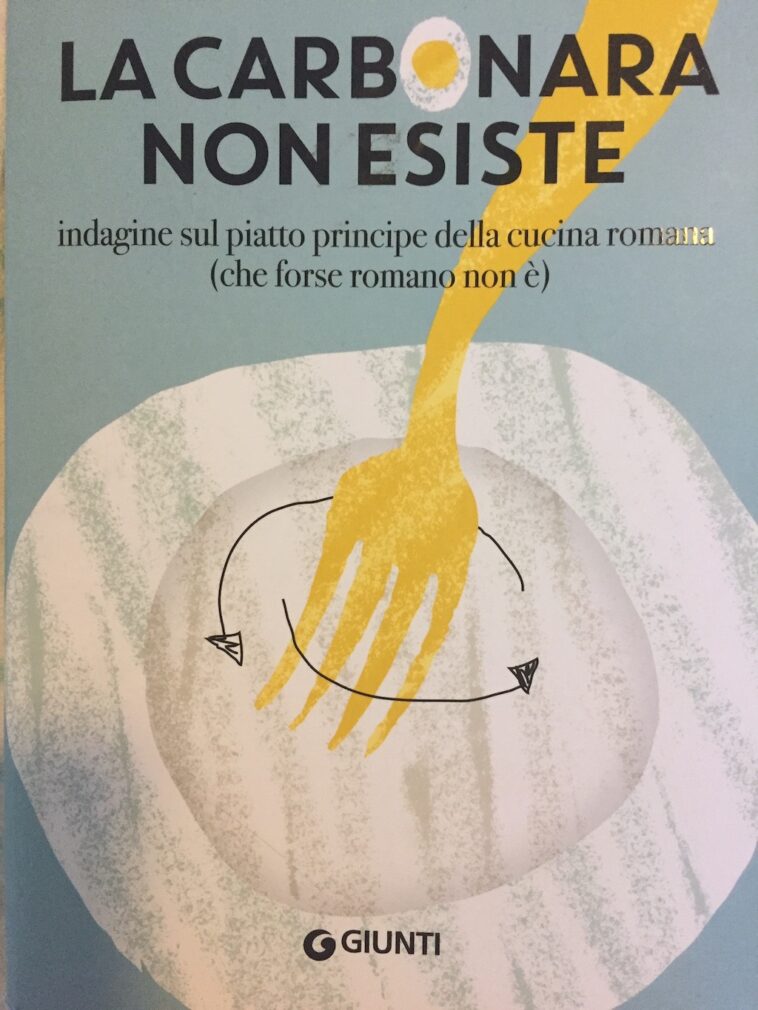
La carbonara non esiste. The carbonara does not exist. As an amateur gastronome you cannot pass up a book with such a title, especially when it comes to the most popular dish in Roman times. trattoria.
When it came out last month, I immediately bought it and learned a lot from it. But the only true and original recipe of the spaghetti carbonara I have not found it, because indeed it does not exist, as author Alessandro Trocino, journalist and restorer, argues with reasons.

Table of contents
1. Where does the carbonara come from?
His book immediately dispels a classic origin myth of the carbonara. The name of the dish is said to have been taken from that of the carbonai, poor charcoal burners who in previous centuries practiced their profession in mountainous regions of central and southern Italy.
These hard-working toilers could use a simple yet nutritious meal, carrying in their knapsack the scarce resources they could afford: pasta, cheese, bacon, some pepper, and eggs. History does not state how the latter survived the journey, but as it is called in good Italian, se non è vero, è ben trovato.
There are even more fantastic stories in circulation. In one of these, the origin of the carbonara is traced back to the Carbonari, revolutionary conspirators of the early 19e century, and in Sardinia they even tried to make a connection with the city of Carbonia, which was only founded in the 30s.
Nice stories, then, but in the classic handbooks of Italian cuisine, Science in the kitchen by Pellegrino Artusi (1891) and Ada Boni's Il piccolo talismano della congratulations (1950) the carbonara does not yet occur. The first 'official' mention in Italy only dates back to 1954, when culinary magazine The Italian kitchen published a recipe that bears little resemblance to today's carbonara, with ingredients such as garlic and gruyere, the northern Italian variant of the Swiss fondue cheese Gruyere.
That was not a real first, by the way, because two years earlier a newspaper in Chicago had already reported a 'pasta carbonara' that was reserved in a local Italian restaurant. The American connection is not coincidental either: the experts now believe that the ancestor of today's carbonara originated in 1944-45 in Rome or Naples from a mixture of local pasta with dried eggs and bacon from the rations of American soldiers. .
2. What goes in the carbonara?
Since then, hundreds of professional and amateur chefs have devised variations with sometimes ingenious and sometimes bizarre additions to the original ingredients bacon, cheese, egg and pepper. For the purists, any innovation is out of the question, and when TV chef Carlo Cracco presented a carbonara with onion a few years ago, there was a storm of protest in the country.
More liberal minds won't immediately be enraged at extras like garlic or parsley. Whether or not the dish can still be called carbonara doesn't really matter that much. But there are limits. I wouldn't recommend a recipe with chopped clams (really!) to anyone and the addition of cream, something restaurants are sometimes guilty of to make pasta easy. creamy (creamy) is not necessary: it is better to use some cooking water if necessary.
The height of culinary horror reached a French cooking site three years ago with a video in which pasta, bacon and onion are cooked at the same time, then grated cheese is added and finally a raw egg yolk on the plate.
In Italy there was a mocking laugh at the French cuisine and pasta giant Barilla was forced to issue an ironic press release:
'Mon Dieu! We are open to all creative interpretations of the mythical carbonara, but this one really goes too far. Desole!'
3. How not to make a carbonara?
At first glance, it is an easy dish. While you're bringing the pasta to the boil, beat a few eggs in a bowl with a pack of grated cheese and some pepper and fry your bacon bits in the hot oil. Pasta in the bowl, stir, pour bacon and oil over it, stir again and you're done! There is a risk that you will end up with pasta with omelette, but a moochie who pays attention to that.
Well, if you come home hungry late and don't have the time or inclination to actually cook, here's what you can do. But if a trattoria offers you something like that (and sometimes it does!), it's unforgivable and the owner deserves summary execution on TripAdvisor.
A good carbonara is indeed not very difficult to make, but you do have to take the time and the right ingredients. And that requires difficult and well-thought-out choices.
4. Parmesan or pecorino

For starters: which cheese do you use? In Rome they prefer the sharp sheep cheese pecorino romano and beyond usually to the much milder parmesan.
A happy medium is a mix of two-thirds pecorino and one-third parmesan, which you can increase the proportion of as the bacon is saltier. (Only pecorino for cheek bacon, part parmesan for pork belly.) Grate yourself, of course.
5. Egg or yolk
There are also several schools here. Some cooks swear by the yolk alone, while others say the white should also be added to make the sauce less heavy.
That is also possible, as long as you make sure that she does not come to the boil. A rule of thumb can be one yolk per person plus one or two complete eggs. And don't take it out of the fridge at the last minute.
6. Pancetta or guanciale
Originally, the carbonara was mainly prepared with bacon (streaky bacon), but over the years pillow (cheek bacon) has become increasingly popular. And rightly so, because this soft, thinly sliced bacon guarantees a smooth, tasty sauce and makes other ingredients superfluous.
The fat content (70%) is higher than that of other types of bacon (about 40%), so that it can be gradually crispy without any additions over a low heat. That takes longer than with pork belly and oil, but it's worth it.

A whole pillow, with its typical triangular shape of the pig's snout, is a souvenir from Italy that you can enjoy for weeks at home. Make sure that both belly and cheek bacon have matured sufficiently, i.e. at least three months.
7. Oil or Butter
Neither, if you pillow used. And with other bacon is a lump lard (lard) not to be sneezed at.
8. Pepper
Black pepper, from the mortar, not too finely ground. Save the chili for the amatriciana.
9. Long or Short Pasta
Does not matter. Spaghetti, bucatini, tonnarelli or else rigatoni of penne, everything is possible, provided and cook until pasta is (except of course with the fresh ones tonnarelli), where the short pasta is useful when there are many commensals on the table.
10. Pan, bowl, frying pan
This is classic: in a large bowl, mix the egg, cheese and pepper, put the cooked and drained pasta over it, stir and finish with the fried bacon in their hot fat.
But it can also be done the other way around: first the pasta and then the sauce, which is distributed more evenly thanks to gravity. Otherwise you will often be left with a large amount of sauce on the bottom, which in itself is not a bad thing if it is your turn last. (You can also return to the pan, as long as the flame is extinguished.)
Professional chefs do it even better. They remove the bacon from the frying pan, add water to the hot fat and deposit the half-raw pasta in it. This is then cooked while tossing, so that a cream forms due to the gluten in the pasta, to which the mixture of yolks, cheese and the sauce is then added, resulting in a nice lobed sauce.
Meanwhile, the bacon is very finely sliced and shredded through the pasta. Very tasty, but with more than two or three servings you have to have a very large frying pan.
11. The dosage
One take… Yes, how much actually? Here too, opinions differ and it is difficult to formulate precise regulations. My advice: be a little more gushing than most recipes, especially with yolks and bacon.
You can always add cheese and pepper if you wish. In the worst case, some sauce will remain in the bowl, but experience shows that this is usually not the case.

Wine tip with pasta carbonara
As far as I'm concerned, nothing beats the Lagrein, the fresh red wine from Bolzano, with the carbonara. But a Chianti or Barbera is of course also possible.
How to make a good pasta carbonara on video:
La carbonara non esiste (Italian speaking)
by: Alessandro Trocino
160 pages
€9,99 (in NL only available as an e-book)
Giunti Editori Firenze, September 2019
ISBN 9788809894327








Comments