


 Steve Smulders
Here you go, 5 more useful words and expressions in Italian, which sometimes mean something different than what you would think. A meaning that is useful to know. I wrote earlier this series en this sequel of 5 other everyday words.
1. Peak

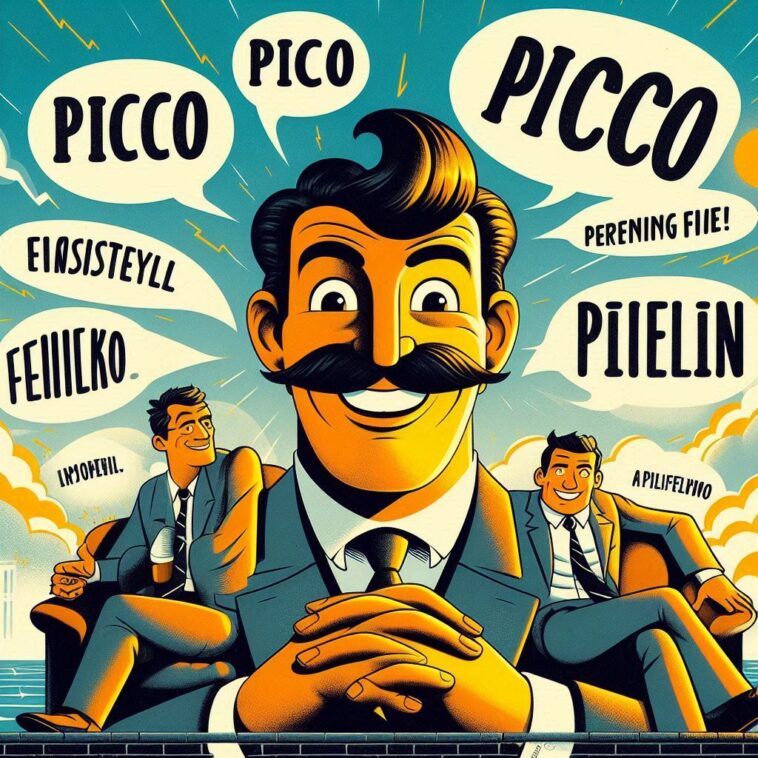
Pico bello say the Dutch and Germans when they want to express that something is perfectly fine. It sounds cheerful Italian but it is not: it is probably a pseudo-translation of piekfijn.
The Italian language does have the word peak for top, peak, but with a double c. Still, it is better not to invest your money at a time when the stock markets a picco have gone because the expression andre a picco means to go under, to fall. So there is no boom but rather a crash.
Strange, you might say, the exact opposite of what peak means. But the expression a picco is used to indicate a state (or a movement) that goes vertically from top to bottom: a house in a nice place, a house on top of a cliff by the sea, a car in a car, a steep flight. The stock market is therefore making a steep flight from top to bottom, a picco.
2. Hello, hello

Create a salami is a salume but one salume not necessarily a salami. With the term salume (derived from salt, salt) refers to sliced pork-based food products that may be salted, seasoned, and matured, as well as ground and encased. The term is also commonly used to refer to any type of meat product, such as bresaola, which is made from beef.
Create a salami is however specifically and only a sausage made of meat, usually pork, ground and in a casing (intestine or synthetic). The slices of a salami are back again cold cuts.
A sausage is a sausage (mainly pork) and then you also have a salami, a sausage made from only pork belly and pork shoulder. Not to be confused with salmonella, the bacteria that makes you sick if you salami of sausage did not heat sufficiently when preparing.
3. Meta, meta

The stress can make a big difference in the meaning of Italian words, as in the case of casino (brothel) and casino (gambling hall). Also the meaning of the words meta en half is very different.
When a coach shouts at his running athlete on the cinder track that he or she in half is, then he runs on sighing. But the coach calls out that he/she a meta is, then the athlete raises both arms in the air and immediately stops.
Meta, without accent but with the stress on the first syllable means finish, end point. Half, with accent and stress on the second, last, syllable means half ('you are halfway'). So watch out!
Half also means half, but is a regular adjective and therefore changes depending on the noun it describes.
Finally, to confuse things a little more, the adjective mezzo (only in the masculine form) used as a noun with the meaning of middle: for example. 'Attento! C'e' un cane in mezzo alla strada!'
4. Fiasco

Create a fiasco is a basket bottle for wine that – wrapped in straw – was developed in the late Middle Ages as protection against breakage when packing large quantities of bottles. It was mainly known in the second half of the 20th century for the somewhat simpler type of wine Chianti.
Internationally, the Italian word fiasco has the meaning of flop, failure or bummer. And in Italian too, the word fiasco, used in the theatre world, exists fare fiasco: to produce a failure.
The origin of the word may go back to the 17th century street comedian Domenico Biancolelli, a comedian from Florence. He always performed as Arlequino where he improvised with all kinds of objects that he found on the spot.
One evening he would find a bottle of wine, fiasco, as a subject which turned out to be a failure. In anger he then smashed the bottle in anger. Others say the expression comes from the bottle blowers themselves, if what they blew was a failure, they called the result a fiasco, because the failure usually resembled a simple bottle.
5. A poltrona

Create a armchair is officially an armchair, which is also popularly called a lazy chair. In Italian there is also that association because a lazy person is often indicated with a armchair. I therefore suspect that the armchair a person's favorite piece of furniture bear is.
Apparently a armchair still worth pursuing because if someone wants to get a certain job, then they say here that he is looking for a armchair, what we would call a seat. Probably to earn a nice salary doing nothing, you hear silently sounding behind it.
I myself prefer to lie on a (sofa) because that gives my troubled back more rest. So I would then choose a sofa are? But I am (usually) not lazy because I also type these texts lying down. You could say that I earn my money horizontally, if that did not evoke associations with a casino.







Comments