

 Aart Heering
The Colosseum is once again the most photographed monument in Italy, and perhaps the world. If you click on the hashtags #Colosseum or #Colosseo on Instagram, you will get 1,5 and 1,3 million photos respectively, together 2,8 million. (In second place is the Trevi Fountain with 2 and 710 thousand for Italian and English respectively, followed by Trastevere, Piazza di Spagna and Piazza Navona.)
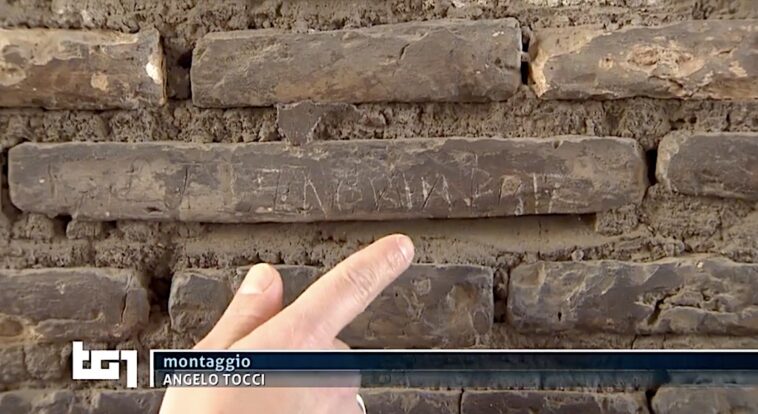
That popularity also has its drawbacks. For example, in the last week of April, the Colosseum was the victim of three barbarians who carved their names into millennia-old travertine. What is striking is that the perpetrators often do not even realize that they are damaging world cultural heritage.
Lack of civilization
For example, a young Hungarian caught red-handed argued that he should leave his name on the monument, because there are so many names on it anyway. He probably didn't realize that this concerns ancient graffiti. Mass tourism also attracts people who act out of 'a mixture of fetishism, stupidity and lack of elemental civilization', as the Roman daily The messenger it aptly expressed.
The city council has now decided to do something about it. As part of an 'anti-vandal plan', the security of the Colosseum has been doubled. In total, almost 50 people are now keeping an eye on things. In addition to the 15 uniformed attendants and guards employed by the Ministry of Culture, there are also 32 private security guards in plain clothes who can catch the vandals before they cause major damage.
Speakers have also been installed at the entrance to convey the message that 'Anyone caught scratching, defaced or soiling the Colosseum will be charged with damage to the cultural heritage'. Now this was previously also read on warning signs for the Colosseum, but experience has shown that hardly anyone reads it.
Small chance of punishment
Incidentally, the sanction for misconduct is still relatively light. The scratching tourist is arrested and taken to the barracks of the police. An official report will be drawn up there, after which he/she will be released again. A prison sentence or (more likely) a fine will only follow a few months later, when he is back home again. The chance that he will actually pay the fine is small, unless he returns to Italy and has to hand over his passport somewhere. But the arrest itself and the hassle and pitying looks around it are of course also a punishment.
In addition, Mayor Virigina Raggi has announced an official letter to a number of embassies, asking them to help prevent "barbarians' leave their country and go to Rome. That letter will be accompanied by a list of ringleaders who have already been convicted in Rome and the aim is to establish a general blacklist of foreigners unwanted in Rome.
The embassies that are addressed are according to the Messenger Spain, France, the US, Great Britain, Hungary and of course the Netherlands, because the destruction that Feyenoord supporters 4 years ago they are far from forgotten in the Italian capital.
Such a request does not have much practical value, however: you cannot actually prevent citizens from traveling within Europe. But it did lead to publicity and attention for the problem in several European countries, and that was of course the intention.
The Municipality of Rome has also drawn up a list of 250 public ponds and fountains, which will be monitored regularly. Bathing, drinking, sunbathing, throwing litter and watering dogs can be punished with a fine of 450 euros.
Generals appointed
To ensure that these and other strict guidelines are actually respected, five generals from the Italian army have been seconded to the municipality of Rome to bring order to the urban bureaucracy, the public gardens and the municipal police.
The local union of government workers has already objected to this 'militarization', but given the sorry state of Rome - waste crisis, holes in the roads, neglect of public green spaces, etc. - a little military discipline can't hurt.








Comments