

 Aart Heering

It doesn't want to be summer in Italy just yet. The traditionally beautiful Italian month of May has so far been characterized by low temperatures, dark clouds, violent showers, strong winds and even flooding here and there.
Nevertheless, the beach season has officially started on May 1 and everyone is counting on it before the end of the month the beautiful season with her sun-drenched summer sweetness will really start.

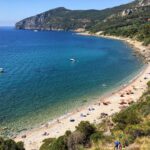
In the run-up to this, as every year, an overview has been published of the quality of the Italian beaches. Italy has no less than 7.500 kilometers of coastline, 5.000 of which are considered to be swimming, or suitable for sunbathing and bathing.
But that is not always pleasant everywhere. That is why annual checks are carried out on beaches in mainly Europe by the Foundation for Environmental Education (FEE), a Danish non-governmental organisation, in collaboration with the Italian Ministries of Environment and Health.

The criteria for the cleanest beach
The main criterion is of course the quality of the coastal water, but factors such as the cleanliness of the beaches themselves, infrastructures, treatment plants, waste, information provision and service for tourists are also taken into account.
All this is indexed according to a points system and the beaches that score sufficiently are marked on the map with a blue flag. This Blue Flag is generally accepted as a reliable indicator and is also readily recommended by the relevant operators.

These are the cleanest beaches in Italy
In 2019, a total of 385 beaches in 183 municipalities received a blue flag. (The full list can be found here:
The cleanest beaches in Italy 2019 (pdf, 2 MB)

Or search on an interactive map for all the Blue Flag beaches in Italy.
That is a few more than in 2018, when 368 beaches in 175 municipalities were awarded. As a result, a steadily increasing trend of better and cleaner coasts continues for years.
The Riviera of Flowers leads the way
The frontrunner is Liguria (Liguria) with 30 municipalities (3 more than last year) and a total of 64 beaches. almost the whole Riviera of Flowers can thus cope with a Blue Flag adorn.

This is followed by Tuscany with 19 municipalities, including in the beautiful coasts of Maremma and Argentario. Then Campania with 18: Sorrento, Capri, Positano, you name it. Then the Adriatic coast of The Marches (15), the vast coastline of Sardinia with 14 and Apulia with 13.
Gap between North and South
What is striking on the list is that the gap between North and South is again life-sized here. Sicily is represented with only 7 municipalities and 17 beaches – including the islands of Stromboli and Vulcano and the beautiful, partly unspoilt beach of Menfi – on a total coastline of 1.673 kilometers, of which 923 km swimming.
If you compare that with the figures of Liguria, which has only 350 kilometers of beach and 280 swimmingThen that's really no comparison. Calabria with 11 locations on 800 km of coastline and Apulia with 13 out of 860 also score much lower than its northern counterparts.
The result of Lazio – 9 on 360 km of coast – is nothing to write home about either. The clean beaches here are all in the south of the region – Sabaudia, San Felice Circeo, Sperlonga, Gaeta and this year for the first time also Anzio – but the more northerly seaside resorts of the Romans – Santa Marinella, Santa Severa, Ostia – are sufficient. none of the conditions for the Blue Flag.

Here too we encounter the southern question, the age-old problem of the economically backward south with its inadequate infrastructure, non-functioning or poorly functioning sewage treatment plants and ramshacklely organized tourism sector. (With the obvious exception of the Salento in Apulia, where a professional luxury tourism has developed in a short time.)

On the other hand, this also has interesting aspects. I can imagine that more adventurous tourists would prefer irregular Sicily and Calabria to the neatly arranged sun loungers and parasols that have cluttered the Ligurian and Adriatic coasts.
The cleanest lakes
In addition to the sea beaches, the FEE also has the Italian Lakes monitored, with striking results. Out of a total of 17 Bandiera Blumunicipalities with freshwater beaches, three are on the Lake Maggiore, only one at the Lake Garda (Gardone Riviera) and none on Lake Como. Let's hope that isn't indicative of the water quality in the large Alpine lakes.
Further south we find a blue flag for the More from Bracciano near Rome and an interesting one new entry, the Lago di Scanno, a little gem in the mountains of Abruzzo (and one of our travel tips in 2017).

Finally, Trentino gets no less than 10 blue flags. These are municipalities on three small lakes, that of Caldonazzo, Levico and Serraia. That's good for the Trentini, but I get the impression that it makes their province overrepresented. But their tourism industry also works like a well-oiled machine.








Comments