

 Aart Heering
When you say Tarquinia, you think of the Etruscans. Rightly so, because the city was, together with Cerveteri, the most important political and cultural centre of this people who ruled central Italy for the Romans.
The last three kings of Rome, who ruled in the 3th century BC – Tarquinius Priscus, Servius Tullius and Tarquinius Superbus – came from Tarquinia. Two centuries later the tables were turned and it was Rome that subdued the Etruscans.
As an insignificant sidecar of its big neighbour, Tarquinia fell into oblivion, only to make a comeback in the later Middle Ages under the name Corneto, which has been called Tarquinia again since 1922. (See the box below.)

Modern-day Tarquinia is a sleepy town of 15.000 in the northern corner of the Lazio region, but its 3.000-year history and rural tranquility make it a popular day trip destination.
For the modern Romans – you can get there in an hour by car or train – and holidaymakers from Tuscany and the nearby beaches of the Tyrrhenian Sea. Here are 7 reasons to visit Tarquinia.
Tarquinia and Corneto
The inhabitants of Tarquinia are known as Cornetani. This name dates back to the Middle Ages, when the memory of ancient Tarquinia was lost and the new city was called Cornetum (later Corneto). After historians and archaeologists had rediscovered ancient Tarquinia, mayors were quick to restore this famous name. Thus, Corneto was renamed Tarquinia in 1922. But the citizens have kept their original name.

1. The Etruscan Tombs of Monterozzi
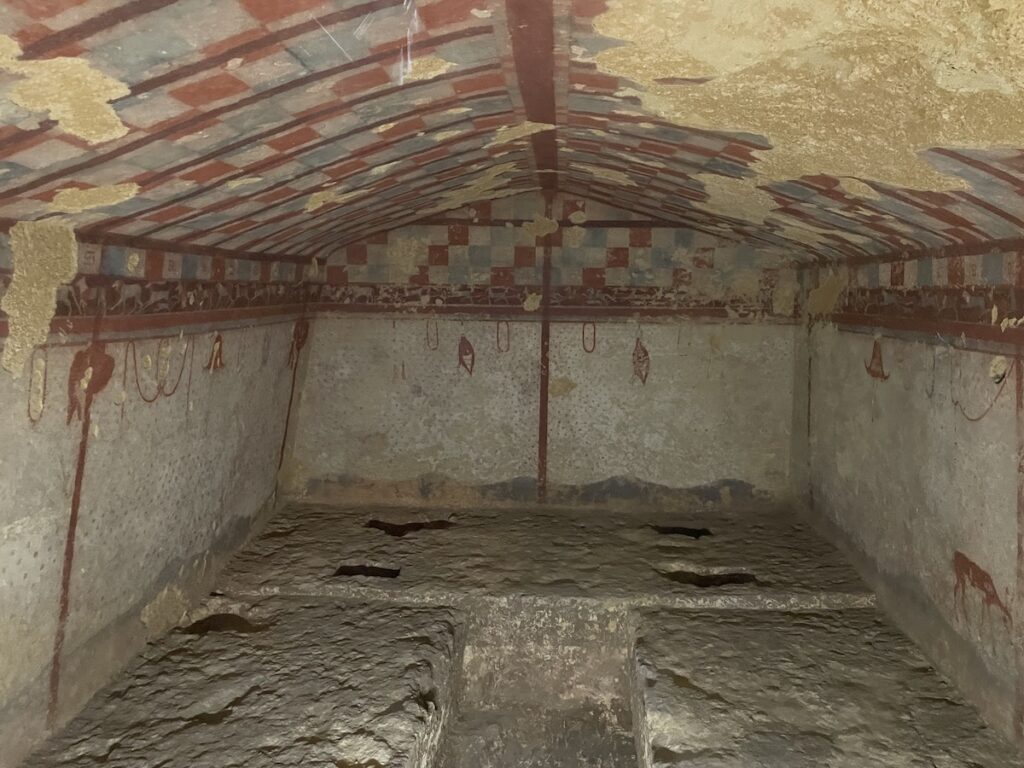
Just outside the city centre lies the necropolis (city of the dead) of Monterozzi, which has been a UNESCO World Heritage Site since 2004. The name refers to the burial mounds that rise above a grassy plain stretching for many hectares, where 6.000 Etruscan tombs have been found. 200 underground burial chambers are enriched with magnificent wall paintings, which are now the main attraction of Tarquinia.
At the entrance to the complex are the oldest graves: mushroom-like solid stone urns with matching lids from the 9th and 10th centuries BC. The burial chambers, 19 of which are accessible to the public, date from the 7th to the 3rd century BC, the heyday of the Etruscans.
A steep staircase cut into the ground literally takes you into the underworld. The burial chamber itself is sealed off with a transparent door to maintain temperature and humidity. But a push of a button is enough to illuminate brightly colored images of lions and bulls, banqueting aristocrats, dancers and sex. They are impressions of everyday life that, in the Etruscan way of thinking, simply continued in the afterlife.


2. The National Etruscan Museum of Tarquinia
The harvest of centuries of excavations has been brought together here in the most extensive collection of Etruscan art in the world. Sarcophagi, statues, vases, ceramics, coins, utensils and a few painted burial chambers that have been transferred in their entirety give an impression of the wealth and prosperity that reigned in the area before Rome became its lord and master.
The museum's jewel is formed by two winged horses that around 400 BC decorated the frieze of the Ara della Regina, the 'altar of the queen', a temple probably dedicated to Diana, the goddess of the hunt. Since 2015, a separate room has been made available for the horses.
The Palazzo Vitelleschi, which houses the museum, is also worth a visit. The palace was built between 1436-1439 for Cardinal Giovanni Vitelleschi, the then potentate of Tarquinia/Corneto, and displays a stylistic mix of Gothic and Renaissance typical of its time.


3. Palazzo Comunale
Vitelleschi, who was both a cleric and a warlord, also left his mark on the Palazzo Comunale, the town hall, which can be reached after a short walk along the main street, Corso Vittorio Emanuele.
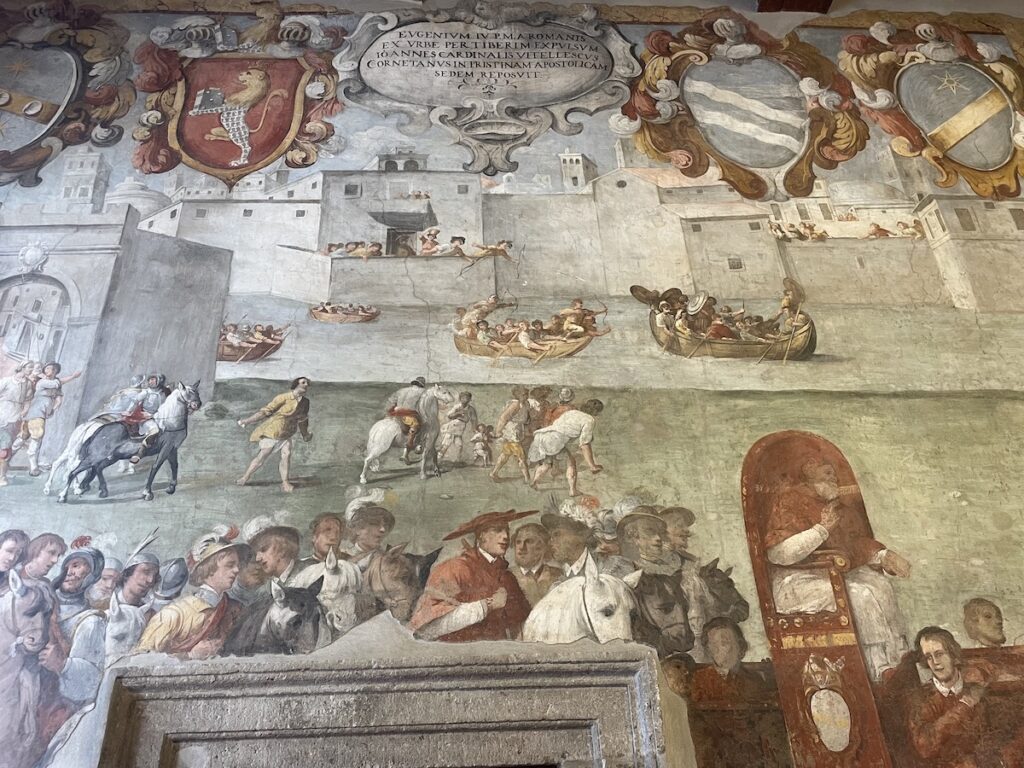
The Romanesque building was already several centuries old when the Sala degli Affreschi was built here around 1600. The walls of this room, which is now mainly used for receptions and weddings, are painted with scenes from Tarquinia's great past.
The most striking of these shows how Vitelleschi saved Pope Eugene IV from a popular uprising in Rome in 1434. The pope was very grateful and showered the strongman of Tarquinia with favors, which made other prelates fiercely jealous of him. As a result, he was arrested during a visit to Rome in 1440, imprisoned in the Castel Sant'Angelo and subsequently murdered there.


4. The Towers of Tarquinia
In another fresco in the Sala degli Affreschi, you can see in the background a skyline of Corneto around 1600, not so different from the present one. Tarquinia can still boast its medieval towers, comparable to those of the much more famous San Gimignano in Tuscany.
Wandering along the city walls, through the old town and (of course) the Via delle Torri you will pass about 8 of them. The Via di Porta Castello leads to an entrance gate, flanked by a half-collapsed tower named after Dante and a large bastion known as the Torrione di Matilda.
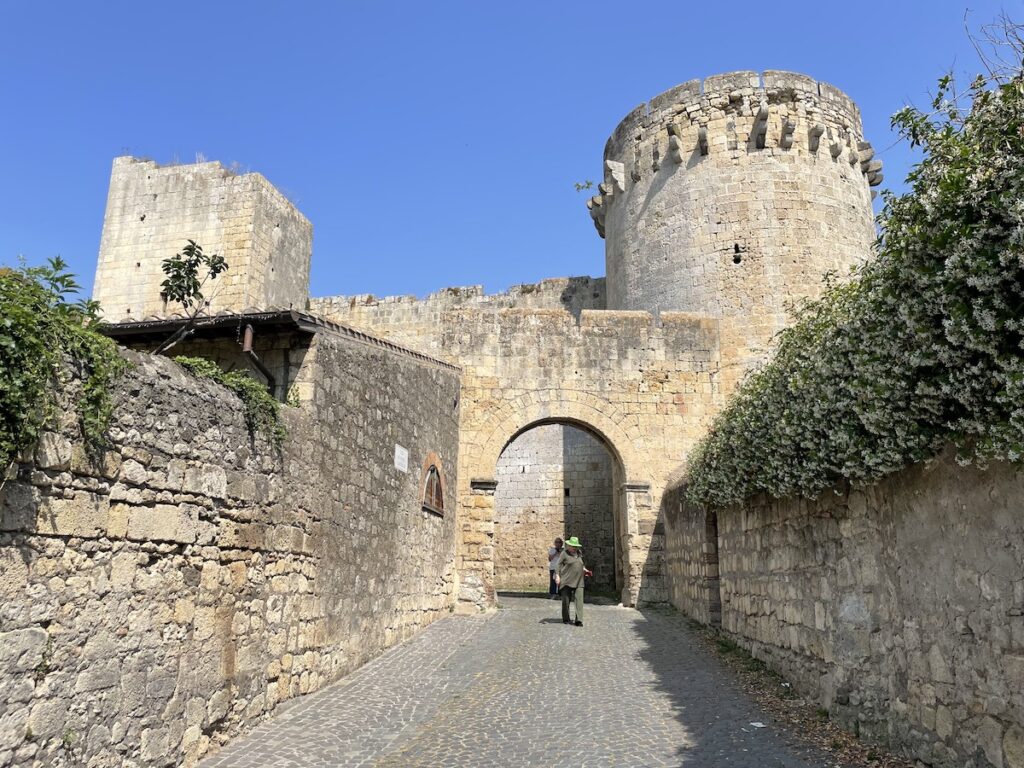
According to legend, it was built by the famous Duchess Mathilde of Canossa, who lived in the 11th century, but in reality Cardinal Vitelleschi was the builder.


5. The Church of Santa Maria in Castello
Tarquinia has 15 ancient churches, including a cathedral that was thoroughly rebuilt in the 19th century. The most interesting is that of S. Maria in Castello, which you reach after a walk along the Via di Porto Castello along the city wall, from where you have a beautiful view of the lower countryside (Tarquinia is situated on a 133-metre-high hill) and, in clear weather, the sea.
It is a Romanesque church from the 12th century, which has retained its original character. The walls are bare and the windows narrow (except for one later added rose window), which gives a simultaneously monumental and sober impression, which according to the guide appeals mainly to Northern European visitors.
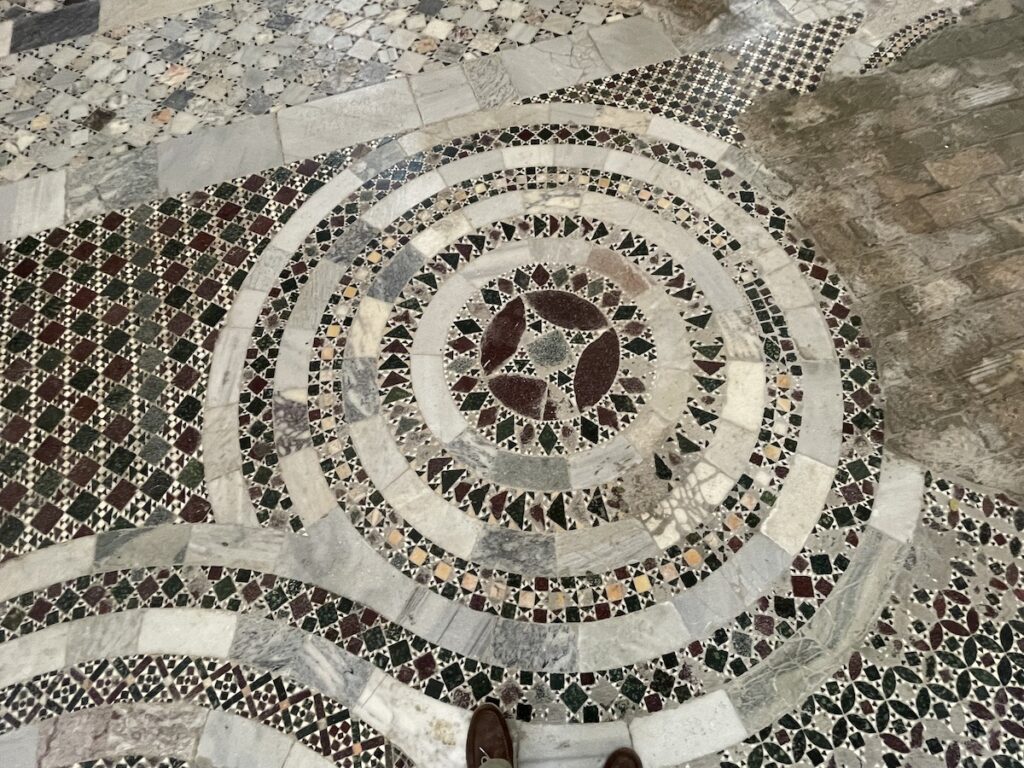
The ground, on the other hand, is paved with so-called cosmatic floors, non-figurative mosaics of red, green and white and black marble, which you also find in many ancient churches in Rome. Behind the Santa Maria, against the city wall, is a terrace with a beautiful view of the old city.


6. Beaches and nature reserves
Tarquinia is 4 kilometres from the sea as the crow flies and the municipality has a total of 28 kilometres of beach. A 10-minute drive from the city centre you will find the Lido di Tarquinia, where families from the neighbourhood come to sunbathe, swim and surf.
In addition to the usual leased beaches with sun loungers lined up in battle formation, there is the 10 kilometre long free beach Pian di Spille where – rare in Italy – naturism is also possible.
Also on the coast is the Riserva Naturale Saline di Tarquinia, a nature reserve in the former salt pans and the surrounding lagoon, where nature lovers and hikers can indulge themselves.
7. The popular cuisine of the Maremma
The cuisine of Tarquinia, apart from the beachside restaurants, is mainly cucina di terra, the meat and (seasonal) vegetable based menu of the inland. Tarquinia is located near the sea, but also in the southernmost point of the Maremma, the rugged inland of southern Tuscany. The food is also rugged, but prepared with excellent ingredients from the region.
cooked water is a rich vegetable soup with potatoes, bread and wild herbs. Cicoria ripassata, boiled and then pan-fried chicory, is a classic side dish. Typical in spring are borage fries (oil balls with borage) and the asparagus frittata (omelette with wild asparagus).
The local specialty mirando consists of beef braised with yellow onions and tomato sauce (from the vacca maremmana, a free-ranging local longhorn breed, but that is besides the point). Other dishes use mutton, wild boar, snails and oyster mushrooms.
How do you get to Tarquinia?
By train
From the port of Civitavecchia you can walk to the train station in about 10 minutes. There take the first train in the direction of Pisa Centrale/Grosseto (€1,50) and get off after one stop in Tarquinia (Museum). Consult the website of Trenitalia for the timetable.
By bus
From Piazza Vittorio Emanuele (near the Cathedral) you can take the Cotral bus towards Tarquinia (Barriera S. Giusto). It stops a few minutes walk from the Etruscan Museum and the historic centre.
Near Largo della Pace and Fort Michelangelo there is also an Eusepi bus (not on Sundays), also stopping at Barriera S. Giusto, near the museum. From there other local buses leave for places of interest in and around Tarquinia.
A bus ticket costs €2 per single journey. Check the official websites of the carriers for current departure times.
By car
- From Rome: take the highway to Civitavecchia and then continue along the Strada Statale Aurelia (90 km).
- From Grosseto: follow the Strada Statale Aurelia southwards (90 km).
- From Viterbo: via Vetralla – Monte Romano or via Tuscania; both routes are about 45 km.








Comments