

 Jane Verdonk
Taormina – in Sicilian 'Taurmina' – some call it the pearl of the Ionian Sea. The town is located on a high rock, about 200 meters above sea level on the eastern side of Sicily, roughly between Messina and Catania.
The town – which is also sometimes misspelled as Toarmina – was founded in ancient times and was given the name 'Tauromenium' which literally means 'house on the Tauro'.
The location is therefore unique and beautiful, with the azure blue sea in the depth, the smoke plume of the Etna volcano in the southwest and in the north. Calabria and the Strait of Messina.

Discovered by tourists
At the end of the 19th century, Taormina was discovered by tourists with the arrival of the German painter Otto Geleng who visited this town at the age of 20.
He was so impressed that he painted everything Taormina had to offer; ruins, sea and mountains. When his paintings were later exhibited in Paris and Berlin, he was accused of having too much 'imaginative power'.
Geleng challenged everyone to go to Taormina with him and promised to pay the expenses for everyone if he did not tell the truth in his paintings.

Whether anyone took up the challenge, the story does not tell. Geleng did return, opened the first hotel (the Timeo Hotel, which still exists) in Taormina and spent the rest of his life in Sicily.

Postcards
After Otto Geleng, Wilhelm van Gloeden also came to Taormina and became friends with Otto Geleng. Van Gloeden was a photographer and he especially created more fame because his photos were used for postcards.
At that time Taormina was a popular place to spend the winter, nowadays the town is overrun by tourists in the summer months (especially in July, August and the beginning of September).
In the course of the 20th century, many movie stars such as Greta Garbo, Cary Grant, Elisabeth Taylor came to Taormina for the annual film festival.
Donald Trump also visited Taormina; in the spring of 2017, the G7 conference took place here, a sign in Corso Umberto I commemorates this event.

Are you going to Taormina yourself? Here are 7 tips for activities and sights.
1. Teatro Greco
The most famous landmark is the Teatro Greco, or the Greek Theater. The construction of this theater probably started around the third century BC by the Greeks and it was suitable for stage and musical performances.

Contrary to the Romans, the Greeks made use of the natural environment when building their theaters, the theater is beautifully situated against a mountain slope.
In the 2nd century BC, the Romans turned it into a kind of amphitheater, where gladiatorial, animal fights and even naval battles could take place.
As with the Colosseum in Rome, sunshades could also be placed here, so that visitors could sit in the shade.
The original form of the podium has partly been preserved, but almost nothing is left of the ornaments and columns.
Probably the first order consisted of 9 columns arranged in groups of 3, while the second was formed of 16 lower columns equally spaced.
It is said that these columns were transported by sea and then pulled to the theater with ropes by many slaves.
During the Middle Ages, most of these columns were removed to build palaces and churches, including Taormina Cathedral.
After the theater of Syracuse, this is the largest theater in Sicily. The view is beautiful, with the bay of Naxos below, Etna beyond, the coast of Calabria and the Strait of Messina to the north.
Perhaps the view is too beautiful, during performances the view is rather distracting.

Since the 50s, the theater has been used for various forms of entertainment ranging from theater to concerts, from operas to ballet performances and award ceremonies. The theater today has a seating capacity of 4.500.
2. Corso Umberto

Corso Umberto 1 is Taormina's main street. This street is named after Umberto 1 of Savoy, the king of Italy from 1878 to 1900. This road was part of the thoroughfare that connected Messina with Catania in ancient times, the road was then called Via Valeria.
The Corso Umberto starts at the Porta Messina on the north side and runs to the Porta Catania on the south side. The Porta Messina was inaugurated in 1808 by Ferdinand IV of Bourbon, the plaque at the top of the gate refers to this.

Porta Catania 
Messina Gate
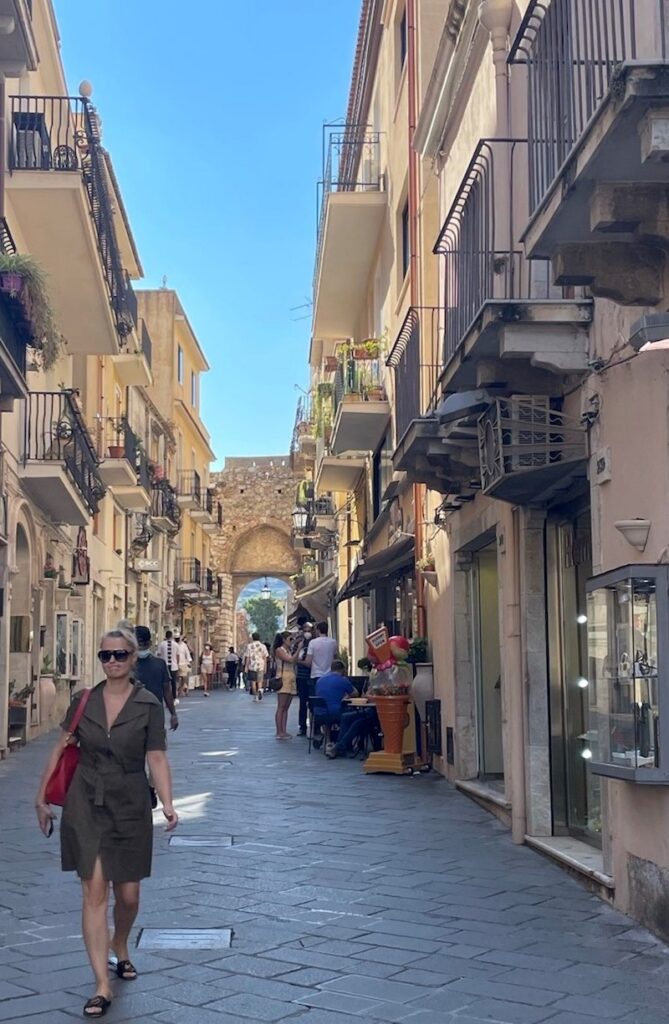
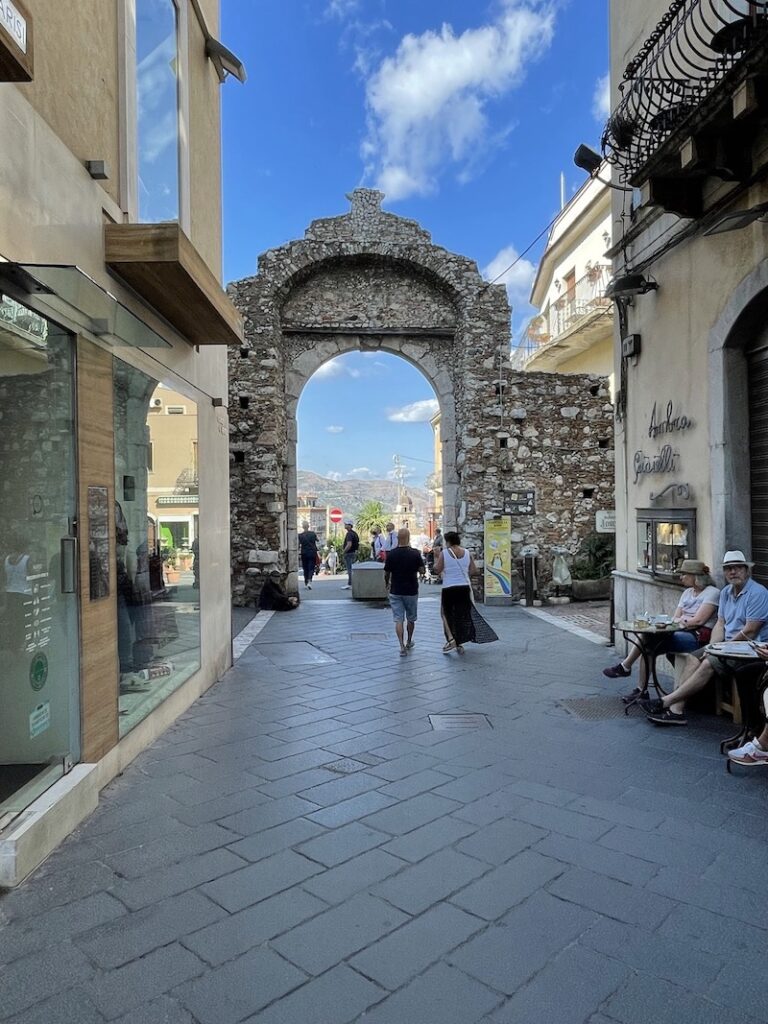
The Corso is a kind of open-air museum with, among other things, the following sights:
- Theater Odeion, built in the Imperial era,
- The medieval Palazzo Corvaja that still has an Arab fortress tower
- The Numachie, a 122 meter blind facade
- The Palazzo Vecchio dating from the 13th century
- The Duomo S. Nicolò built in the 15th century

Today Corso Umberto is a pedestrian zone and is Taormina's main shopping street.
3.Piazza IX Aprile
Halfway down the Corso is Piazza IX Aprile, also known as the salotto (= living room) of Taormina. You also have a nice view from this square.
The square is especially popular during the walk in the evening. The Sicilians stroll here, you can have a caricature of yourself drawn and enjoy a drink on the terraces.

The square was given the name IX aprile because on April 9, 1860, during a mass at Taormina Cathedral, it was rumored that Garibaldi had landed in Marsala to begin the conquest of Sicily that would eventually lead to the unification of Italy .
The news turned out to be false: Garibaldi would not land in Marsala until a month later, on 9 May.
The inhabitants of Taormina nevertheless wanted to remember April 9 and dedicated the most beautiful square of the city to it. Before that, the square was named after Sant'Agostino, a church that was built here in 1448 and which now houses the library with Dutch books.

Admission is free and you can also admire several coral works of art.
Also on the square is the church of San Giuseppe, built in the 17th century and a fine example of Sicilian Baroque. Also worth seeing is the double staircase in front of the entrance.

But the most important building in the square is undoubtedly the tower, also known as the clock tower called. Built in the 12th century, destroyed several times over time, but always rebuilt.

4. Villa Comunale
The Villa Comunale was originally the park of Lady Florence Trevelyan's home. It is said that Lady Trevelyan, a Scottish noblewoman, fled her country in 1884 after an affair with the heir apparent of England, Edward VII.
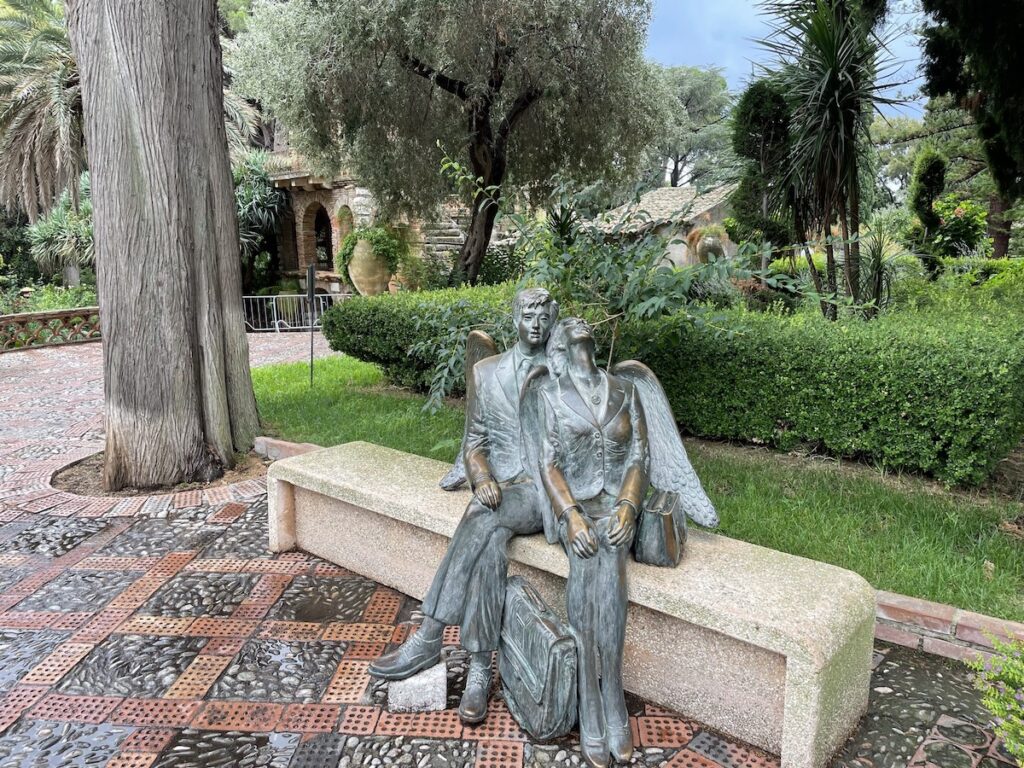
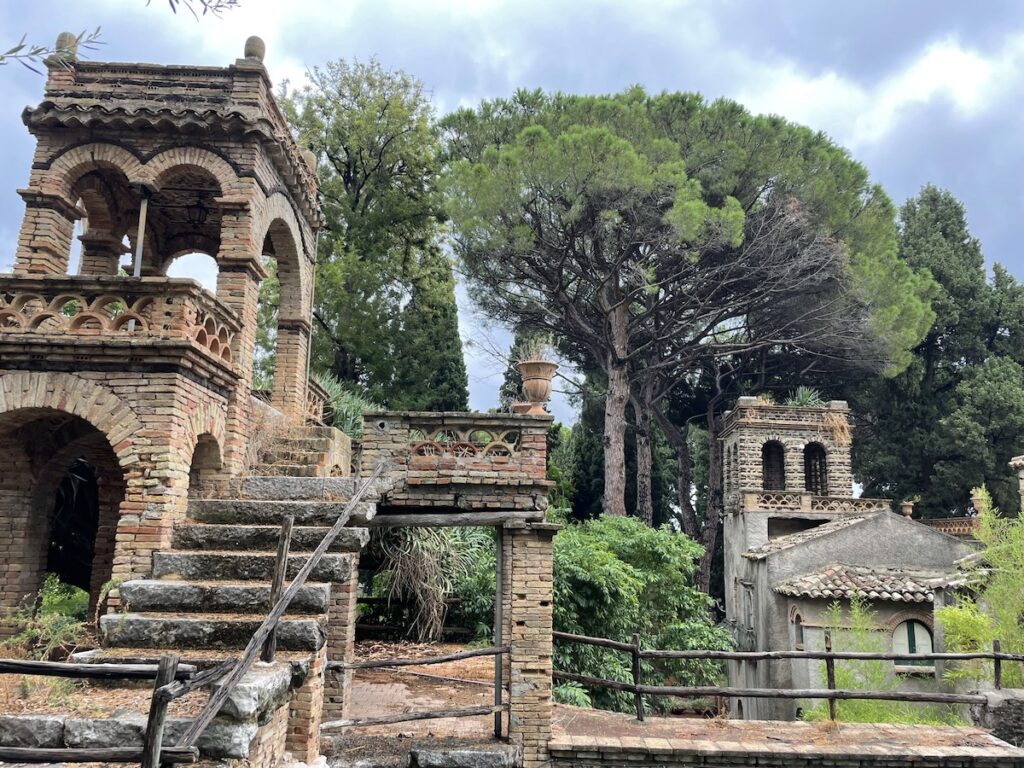
In Taormina she married the then mayor, Salvatore Cacciola. At the request of Lady Florence, the park was laid out as a typical English garden with many species of rare plants.
In addition to rare plants and trees, special buildings can also be seen here, the so-called Victorian Follies.
The garden became the property of the municipality from 1922 and is still open to the public.
5. Isola Bella
Isola Bella is a small peninsula near Taormina.

There is a narrow path that connects the island to the mainland. The island has a rather rocky beach and there is also a small museum.
The island is very photogenic and has been used for several Italian films as well as for a blockbuster like the James Bond film Octopussy.

King Ferdinand 1 donated the island to the city of Taormina in 1806. In 1890 Lady Trevelyan bought the peninsula and had a house built here. Subsequent owners maintained this until they went bankrupt in 1990. Now it is a protected nature reserve.
You can visit the small peninsula by taking the funicular from Taormina (on Via Luigi Pirandello near the Porta Messina).

The funicular goes every 15 minutes. From the Belvedere point at Taormina you can also walk up to Isola Bella by stairs. The staircase has 134 steps.
6. Giardini Naxos

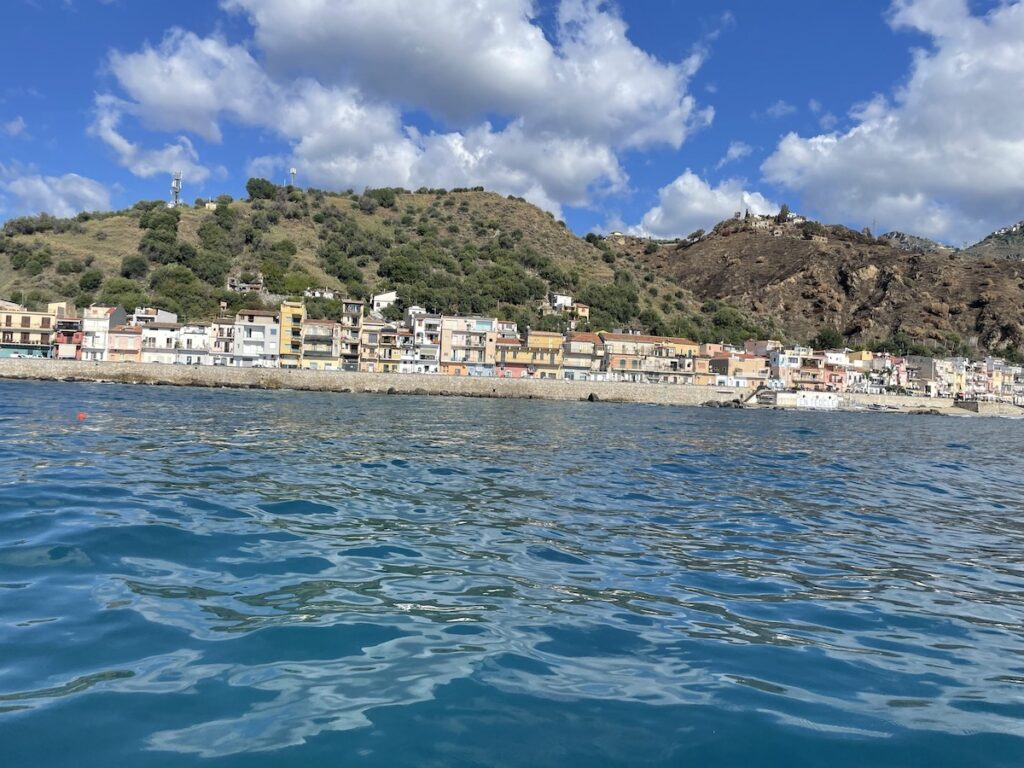
The original name was Viridiana, a little later until gardens (=gardens) was corrupted. It was not until 1978 that the Greek name Naxos was added as a reference to the ancient Greek settlement in the hope of attracting more tourists.
Giardini Naxos is located by the sea with a beautiful and long (sand!) beach. There are non-public beaches, where you can rent sunbeds, umbrellas and chairs, as well as a public beach.
It gets deep slowly, so the beaches here are ideal for families with small children. You will also find a large number of hotels and restaurants here (especially in the Recanati district).
In addition to the beach, there are also excavations of the first Greek settlement in 735 BC.
The settlement was largely destroyed by the army of Syracuse a few centuries later, but a city wall, ruins of a residential area and foundations of probably a temple have been preserved and can be visited, as well as the archaeological museum.

Cave along the coast Grotto Azzura Rocks during the boat trip
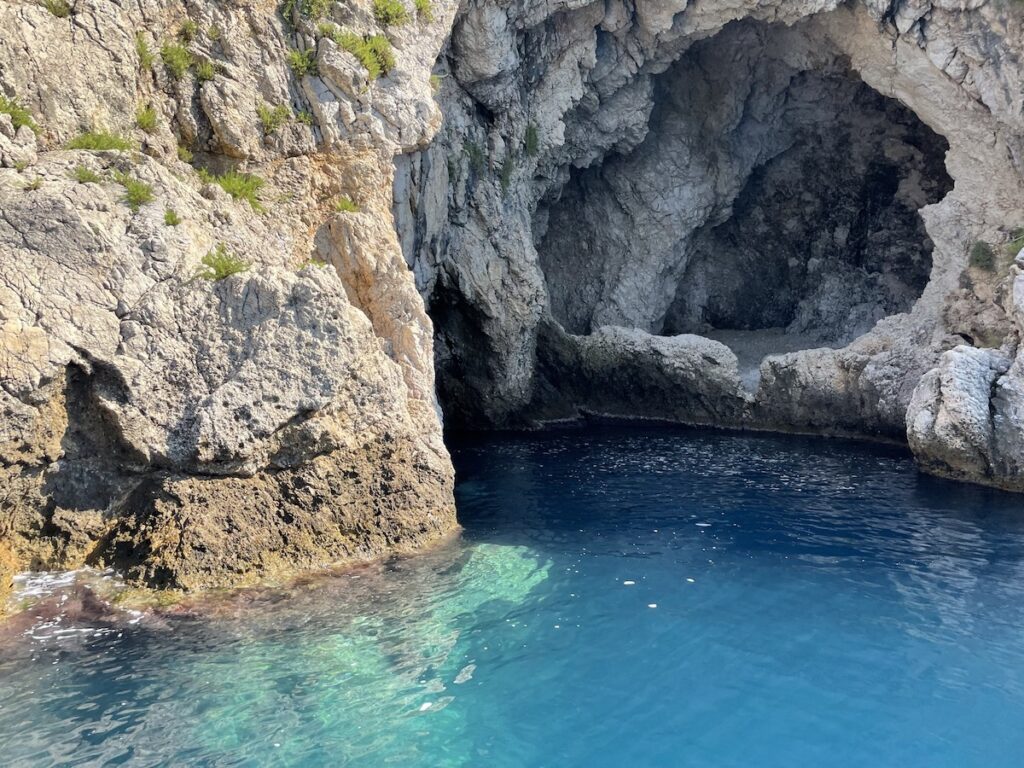

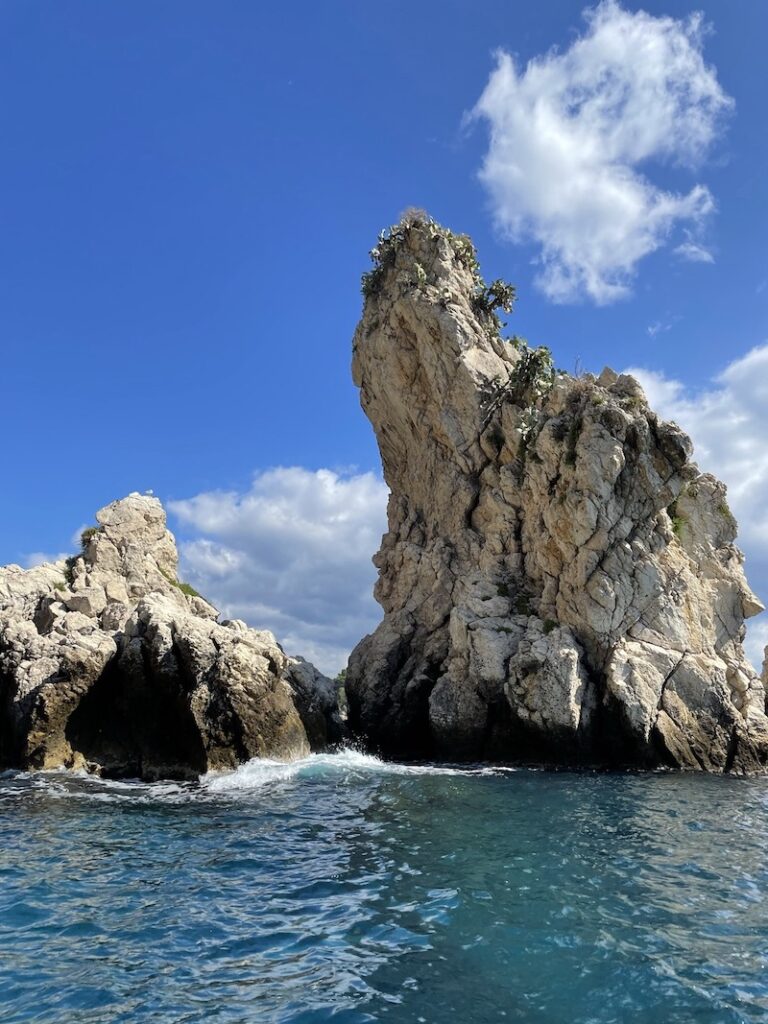
Tip: take a boat trip from the port of Naxos, there are several providers. The best one is perhaps 'Antonio'. He shows you the cave azzuro, grotto del diavolo, grotto d'amore en Beautiful island You get the opportunity to swim and/or snorkel and you also get a glass of prosecco! (www.taorminaescursioni.it).
7. Castelmola

Do you have time to spare and do you enjoy walking? Then you can take a 5 km long hiking trail in Taormina to Castelmola.
Castelmola is a village located above Taormina. There used to be a castle (hence the name Castelmola), but only a ruin of it remains.
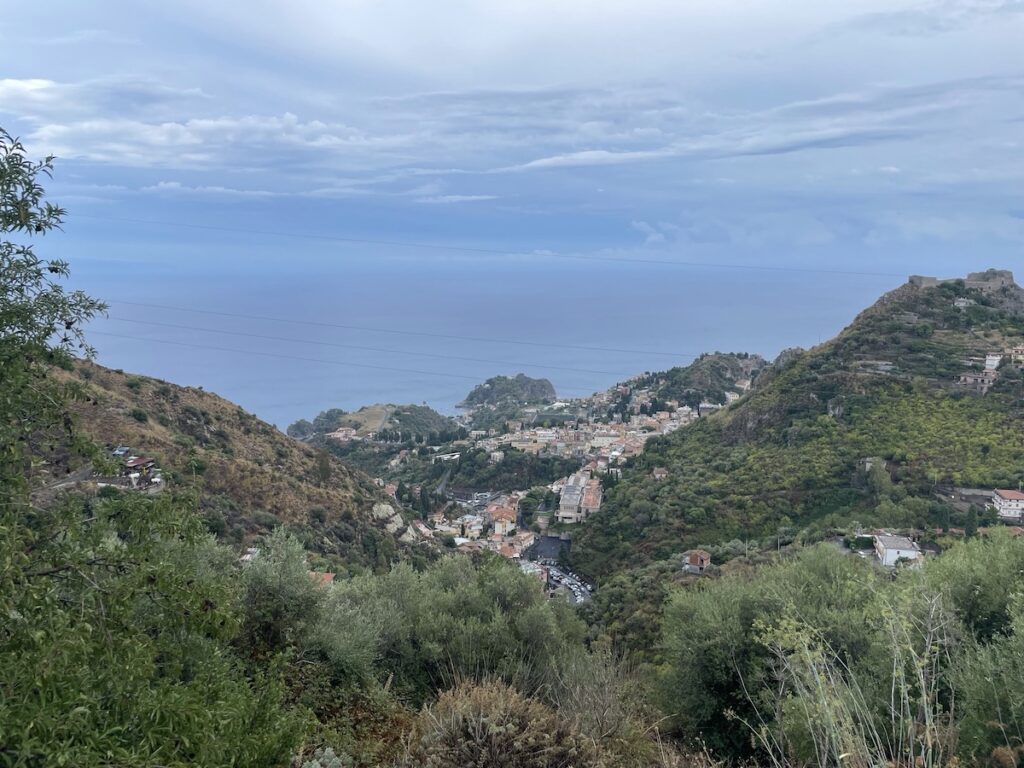
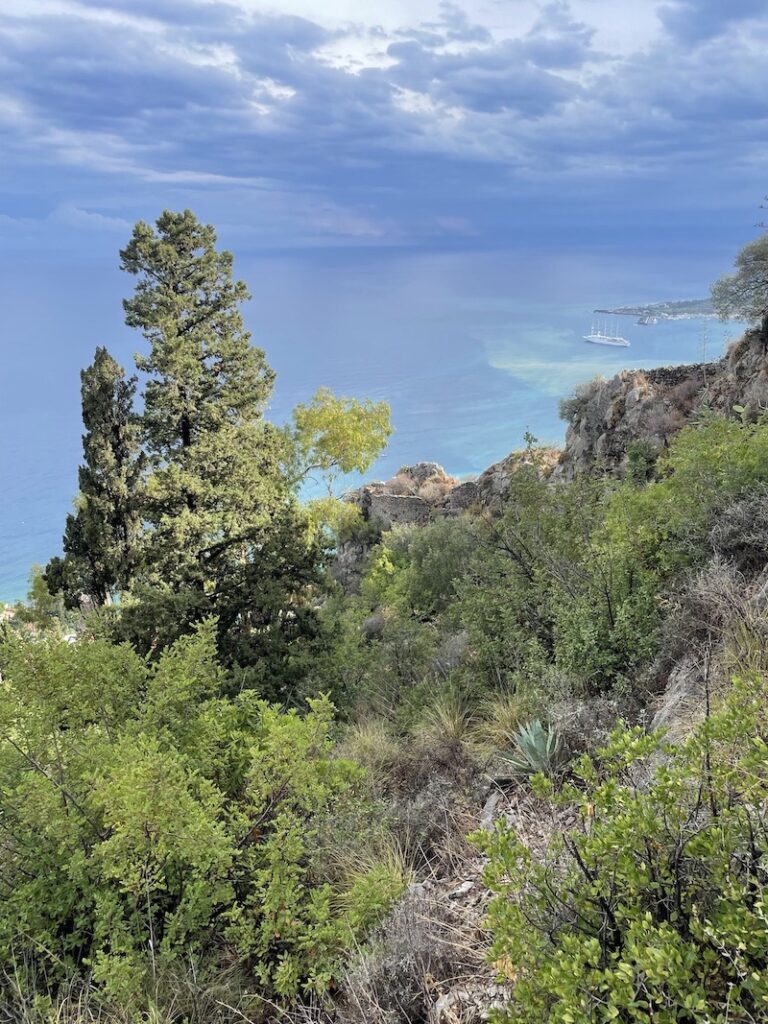
Castelmola has a few nice squares and especially the view is special! The walk starts with a way of the cross with many steps and statues of the crucifixion of Jesus.
At the top you come close to the Castello Saraceno which is unfortunately currently closed, then you walk a bit on the road and then further up via a footpath.
In Castelmola, go to Bar Torrisi, a bar in the center with a terrace on 4 floors with a magnificent view.

Taormina – practical information
By car you can take the ferry to Messina in San Giovanni (Calabria). The crossing takes approximately 20 minutes and cars can be taken on the boat. Tickets are available at Caronte & Tourist, this website is also in English. From Messina it is about a 45 minute drive to Taormina.
Another option is by train. There are night trains from Milan or Naples, the train also goes by boat. However, it takes quite a while before the entire train is on the boat, but you can in principle make the entire journey without a transfer.
You can get off at the station Taormina – Giardinic, a very nice station. Filmed here is the scene where old Michael Corleone (Al Pacino), collects his ex-wife Kate (Diana Keaton) from the train station in The Godfather III.
However, the fastest way is to fly to Catania. From Catania it is about an hour's drive to Taormina. This can be done by rental car or taxi, but there are also buses.
For such a small town, there are a lot of hotels in all price ranges, from €30 per night to more than €2.000 per night.
You will find beautiful and affordable hotels and holiday homes in Taormina here.
There are plenty of restaurants and bars to suit every budget and taste. There are even 3 Michelin-starred restaurants in Taormina: La Capinera, Otto Geleng and St. George.
Sicilian specialties are, for example, the swordfish (swordfish), which you should definitely eat fresh, arancino di pistachio (fried 'rice ball'), pasta alla norma (pasta with a sauce of tomatoes, eggplant, onion, capers), cannola con ricotta (Sicilian Pastry) or brioche con gelata o granita (a sweet bread, served with ice cream or with granita) that the Sicilians also eat for breakfast in summer.









Comments