

 Aart Heering
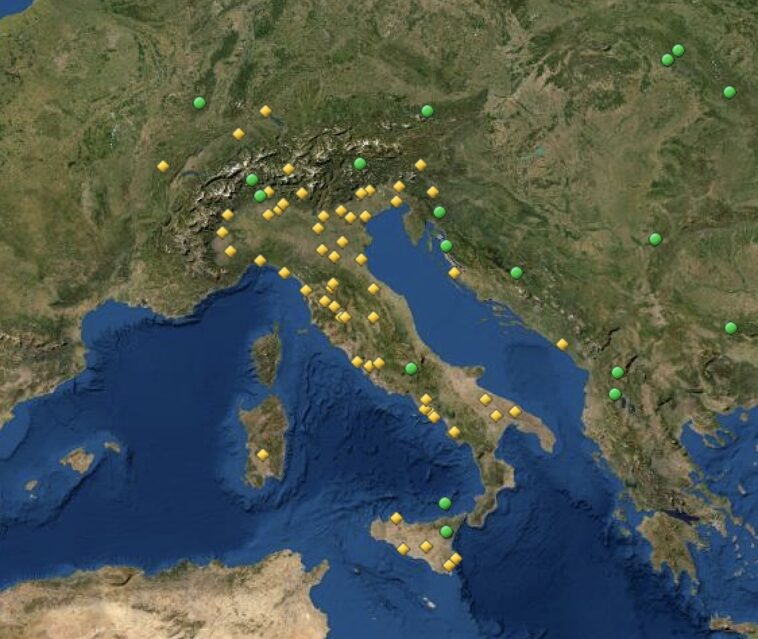
No country in the world has as much world heritage as Italy. In recent years, UNESCO has compiled a list of 1.154 World Heritage Sites in 167 countries. According to the UN organisation's definition, this refers to 'cultural and natural heritage that is regarded as irreplaceable, unique and the property of the whole world', and which must therefore be preserved. Of these, 58 are in Italy, closely followed by China with 56. After that come Germany with 51, Spain and France, both with 49. The Netherlands has 12 and Belgium 15.
Last month, the daily La Repubblica had the lucky thought of publishing an overview of all these 58 'wonders of UNESCO' (also available at www.unesco.it), as a kind of travel guide 'in search of the beautiful'.
The result is overwhelming, of a truly unique cultural and scenic richness and variety. Writer Corrado Augias gives the following explanation in the introduction:
“We Italians have been divided for centuries into kingdoms, duchies, domains and baronies and that has been a disadvantage from a military and economic point of view. But artistically it was mind-boggling. Every local ruler wanted his territory to be the most beautiful of all. And every piece of land that has produced political misfortune since the end of the 15th century has also created artistic happiness.”
Interesting, but not complete. After all, the UNESCO list also includes a lot of culture from before that time and natural heritage. The immense variation is therefore also related to the geographical situation and the long history of Italy.

UNESCO has of course declared the classical Italian masterpieces World Heritage. Venice, Genoa, Florence, Rome, Naples, Palermo, smaller gems like Assisi, Siena, Pisa, Ferrara and Ravenna, archaeological stunners like Pompeii, Paestum en Agrigento, the castles of Caserta and Piedmont, the villas of Palladio in Veneto, the towers of San Gimignano, the trulli of Apulia, the Sassi di Matera, Leonardo da Vinci's Last Supper, they are all included.

But the guide also mentions dozens of less obligatory and therefore less known and visited heritage sites. Like Ivrea, described as a 20th century industrial city. Located 40 kilometers above Turin at the foot of the Alps, Ivrea was the city of Olivetti, manufacturer of typewriters and then PCs, and pioneer of corporate social responsibility. The former factory buildings and the original Olivetti hotel in the shape of a typewriter are now a beautiful example of recent industrial archaeology. Moreover, Ivrea itself is a pleasant town, with good eateries and surrounded by mountain lakes. Crespi d'Adda, a similar location in Lombardy, is also on the UNESCO list.

It is no surprise that the Scrovegni Chapel in Padua, with Giotto's beautiful frescoes, is also on it (since last year). But in the same city, the botanical garden is also a World Heritage Site. It was founded in 1545 as the first of its kind and from that time stems a dwarf palm, which has almost reached the size of a standard palm in almost 5 centuries.
The first Italian World Heritage Site in 1979 was not one of the traditional cultural cities, but the more than 140.000 petroglyphs created over 8.000 years in the Valle Camonica in northern Lombardy. The stilt houses in the southern Alps and the nuraghe from Sardinia.

Less well-known, but certainly justified, is the UNESCO recognition of 'the places of power of the Lombards in Italy'. Not much has survived of this people who ruled Italy in the early Middle Ages, but in Cividale del Friuli you will find a lot that is worth seeing.

12 heritage sites are typical landscapes and natural areas such as the Langhe in Piedmont, the Prosecco Hills in Veneto, the Dolomites, the Amalfi Coast, Mount Etna and the Aeolian Islands above Sicily. Also on this list, as part of a transnational heritage of primeval forests, are the beautiful beech forests in the Calabrian Aspromonte mountains.
And all the way on the other side of Italy, on the border with Switzerland, the Monte San Giorgio, with its unique fossils from the Middle Triassic, 240 million years ago, when this area was under water. Finally, there is a list of 'intangible heritage' that includes: the Mediterranean diet, the Sicilian puppets (traditional Sicilian puppet show), falconry art, the violin makers of Cremona, Neapolitan pizza bakers, Sardinian tenors, the transhumance (the annual herd migration), and so on.
In short, a mess. But either way, the UNESCO listing can certainly offer suggestions for your next Italian vacation.

Le meraviglie dell'UNESCO. Viaggio in Italia alla scoperto del bello has appeared in the series Le Guide ai sapori e ai piaceri as an annex to La Repubblica. The 552-page book, with tips for hotels, restaurants and local products, is of course written in Italian, but for the list of 58 world heritage sites you can also go to the site www.unesco.it (Italian with links to explanations in English).









Comments