

 Aart Heering
We've all experienced it in Rome. After the meal in a cozy tavern the owner arrives with a ragged piece of paper with some indiscriminately chalked hieroglyphs and a total amount.
After some insistence you can get a more itemized bill, but it has to be paid in cash because 'the ATM is broken'.
This scene is no exception. Paying by card is often impossible in small shops and restaurants and sometimes it is also clearly indicated: no carte di credito.

And it happens all too often outside the hospitality industry. A Roman plumber issuing a receipt has yet to be invented—at least in my experience.
My ophthalmologist's secretary invariably asks whether it should be 'with or without a receipt' and the dentist has resisted the introduction of the POS (short for point-of-sale), as the ATM is called in good Italian.
Even at the notary, a good friend had to hand over 900 euros in addition to the official rate of € 200 (not cheap anyway) for reading a will.
Thus, the annual report of the Italian tax authorities is always good for a hefty dose of grumbling, grumbling and disbelief. Poor jewelers and hoteliers, entrepreneurs who systematically earn less than their employees, loss-making shopkeepers and cafes and restaurants that seem completely devoid of business: it is a colorful fraudulent collection, which every Italian knows all too well and which puts a lot of pressure on the public finances.
The total amount that the state treasury misses out annually as a result, according to a commission of inquiry of the Ministry of Finance, is about 109 billion euros. According to the recently published report self-employed people evade no less than 68% of income tax, for a total of 33 billion euros per year.
Not to mention a 36 billion VAT evasion. Tax discipline is higher among employees, for the simple reason that the poet is withheld from them at the source, so that no more than 3,6% is missing from the appeal.
A serious approach to these practices would put a lot of money in the always empty drawer of the state. Every government proudly announces this when it takes office, but then quickly slows down again, because evaders and dodgers simply account for millions of votes.
Moreover, they consider themselves not so much as thieves of the community, but rather as successful fighters against a hostile and greedy government. (Historians Arthur Weststeijn and Pepijn Corduwener offer a good explanation for this in their book Experimental garden Italy.)
So tax morale in Italy is not particularly high, to say the least, and has not gotten any better in the 20 years that a politician convicted of tax fraud has spoken out in the country.
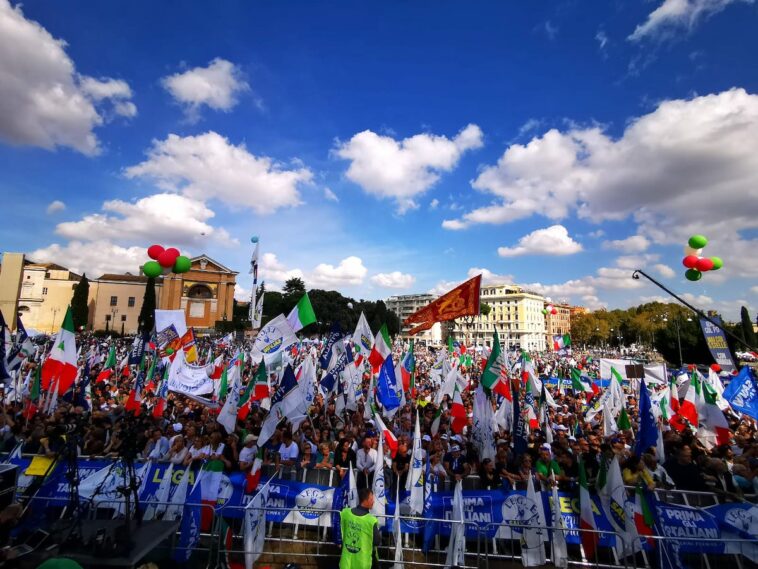
I noticed that again last month at the large national protest rally of the right-wing opposition against the government of Partito Democratico and Five Star Movement.

A series of speakers rode in front of approximately 200.000 demonstrators, including party leaders Silvio Berlusconi (Forza Italia), Giorgia Meloni (Fratelli d'Italia) and of course Matteo Salvini, the captain of the Lega and a deadly future prime minister, their usual hobbyhorses: immigration, insecurity and the 'treason of the people' of Democrats and the Five Star Movement, who teamed up last summer to avoid a Salvini cabinet.
But the most popular theme was the fiscal proposals of the 'red-yellow' cabinet: a ban on cash payments for transactions above €1.000 (now €3.000); the obligation for self-employed persons to install a POS; and imprisonment for evaders above € 50.000.
In short, a 'fiscal dictatorship', we heard from the podium, which would mean 'the death of the self-employed'. The ensuing loud applause came from the Leg supporters themselves, of course, but is also a bad sign for the governing parties, who also prey on the votes of the self-employed.
I am therefore convinced that payments without receipt and POS will not be eradicated for the time being.
Just for a laugh: this is what happens when you ask for a receipt in southern Italy…









Comments