

 Willemijn Lindeboom
There are not many olive trees in the Netherlands and if you have one, it is unlikely that you will make oil from the olives. Nothing else happens in central Italy. Tuscany en Umbria are famous for the high quality olive oil and anyone who has ever been on holiday here will at least have wondered what all those gray trees are, in between the vineyards. Well, those are olive trees. A permanent part of the culture. A culture that, fortunately, does not completely succumb to modern conveniences.
How do you make olive oil?
In the period between mid-October and mid-November, most people (in the countryside) are still involved with olives and olive oil in one way or another.
In the Netherlands, few people know how olive oil production works. It's a world in itself that you can make as complicated as you want. The more you know about it, the more you realize you know very little about it. Anyway, that's my experience so far.
An important point in advance… you cannot eat olives directly from the tree. That is, you can do it, but you only do it once. Are they poisonous? No, but very bitter. That is why you will always find pickled or dried olives.
Or olive oil! By putting olives in the salt or drying them, the bitterness is almost completely gone. By making olive oil from it too. The bitter taste, simply put, is in the water contained in olives, so removing that makes olives edible.
Picking olives
Olives are really picked in central Italy. This happens from about mid-October to mid-November. Picking can be done in several ways. We do it by hand, but others do it with a long stick with some kind of fast moving brush on it. Large companies sometimes use a shaker, but I have rarely seen one.
When picking by hand, put a large net around the tree. You can buy these nets everywhere here and are especially for olive picking, as well as the plastic crates in which the olives are transported. Once the net is in the right position, pull the olives from the branches and try to step on the olives that are already on the net as little as possible while working.
The more damaged the olives are, the sooner you have to go to the press, but I'll get to this later. Once the tree is empty, collect the olives on the net in a central point and throw them into a crate. Then go to the next tree and repeat the procedure. It couldn't be simpler!
Harvest faster
The pickers who use an attachment (that long stick I was talking about) often use very long nets that can be placed around multiple trees. A net on each side of the row of trees. There are teams that 'knock' the olives out of the trees and others that empty the nets and put them back at new trees. This method is much faster and is now also used by many people who only make oil for themselves and their family.

The shakers are used by large companies and only in suitable olive groves (they should be fairly flat with plenty of space around the trees). These machines shake the olives from the trees with small vibrations, but a disadvantage is that many olives get stuck. In addition, it does not seem to be good, in the long run, for the trees.
The press - The oil mill
After picking, you should press the olives as soon as possible. The reason that this has to be done as soon as possible is that olives that are no longer hanging from the tree and that are piled together will rot. The olives that we pick one day are in crates that are kept in a cool place.
The day after, you can warm your hands by wriggling them into those crates. If you want good quality olive oil, it is therefore important to press the olives as soon as possible after picking. The longer you wait, the higher the chance of strange aftertaste in the oil or even literally rancid oil.

Of course this was not possible in the past and the olive oil was not always the best, I was told. But, hunger makes raw beans sweet and so it was fine the way it was. However, now that we can easily get to the oil mill can, most people try to squeeze their olives after 3 or 4 days and that gives excellent oil. If you want better quality, you have to press earlier. The best is every day.
Often the mills (olive presses) their own olive groves. That's the reason they bought a press. They almost always press for others and ask for money or oil. If you have few olives you can, if they are of good quality, go with the olives from the oil mill throw yourself. Often the minimum you can squeeze is 300 kilos, but sometimes it is 500 kilos, that depends on the oil mill off. If you want your own oil, but you can't meet the minimum, you can pay extra.
There are different types of presses, not only multiple brands, but also different ways they work. Nowadays all presses are for Extra virgin olive oil, so they cold press.
The original pressing method

The original method was beautiful, with large millstones grinding the olives into a pulp, the pulp being spread on disks of sisal or other rock hard substance, layer upon layer until a high pile was formed. That pile went under a press.
The juice slowly seeps out. At the end centrifuge with this so that the oil is separated from the water. Before centrifuges existed, the juice was put into baking and the oil floated to the top after a while. Then they scooped it off the bitter juice.
This old method is still used in several places, but there are fewer and fewer mills where this is possible because hygiene can be an issue and the process is also slow. However, some swear by this method of pressing and only want to take their olives to a traditional press.
Making olive oil is a complicated process
These kinds of issues are often discussed in October! Which press is better, which oil is tastier, should you filter the oil or not… After years of making olive oil, I still don't have my own opinion, I just really don't know! The process is complicated and good oil tasting is even more complicated.
During the period when olives are picked, it is most mills a madhouse. Normally you reserve a place for your olives, but the schedule is almost always messed up and so there are people waiting.
At some mills you can toast bread on a fire and taste their oil. Others are less hospitable. What they all have in common is that the owners of the olives happily carry crates of olives and then full tanks of oil.
Many people wait for their oil so that they can oil mill can control well. That is why at the olive-picking period there are always people present who compare the harvest with each other, the yield (la resie how much olive oil you get from 100 kilos of olives), the work they have done, whether the olive fly has caused damage and what they do about it… You learn a lot!
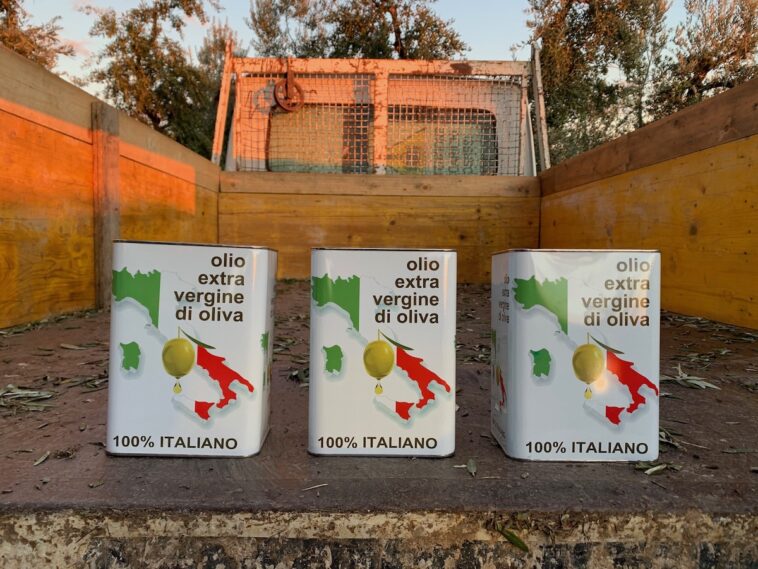
What is olio extra virgin di oliva?
Nowadays almost all olive oil that you can buy (in Italian) supermarkets is 'extra virgin', that is to say: cold pressed. This is also known as extra virgin olive oil.

When you think of 'virgin' you immediately think of 'virgin', but in Italian it also means 'pure, unprocessed'. So pure olive oil. However, if you want good olive oil, it is important to really pay attention to the word 'extra', because there is also olio virgine di oliva and it is of lower quality. Furthermore, there is simply olive oil of often poor quality.
oleic acid
The quality is partly in the quantity oleic acid (oleic acid) of the oil. Extra virgin olive oil has max 0,8 grams of oleic acid per 100 grams of oil. Olio virgin may contain up to 2 grams per 100 grams of oleic acid and olio di olivia is a blend of all kinds of other olive oils, including lamp oil and refined olive oil.
The names don't sound good and the procedures to obtain this oil are complicated. What remains from the cold pressing, say the pulp, is heated to extract some more oil, or it is chemically treated for the same purpose. It is better not to use this oil.

You may sell extra virgin olive oil as such if the oil is cold pressed and contains no more than 0,8 grams of oleic acid per 100 grams of olive oil. Each oil mill can have the oil tested for the percentage of oleic acid, which is mandatory if you want to sell olive oil as extra virgin.
Protected Designation of Origin (PDO)
In addition to the extra virgin olive oil does it exist too olio extra virgin di oliva DOP. The DOP stands for Protected Designation of Origin. In Italy there are all kinds of DOP products, including olive oil.
Another term applies to wine, the DOC or DOCG. DOP means that the olives only come from a specific area and are processed in that area according to strict standards that apply to that area. Olio Extra Virgine d'oliva DOP Umbria is olive oil from Umbria, for example, made by farmers who adhere to the rules set by the Consorzio di Tutela Olio DOP Umbria.
In Italy there are many DOP areas for olive oil and having a DOP brand on a bottle guarantees excellent quality.
Why is olive oil so expensive/cheap?
I often hear the Dutch say that they extra virgin olive oil very expensive find in Italy. Now the prices in Umbria are lower than in many parts of Tuscany, so it is impossible to talk about 'the price'.
In Umbria you can buy good oil for about 40 euros per 5 liters. In Tuscany, the price is usually at least 55 euros per 5 liters. The land in Tuscany is much more expensive, I suspect that's one reason, but tourism will certainly be a reason too.
The handicraft
Where does the cost of olive oil come from? Roughly speaking, the work consists of: pruning, maintaining the olive grove, picking and pressing. Some producers also treat their olive trees against the olive fly or other pests and diseases, but for the sake of convenience I don't count that here.
Say that it takes an average of half an hour of work per tree to prune a tree, if someone does it commercially (so very quickly). Then the olive grove should be mowed at least twice a year and then the olives should be harvested. That is very labour-intensive work.
A really good olive tree produces a maximum of 20 kilos of olives (there are some trees that produce more olives, but the vast majority of trees reach around 10 kilos and certainly not every year).
The yield of olive oil
De travel is between 10 and 15%. That is, 100 kilos of olives give between 10 and 15 kilos of oil. A very productive olive tree (as mentioned, there are huge exceptions) can therefore produce around 2 to 3 kilos of oil. However, most trees give much less and not every year.
The average is therefore much lower than 2 or 3 kilos of oil per tree. But the amount of work is the same (pruning and mowing). Actually, picking olives from trees that are not so crowded is relatively more work than picking an overcrowded tree.
The cost of pressing
In oil mill olive oil is calculated in kilograms. A kilo of olive oil is more than a liter, because oil floats on water. You pay for pressing the oil per quintal (100 pounds) of olives you bring in.
The price is not with every oil mill the same, but varies from 15 to 20 euros per quintal. Converted into oil, that is approximately between 1 and 2 euros per kilo (also highly dependent on the travel).
In short, the cost of olive oil is not in the pressing of the olives, but in the manual work that goes into having olives. A very roughly calculated average is more than an hour of work per kilo of oil.
If you compare that with grapes and therefore wine, the question is actually: why is Italian, hand-picked, extra virgin olive oil so cheap? Why do we think it is normal to buy a good bottle of wine and drink it in one evening, but do we think good olive oil is expensive?
Many farmers have stopped producing olive oil because it is impossible, certainly not since it was decided in Europe to no longer tax a large quantity of olive oil from Tunisia on import. A subject that is hotly debated, but fortunately rarely on a local level, where most people simply make their oil for their own use. That oil has no price.
Also read: 9 things you should know about olive oil.









Comments