

 Lucy Beker

"Ecco, le chiavi," says Francesca, handing me the keys to her apartment in Bologna. Her home, but now I'm living there too, for a week. A whole week! And I'm not here as a tourist; no, I'm a student in this university city, also known as "La Dotta" (the learned one) because it boasts the world's oldest university. But besides classes, this week I also want to discover the famous "secrets of Bologna."
I put the keys in my pocket and head out the door. Downstairs, I immediately find myself in a genuine portico, an arched gallery of which Bologna has more than any other (Italian) city (almost 40 kilometers in total!).
So my house is in one of those porticoes. So you really do live in Bologna, I think contentedly. From here, I walk through archways to my school in fifteen minutes. To be honest: I'm not going to that famous university, but to the Scuola di Lingua Italiana Arca. Tomorrow I'm starting my Italian lessons. First, into the city. In search of its secrets.
The leaning tower is about to collapse
The two large towers are certainly no secret. You can see them towering over the city from far above: a tall, straight one and a slightly shorter, leaning one. Old drawings show that Bologna once boasted over 100 of these towers!
Now there are about 20 left, but the AsinelliThe tower in the city center is the tallest. Until two years ago, you could climb it, but that's no longer permitted because the leaning tower next to it is on the verge of collapse. Construction fences are now around it, but it's questionable whether the tower can still be saved.
What I can climb, however, is the Torre dell'Orologio on Piazza Maggiore, the tower of the town hall. It offers a fantastic view, and you'll understand why Bologna's second nickname is "La Rossa" (The Red Light District). Lots of old red buildings and red roofs.
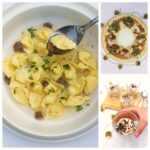
Bologna has another nickname: "La Grassa" (the fatty one), because the food is so delicious. Of course, you immediately think of spaghetti Bolognese, but I quickly learned that's not the way to say it in Bologna. Here, you order tagliatelle con ragù. Other specialties include mortadella, fresh pasta like tortelloni, and Fabbri's cherries in syrup. Yum!
And what about those secrets? Yes, I find them too, like most tourists. Neptune's peculiar thumb, the secret window in Via Piella (if you open it, you look out onto an old waterway), the three arrows in an ancient, high wooden portico on the Strada Maggiore, the meridian in the Basilica of San Petronio.
There are wonderful stories to tell, the kind you can find online. But I also discover real secrets that aren't in the tourist guidebooks! And that's thanks to Erica, the conversation teacher at my school.
The most fun homework ever
My class (7 students from different countries) starts every morning with grammar from Sara, which is more fun than it might sound, because Sara makes it a lively lesson, and there's lots of laughter. Then it's break time, and we all go to a bar two streets over for coffee. A cappuccino and a cornetto with crema, in my case.
And after that pleasant break, Erica comes to our class. She gets us talking in all sorts of ways, with questions, games, and drawings. We have some great conversations. And at the end of the lesson, she gives us homework. The best homework ever. Erica then gives us an address in the center of Bologna, where a secret can be found.
After a pleasant lunch together, we set off, using Google Maps to search for that mysterious address. The first time, we see nothing unusual. The next day, Erica tells us what we missed. The second time, we spot it immediately. But of course, I can't reveal these secrets here... Or well, okay, just one.
Erica's assignment on Thursday takes us to Via Zamboni. There, we're looking for a gate to the former Jewish ghetto. Above that gate, there's something unusual to see. Yes, a large devil's head!
Erica knows more about this, much more than can be found online. For example, a very wealthy family once lived on this corner, who had the custom of having wine or soup squirted out of the devil's mouth after a party, which ordinary people could then catch in small pots. È vero!, she says convincingly.
wine tasting
It's a story from a completely different time. We also get wine, but at a school-organized wine tasting in a small shop, crammed with bottles and with just one table for the tasting.
Our group consists of Arca students from various classes and countries: the United States, Germany, Liechtenstein, Ireland, France, and the Netherlands. There are beginners and advanced students. After a few glasses of wine, we all speak Italian more and more effectively. There's plenty of joking around.
"You already speak good Italian," someone says to me. I'm not so sure about that. "Hmm, when I order something somewhere, I get an immediate response in English. It's like: take away?'
Everyone recognizes this. Of course, the people of Bologna mean well to help foreigners. But we're especially eager to practice our Italian. The teacher on hand has a solution: from now on, we should just say: Lo porto viaI'll take it with me.
This language trip is flying by. My last lesson is on Friday. On Saturday, I'll return the keys to Francesca. I can't take her with me. But I will take a lot of other things with me. Delicious things, of course, but especially wonderful memories.
I segreti di Bologna, lo porto via.







By the way, do you know why your teacher told you to say that? If you say "lo porto via," Italians will rush to tell you to sit down, because it'll cost more. It's bad business sense. So next time, put on a little show when you want to speak. First, say you'll bring it (in Italian) and then look them straight in the eye to give them the chance to invite you to sit down. Then they can court you as a customer. And you can really use your Italian for that.