

 Willemijn Lindeboom
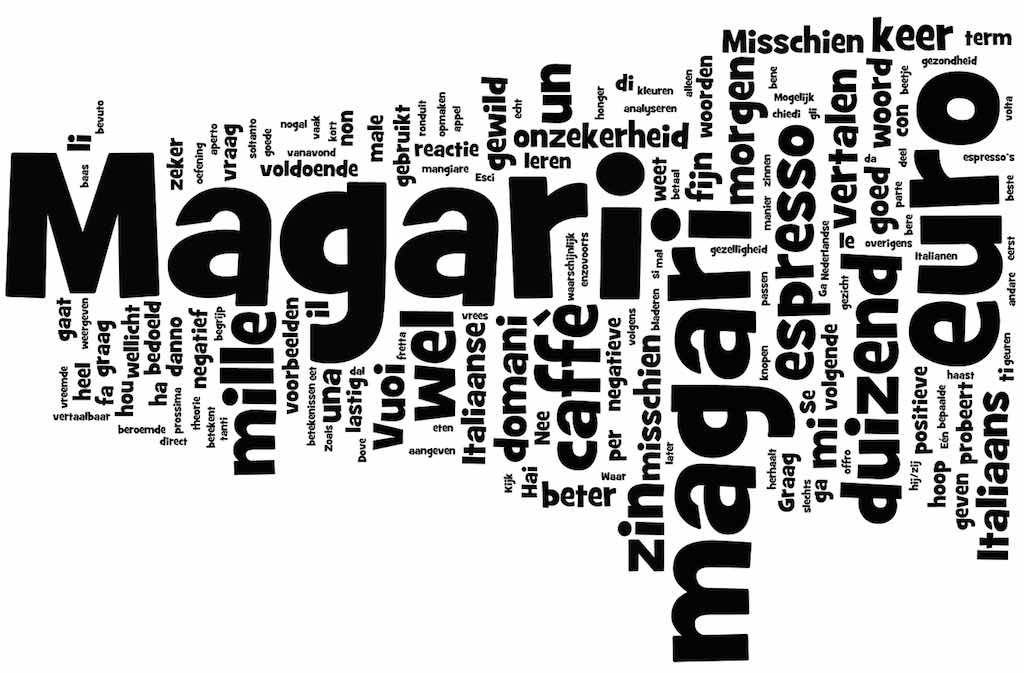
If you're trying to learn Italian, you'll notice that there are Italian words that aren't easily translatable. And Dutch words that are difficult to translate into Italian.
One very famous one is of course a word that evokes a whole range of emotions, smells and colors in the Netherlands: 'sociability'.
It is more of a concept than a word and that makes it difficult to translate (not only to Italian by the way).
I'm not going to risk it here, but save this for next time (magari ne parlo una prossima volta, I think I'll talk about it next time).
Magari, a difficult term to translate
Today I first want to talk to you about a well-known but difficult to translate Italian term. Magari is an Italian term that is frequently used and does not really have an equivalent in Dutch.
Difficult, but a good exercise if you don't try to translate everything literally (in my opinion the best way to learn a foreign language anyway).
You then notice that it falls into place and has a certain logic. Mind you… you only notice that if you repeat it a lot, already speak a little Italian and listen to it often.
Which means maybe?
In brief: maybe means 'maybe, even, perhaps, I hope so, gladly, alas, I would have liked to', and so on. At first glance, no rope to tie! But fear not, with a few sentences and examples a lot will become clear:
- Vuoi un caffe? magari! – Would you like an espresso? Gladly!
- Hi bevuto un caffe? magari! – Did you drink an espresso? I would have liked that!
- Magari domani mi offrono un caffe. – It would be nice if they offer an espresso tomorrow.
- Vuoi un caffe? No thanks, magari dopo. – Would you like an espresso? No thanks, maybe later.
- Magari bere tanti caffè fa male. – Maybe drinking a lot of espressos is bad for your health.
- Magari un caffe ti fa bene ora. magari! – Maybe an espresso will do you good now. That would be nice!
- Se gli offro il caffè magari si offende. – If I pay for the espresso, he might be offended.
As you can see, it can fit into a sentence in many places and have all kinds of meanings. I'm trying to analyze it a little better now.
Magari in response to a question:
– a positive response are:
Vuo mille euros? magari! (Do you want a thousand euros? Please!)
– but it can also be negative in the sense of 'I would have liked that'.
Hey mille euros per me? magari! (Do you have a thousand euros for me? Unfortunately!)
– it can also be more vague and show hope:
Bastano mille euros? magari! (Is a thousand euros enough? That would be nice!)
what meaning maybe when did hang li by li (over and over) of the intonation and the preceding question. You can usually tell from context what is meant, especially since Italians speak quite expressively. If you look closely at the speaker, you immediately understand what is meant.
The word maybe used in a sentence can also be both positive and negative and indicate uncertainty.
– a positive sentence (albeit in uncertainty) with maybe:
Magari domani mi danno mille euros. (Maybe they'll give me a thousand dollars tomorrow.)
Se chiedi il capo, magari ti da mille euros. (If you ask the boss, he may give you a thousand dollars.)
– a negative uncertainty in a sentence with maybe:
Magari i mille euro non bastano. (The thousand euros may not be enough.)
– a downright negative sentence with maybe:
Magari domani non mi danno mille euro, ma soltanto una parte. (They may not give me a thousand euros tomorrow, but only a part.)
Well, enough analysis for now, here are some more examples that certainly help better than theory!
Some more examples with maybe
Ho mal di testa, magari con un'aspirina mi passa. (I have a headache, an aspirin will probably make it go away.)
Vuoi mangiare qualcosa? Non ho fame, magari mangio una mela. (Would you like something to eat? I'm not hungry, but I like to eat an apple.)
Fai in fretta, magari li trovi aperto. (They may still be open if you hurry.)
Esci con me stasera? Magari Domani. (Are you going out with me tonight? No, but who knows tomorrow.)
Stand man. Magari ha bisogno di andare dal dottore. (He/she is sick. It would be better if he/she goes to the doctor.)
Dove sono le foglie? Magari il vento le ha portato via. (Where are the leaves? Who knows, the wind may have blown them away.)
Magari finisco here. (I'll stop here.)
Well, another song with maybe then, from Renato Zero.








Comments