

 This Is Italy
If you really want to learn Italian well, you cannot avoid a teacher or a thorough (paid) course, such as the Italian course from This is Italy. But if you want to master the basics of Italian (and a little more), you can learn Italian for free online. For example because you want to be able to speak some Italian before your holiday or because you want to be able to follow Italian series and films better.
We've browsed through the huge range of Italian online courses for you and broken down our best findings for you into websites, podcasts, YouTube channels, resources and courses for beginners and advanced.
Table of contents
Italian lessons for beginners
Do you want to start learning Italian? Then take a look at the links below to learn Italian online that can help you along the way.
Book2 by Goethe Verlag
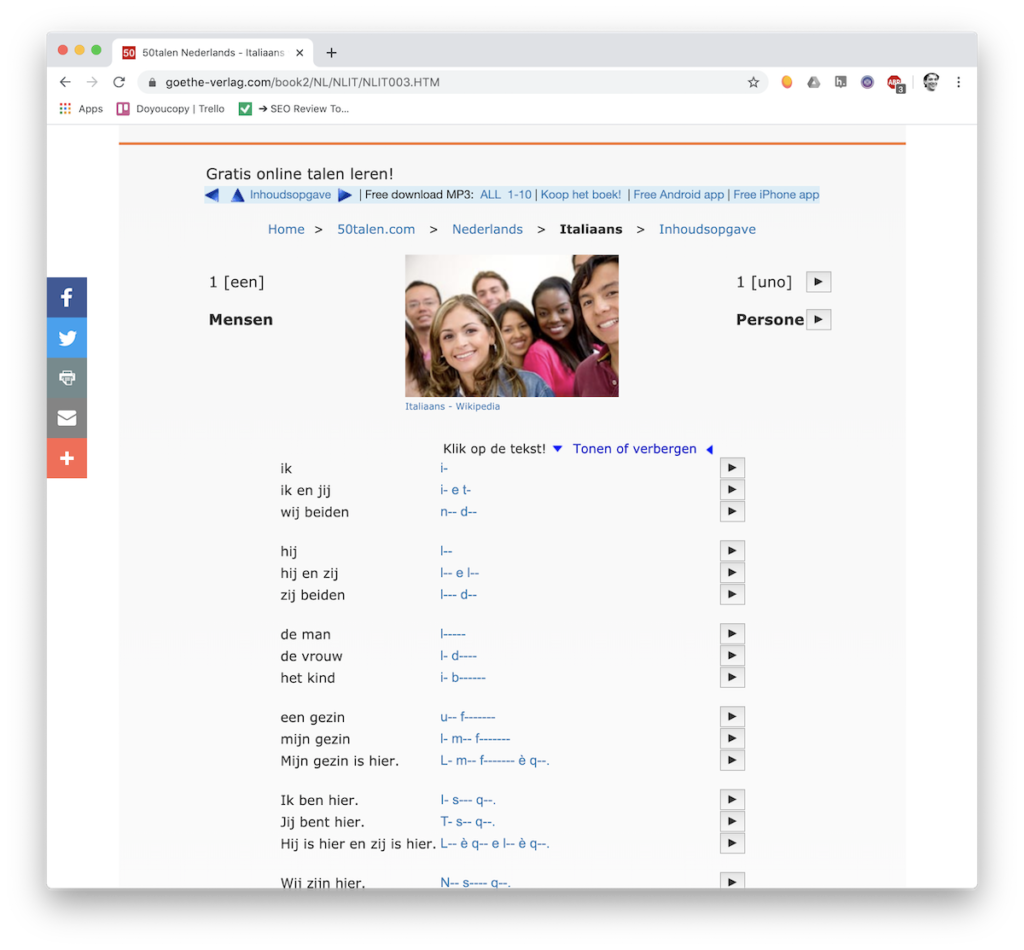
This free Italian course is completely speech-oriented. You can listen to and repeat the words and sentences via MP3. Isn't it nice that you can do 100 of these Italian language lessons for free? There is also an app for Android and iPhone, which you can use to practice your Italian on-the-go.
https://www.goethe-verlag.com/book2/NL/NLIT/NLIT002.HTM
Falo's Italian School

Olaf van Maaren offers every beginner 20 free Italian lessons with his platform Falo. You just need to create an online profile and you can start right away. The layout is nice and the explanation is good, but unfortunately there is no way to practice the pronunciation.
Olaf says he initially created the platform for himself, but later decided that he could also help others with it. And you can now take advantage of that for free.
You can create an account here and then do 20 lessons for beginners. They are beautiful well-developed lessons, the layout is pleasant and the grammatical explanation is fine, the exercises are fun too. The fact that it is free is of course a huge advantage, but the course ends before you have reached level A1. It contains grammar and cultural background information, but no listening fragments and you also get no feedback on your pronunciation. It is a nice introduction if you want to prepare for your holiday, for example.
https://www.deitaliaanseschool.nl/cursus-italiaans
Loecsen

Want to learn Italian at your own pace behind the computer, but a little playful? Loecsen offers you various Italian lessons in interactive form, mainly aimed at learning words and sentences. Nice to try if online learning is something for you. And again completely free.
https://www.loecsen.com/nl/cursussen-italiaans
Lingo Hut

Over 100 Italian lessons on simple topics like family, food ordering, my body, travel and clothes. There are various exercises to do and all words including pronunciation are passed. Works great and is completely free to use.
For students, I estimate this is fun and interesting for two hours and then 'the course' is exhausted. The word lists, some also with a play button to hear Italian, are not expanded and there is no grammar. Quite logical, because why fill in all those word lists, when learning word lists is a time-consuming and old-fashioned technique. Students give up quickly and that is why it does not pay the makers of the website to continue building on their work.
https://www.lingohut.com/nl/l60/leer-italiaans
Duolingo

It's not for nothing that Duolingo is the No. 1 downloaded education app in the App Store. Learning Italian with Duolingo is fun and engaging. The app works well and encourages you to learn a little every day. The level starts very easy and crawls according to the rules of Gamification up, including badges and trophies earned.
They have understood that well at Duolingo, because that way you can easily keep it up. You can also do Duolingo on your desktop or laptop. Learn Italian by practicing for 5 minutes every day, completely free.
Unfortunately Duolingo works from English.
https://www.duolingo.com/course/it/en/Leer-Italiaans
Buon Italian

Would you like things a little simpler with clear overviews of Italian words and concepts based on topics? Then take a look at the simple Italian beginners lessons from Buon Italian. These are offered to you for free, after which you can opt for a paid online course.
https://www.buonitaliaans.nl/online-italiaans-leren/
NTR Italian course

A nice free Italian holiday course is that of the NTR, offered by MAX Today. In 13 videos, Italian teacher Luca Avanzi guides you through the main topics you will encounter when traveling to Italy. You can watch the videos of this course in chronological order, or just watch the parts that appeal to you.
After watching the video, your knowledge of Italian will be tested with a number of quiz questions. If you have completed the video course you can download a certificate as proof of participation.
https://www.maxvandaag.nl/cursussen/italiaans/
Italian lessons for advanced students
Do you already have a few years of experience speaking Italian? Or have you taken Italian lessons before? Then you can expand your knowledge further with these online Italian lessons and resources for advanced students.
Italian Podcast

Learning Italian in the car or on the road in public transport? Davide has a great podcast that will help you further improve your Italian through interesting and authentic themes. Davide is a good teacher and also speaks excellent English. Just give it a try!
News in Slow Italian

Do you already speak a little Italian? Or do you at least understand it well? Then it's nice to mix it with current events. You can hear the latest news in slow Italian on the News in Slow Italian website. You can also read the text of the podcast episode. Ideal if you want to improve your language skills!
https://www.newsinslowitalian.com/
Impariamo l'italiano

A very comprehensive website with a large following on social media and a variety of grammatical topics. If you want to deepen your knowledge of Italian grammar, but don't want to pay for it, this is the place to be. The website looks simple and rather messy, but offers excellent explanations and exercises.
The website has all kinds of old school grammar exercises, organized by subject. Social media gives you a daily dose of knowledge about the Italian language. You will quickly receive nice reactions if you leave a comment on one of the social media channels. And that interaction is good for your Italian of course! This website is widely used, the website can also be followed on social media. The disadvantage of this website is that easy and complex exercises are mixed up and you as a beginner can become frustrated and overwhelmed.
http://www.impariamoitaliano.com/
Rai Cultura

The Italian public broadcaster offers exercises at A1, A2, B1 and B2 level. The website and the videos are very outdated. But Italian is of course also an old language 😉 That's why it's a great starting point to further improve your Italian.
http://www.italiano.rai.it/livello-unita/unit%C3%A0-1/560/487/default.aspx
LearnAmo

Do you mainly want to learn Italian by watching YouTube videos? Then you must be on LearnAmo. Here you will find videos with Italian lessons at all levels, but especially aimed at the more advanced language user. Very visually it is explained what grammatical terms mean and why they are important in Italian. Bit of a disadvantage is that the grammar you at level A1 and want to learn A2 is explained in Italian. You spend more time deciphering their message than processing the lesson content.
OnlineItalianClub.com
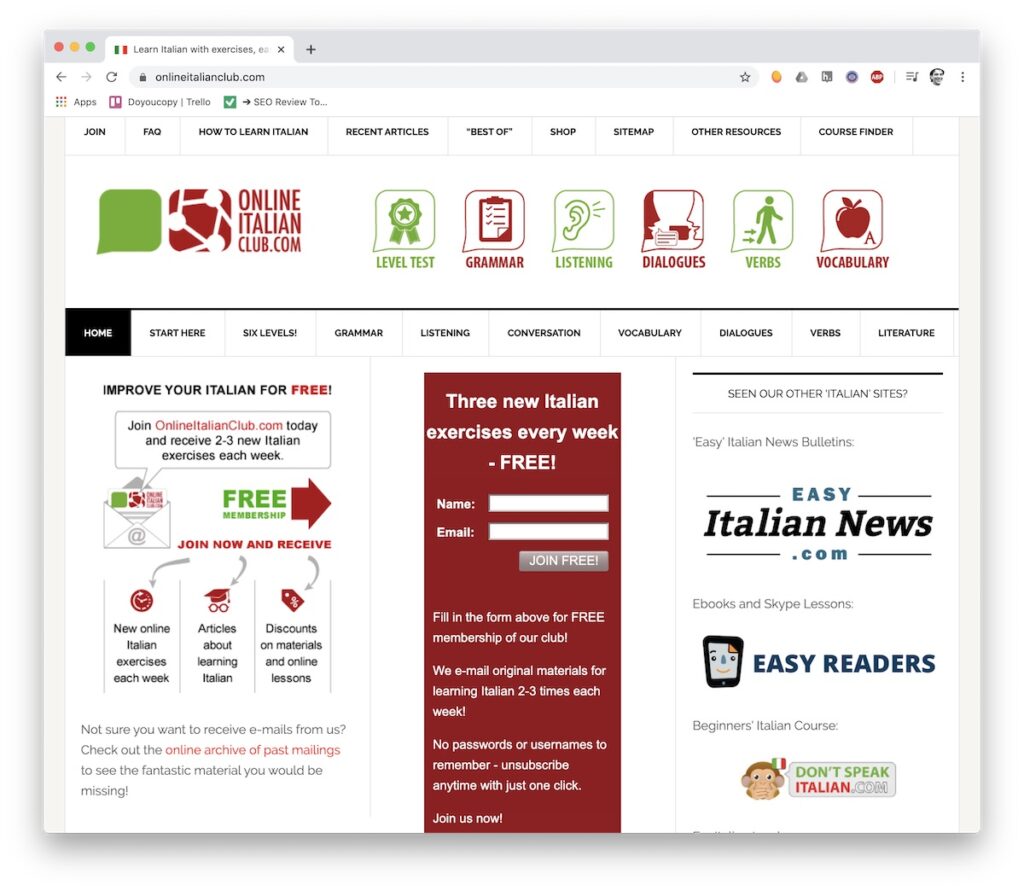
An English teacher who now lives in Italy has developed his own method of learning Italian. If you sign up, you will receive regular emails with Italian exercises and articles about Italian. Here you will also find links to news items in plain Italian and links to ebooks and other materials.
The advantage of this site is that it is designed according to the CEFR, so that you are less likely to get frustrated because you do the wrong exercises.
https://onlineitalianclub.com/
Italian automatic

Learn even more Italian on YouTube! This YouTube Italian course is for those who already have some knowledge of Italian grammar and vocabulary. Only: speaking is not so good yet. Alberto and his nonna have made lots of nice videos for you, which are a joy to watch and listen to. Just do a video every day and your Italian will improve by leaps and bounds, on autopilot!
The following also applies here: fun from level A2/B1, otherwise you will have a lot of trouble following the conversation.
https://www.youtube.com/user/ITALIANOAUTOMATICO
Ungrammatical

Are you more advanced in the Italian language and do you want to sharpen your grammar? But how about a little fun? Like over 60.000 others, subscribe to Fiorella Atzori's YouTube channel. This Italian offers hundreds of videos in the field of the Italian language and specifically grammar.
The video lessons not only benefit foreigners who want to learn Italian, but also Italians who want to brush up on their knowledge of their native language. You can immerse yourself in these videos from language level B1.
Her videos were intended for both Italians and foreigners learning Italian, but for the more advanced student. In the meantime, Fiorella has also published her own book, which somewhat resembles the Italian version of the books by Paulien Cornelisse. Only then more focused on grammatical errors than on special expressions of language. However, the mistakes she finds interesting are more interesting to a native speaker than to a foreigner. They usually make different kinds of mistakes. It's kind of them/their/dt/d. Not very disruptive in communication, especially important at high level and mistakes that are ingrained in society. Level B2/C1.
https://www.youtube.com/user/sgrammaticando/
Tandem Linguistico Dutch Italiano

Learn Italian via Facebook? It is possible if you join this group in which Italians are looking for Dutch language buddies and Dutch and Flemish people are looking for Italian language buddies. Introduce yourself, indicate what you expect or what you can do and you will learn Italian from a real Italian in no time!
https://www.facebook.com/groups/2146759128881383/
Free apps to learn Italian

Are you more of the apps to brush up on your Italian on the go on your smartphone or tablet? Then there is also plenty of choice, even if you don't want to pay anything for it.
Some of the online courses and resources in this article also have an app (free or paid).
The best free apps to learn Italian can be found here.
Better than a course: a good DIY informative website
For you reading skills is Filthy nice, the Italian version of De Speld. Satire on news at B1/B2 level freely accessible, also nice to get a look at Italian society. Many people enjoy learning Italian through cooking recipes. Check out the websites of the Silver spoon of BlogGiallo Zafferano. Recipes are not that difficult, the vocabulary is limited and repeated over and over. This is possible from level A2. On my own website that you are now visiting, you will mainly find many tips about study skills.
You can also learn Italian online by going to the Italian radio and TV (listen to italia.fm or watch the Rai Uno ) via streaming through the Rai's streaming program, Raiplay. On DitisItalie there is an article devoted to looking at Italian TV via a VPN connection. With this you can also watch other Italian channels on your laptop, which are now protected due to national TV rights. That VPN connection is still legal, but I believe it will be banned in 1 or 2 years. I already wrote a blog about it streaming italian movies. This usually costs 3 euros, usually you can pay via Ideal. I also wrote a blog about it Learn Italian with Netflix.
Language School Websites
Language school websites often have good information, but of course they will always try to get you as a student. They don't offer courses or large amounts of exercises but online skype/teams/hangout lessons. Of course you have to pay for that. However, you can often find many good study tips on their websites.
Dilit International House Roma (7000 followers on Facebook, 1800 followers on Instagram, 2000 followers on Twitter) Italy's most famous language school with Italian courses for foreigners. Also renowned for its didactics courses for Italian teachers in training. Innovative and dynamic.
Italian with Leo 7.000 on Facebook, 1300 on Instagram, 7000 on YouTube). Leo Todaro is a nice Sicilian who takes you on a cultural journey through Sicily. His account is personal and friendly and lets you get to know him as a person and thus you gain an Italian friend, which is nice for any student of Italian. There is a lot of interaction on his social media and he is very approachable for all kinds of questions. His search for everything that has to do with it is fun Montalbano, the Sicilian police commissioner from the TV series (also on Netflix).
Italian Pills (4000 on Facebook, 4000 on Instagram). Serena is a talented teacher who really has an eye for the needs and difficulties of the somewhat advanced students. She has studied foreign languages herself, but has nevertheless started to focus on Italian to teach it, but through that experience she knows exactly how to pinpoint difficulties that students of a foreign language encounter in practice. Her name is Serena and she is serene, a very calm, patient and sweet teacher, but who also does not hesitate to say what she thinks you need as a student.
Podcasts
On podcast platforms, such as iTunes or Spotify, you can find different podcasts to learn Italian. Unfortunately, these are often in English, as is the case with many paide in free apps. Many students swear by those English-language apps, but as a teacher I have my doubts. So there is no podcast available in Dutch yet specifically for learning the Italian language.
Some Italian teachers on You-tube are also working on podcasts, but they don't quite realize that a podcast is really a different channel. With You-Tube you have images to get your message across. Image is non-verbal communication, a context, gestures: there is so much in it that you miss in a podcast! As a result, the YouTube channels of Italiano Automatico and Doppio Espresso are better for beginners than their podcasts. They go too fast and at a (too) high level with their Italian. That will soon be level B2. This is the level that is mainly achieved when you study at the university.
Dutch podcasts about Italy (free!)
Podcasts about Italy do exist in Dutch. But then there is talk in Dutch about Italian football, Italian food or Italian politics. Just search for the keyword 'Italy' the website of Podcast Listening.
I myself like Radio Mangiare, although it is not always about Italian cuisine. For Valentijn the football fan, Lo Stadio's Dutch podcast about Italian football is very nice. This is all very nice for the Italian feeling, and of course you learn something about the Italian culture, but you will not learn the Italian language.
You can also add the Tutta Lingua podcast to your favorite Dutch podcasts about Italy. These were made by Fiona Woering, who has her own language school. The episodes are usually about 20 minutes long and there is some chatter and some grammar covered in a light-hearted manner. Level: A1.
English podcasts about Italian (the good ones are paid)
To really learn the language with a podcast is therefore a bit more complicated. There are podcasts in English, such as Coffe Break Italian and 30 minute Italian. There is a lot of talking in English, little in Italian. You don't learn much from it. You also have interference from English, which means that you are also busy with the English language. If you don't speak English very well, you will notice that your attention also goes to the meaning of English.
The best English podcast, which can also take you to advanced level are paid. An example is italianpod101.com. For 4, 10 or 23 dollars per month you can access different types of services. There is a free account, but then again you have next to nothing. The simple account provides access to simple cheaper account you get access to a lot of listening clips, and there is a really huge database, from beginner level to advanced. With the more expensive paid account you get help from a tutor and a tailor-made program.
There is also News in Slow Italian, hereby you receive the Italian news on podcast, with an adapted vocabulary and pronounced slowly. This is from level B1. However, this is also paid and costs $ 12,90 per month. There are also audio books on this site.
Italian podcasts
A new Italian podcast for beginners is hot Italian ON Air and is made by the Leonardo da Vinci School, which has been teaching Italian to foreigners since 1977 in the cities of Florence, Milan, Rome, Turin and Viareggio.
The Scuola Leonardo da Vinci places a lot of emphasis on spoken language, which allows you to communicate fluently with native speakers while also absorbing grammar in a simple and fun way.
The Italian teachers of this school have devised a format for learning words, expressions and idioms. Every week they publish a short, new episode of about 4/5 minutes, with a dialogue about current affairs, culture, curiosities and much more.
A great method for practicing listening, pronunciation and learning the vocabulary, expressions or idioms of the Italian language.
What you can do for free at level A2 (just past the beginner level, see info about the CEFR) is to listen to slow Italian children's fairy tales. After all, you already have a context. You know how the fairy tales go and can therefore more easily recognize the storyline and key words. Listen to the same fairy tale several times and make notes on the words you don't understand. In this way, this way of exposing yourself extra to the Italian language is certainly a valuable contribution to your learning process. You can also listen to Italian nursery rhymes and rhymes, but you can also get tired quite quickly. We are simply in a different phase of life. That level is often even higher than you would expect. The Italian children for children is really too complicated for an A2 student, who really has to think about nursery and toddler songs and rhymes.
Slow Italian fast learning and News in Slow Italian are useful podcasts for B1/B2 students. In these podcasts, the news is told in a somewhat slower way. At level B2 you also have Storia d'Italia, the history of Italy. Also entirely in Italian (despite what the name suggests) and at level B1/B2 is The Italian Coach. The Italian coach does his best to make it easy for students, but still chooses difficult topics, too difficult.
The boys, Paolo and Massimo from l'italiano vero are very sympathetic and have a nice chat. Their podcast is specially made for foreigners learning Italian and they take you to everyday Italian places. They make nice stories, but they say very easily that you should throw away the grammar. They are not Italian teachers themselves, they have a very different background in the commercial sector. You can only understand their conversations from level B1/B2. You can also find their podcast at Spotify.
The podcast Pensieri e parole, is also a good one.
Learning Italian with podcasts is not that easy after all. Netflix and YouTube also offer starting points for learning the Italian language, precisely because of the visual component.
tips for self-study
#1 Be critical of your progress
The most important thing in a study that you do on your own is the ability to honestly evaluate your progress yourself. If you don't have an idea of what you still have to do or what you can already do, then you won't succeed with that self-study either. So regularly spend time evaluating the state of affairs.
For example, I can remember that when I was working on level B1, I had to give a lecture in Italian. I was allowed to choose my subject and (as a historian) chose the Risorgimento. Italian unification. I was on a language course in Italy.
I had absolutely no idea where to get my information from. To avoid having to face the problem, I bury my head in the sand. And I let the teacher know that I had nothing for my speech. That I couldn't. It never occurred to me that I should go to the children's section of the public library and ask for help. I also couldn't imagine that I could have chosen a more appropriate subject according to level. For example, you sometimes have a lot on your mind and you cannot think efficiently in solutions. SO IT SHOULD NOT BE!
For example, many students know what they should actually do, but they don't do it because they find it exciting or think it won't work. This is then exacerbated if they set goals that are too high.
#2. Be realistic
Most people envision being fluent in another language when they start studying a language. But is that really so realistic? This won't happen overnight and for many people it takes years before they think in another language. Being able to save yourself in one language, to be able to say what is important at that moment and to be able to communicate in another language is not necessarily necessary and at that very highest level within two years. Inform yourself about the different levels of the CEFR. Being realistic also means facing problems. Be critical and see what you really need to move forward. Evaluate yourself regularly.
#3. Set goals!
There are many people who hate keys. Why does everything have to be tested? they ask me. I think they have the wrong idea of a test. You should first make a test for yourself. To gain insight into your progress and what you learn. If you have an insight into what you should be able to do in a year, for example, you can work towards this more effectively. More than if you just watch lesson by lesson what is coming your way. In consultation with your teacher, make a plan of what you want to be able to do in one year, for example. When it is clear how much time you have for study, what your background is, your way of learning, etc., you can make a realistic plan.
#4. Study your goal and act on it!
For example, if you know that you want to take the CILS A2 exam at the end of the school year, check which components belong to it. What grammar do you need to know? Do you already master this? Make your own overviews of what you need to know and practice these for each part. Choose the parts you want to practice yourself. If you make mistakes, see why they are wrong. Start with easy exercises and general rules and gradually study the exceptions from there. Ask your teacher what the criteria are for assessments of tests. What should you be able to do in a conversation? What kind of texts do you need to be able to understand? Then look for those things and make sure you come into contact with them as much as possible.
#5. Provide moments of success
Check regularly what is going well and what you can already do. If you set realistic goals you can be proud of yourself at different times. Become aware of your progress. Pass exams. How handsome is that?? Do you only have a 6? You made it! I have always barely passed, much more important is your perseverance in the long term. Let others know what you can already do on social media and throw an Italian party to celebrate. Realize that you can already sing along to music, read brochures, order coffee, etc. Don't look at what is not going well and what you do not understand when you go to an Italian film in the cinema, but be focused on recognition. Go to Italy to put your acquired skills into practice, but don't be put off by fast-speaking Italians who don't understand you well. Keep calm and use your own creativity and insight to understand Italians with the knowledge you do have. Don't always see Italian as a goal, but also as a means to play, chat and do other things. Make mistakes and enjoy!
#6. Push on!
After one or two years of studying Italian one day a week, you will be able to speak Italian well, but you will also learn the frustration of not knowing words, not understanding the other person, misunderstanding or not being able to say what you want. . Then don't give up, but keep going! Good things take time. Stay positive, look for fun things to keep your motivation. Reward your studies with a nice Italian CD or Italian book. Do you realize that you don't live in Italy, you have also done a lot of other things in the past two years.
Good paper titles for self-study
Okay, this blog is about online courses, but as an Italian teacher, I can't help but recommend that you buy a good book until I have developed a good online course myself. The quality of the books so far far exceeds that which can be found online. So I will always recommend that you buy a book.
1. Grammar di base dell'italiano from Publisher Casa delle lingue costs 26,30. It was written by Andrea Petri, Marina Laneri and Andrea Bernardoni, let's give them the credit they deserve. It is a large book with over 300 pages. It is divided into 7 chapters (1.sostantivi e aggettivi 2. determinanti 3. pronomi personali 4. verbi 5. preposizioni 6. frasi and 7. phonetica e ortografia) each with a different color, which are again divided into paragraphs. Those sub-topics / paragraphs are at a minimum level, there are few generalizations in them. You can really work with micro rules: there is an exercise for every exception. As a result, you do not have different grammatical rules in one exercise. I think this is a clear division, although some chapters (verbi) are 8 times as long as others (preposizioni). It is a practical format that helps the student to find what he is looking for. There are many exercises in which also frequently made mistakes and examples are cited, useful to learn from. The keys / solutions are at the beginning of the book, as is an overview with tavole verbali (regular and irregular verbs), although there are also very handy free apps for that.
The more than 300 exercises are classified at CEFR level, which is also a plus. Because of this, you have less chance of doing exercises at the wrong level, which prevents frustration. You quickly run into frustration if you do exercises at the wrong level and this is very annoying for many people and if this happens often, people can even drop out of the study. This book understands that well. It is clear that this book was not written by academics who know much about the theory of grammar, but by teachers who know the problems students encounter in practice. For all the above reasons, this is the book that I myself will recommend to students.
2. Nuova grammar pratica della lingua Italiana by Susanna Nocchi is an Italian book. The book also includes solutions. The book is from the Italian publisher Alma Edizioni but is sold in the Netherlands by Intertaal. The book covers grammar from level A1 to B1, but I think it's also good to have to read again when you're practicing for your B2 or C1. The grammatical parts are divided into subtopics. Sometimes it takes a while to see where something is. For example, you will find the combination pronomi with past participle with the pronomi and not with the passato prossimo, which I think could have been just as well. Well, every book has its own layout.
The book is in colour, beautiful and has about 5 to 6 exercises per subject, which is slightly more than, for example, Prisma's book Basic Grammar Italian and thus gives a little more firmness to actually master a subject after practice. So the exercises are a bit more diverse. Sometimes you have to rewrite a sentence, sometimes fill in the right word, sometimes choose the right word, sometimes answer a question, etc. That is important, because one assignment is not the same. If you have to cough up a sentence, this asks more of you than choosing the right answer and having a 50% chance of betting. The exercises are also presented gradually, from easy to difficult, which shows that they were really well thought out didactically. This book has almost 300 pages and is therefore extensive and complete. Also in this book are the Chiavi, the keys. The examples are selected by frequency, which means that exceptions that often occur in practice are mentioned and that gives relevance to an exercise.
The book costs 26,30 if you buy it directly from the publisher.
An added value of this book is that after a number of chapters there is a test. It is always good to test your language skills.
3. Basic Italian Grammar by Rosanna Colicchia, teacher and owner of Italrosa in Hilversum, has appeared at Prisma. The book covers grammar for beginners and advanced students. The topics are clearly demarcated with two pages per grammatical topic, making it easy and quick to look up something. Some explanation and a few exercises to get the hang of it. It is nice for grammar enthusiasts that there is a good explanation + thorough exercises of the prepositions. These are difficult for many students. Dutch grammatical terms are used, but there is also an overview of these terms in Italian, useful if you have a madrelingua teacher who does not speak Dutch.
The book is divided into two parts: beginners and advanced. That is recommended, because even in Italian language courses, a subject in the grammar is always cut into pieces. This is to avoid having to confront the student with all facets of a topic at the beginning. It remains that the classification is a bit arbitrary, one will find this for beginners, the other that. In my opinion, a classification at CEFR level would be more useful, so that students can practice more specifically for passing an exam in the short term. This book was published before the CEFR was widely used. The number of exercises is also limited. But that applies to all books, unless you take a book below from ALMA on one grammatical subject where you can practice one subject to the end.
The book has 150 pages plus the solutions behind it. On Bol.com it is often labeled by readers as 'clear' and 'practically applicable' and I can only agree with that.
So the book is nice to get the grammatical topics in order and to practice with them, in a different way. In addition to the normal method that your teacher uses in class, this is certainly a good addition.
The book costs 15,50
4. So nice are the ALMA edizioni editions where you can practice a specific grammatical subject. If you have covered EVERYTHING in the other books, but with only 2,4 or 6 exercises, with ALMA's books you practice one subject to the end, until you master it. Like a book about essere or avere (by Fabrizio Ruggeri), passato prossimo e imperfetto (C. Brighetti, A. Fatone, and T. Pasqualini).
These are available at Intertaal.nl. The advantage of these booklets is that you are forced to make a choice in a certain situation and unlike 1/2/3/4 you have to choose which grammatical tense or which verb or conjunction to use. The exercises are therefore more active and more difficult and no quick fill-in scores. They are not so much to learn the conjugations as to learn the precise usage in different situations.
The booklet essere / avere actually contains everything that has to do with essere or avere. The exceptions to the rule, and all the micro-rules that are scattered in a manual over the presente indicativo, the verbi irregolari, the passato prossimo and the verbi reflessivi, for example. Here too, the types of exercises are diverse, sometimes you have to underline, sometimes indicate right or wrong, sometimes conjugate something, sometimes connect the correct answers, etc.
I would have liked to have had that booklet about the imperfetto versus the passato prossimo myself. I've picked up these grammatical topics in practice and never really learned the rules well and then you keep making the mistake of duplicating certain things, even when you're still at C1 or C2 level. Then you get wear errors. Where I myself still go wrong (and many Italians do with me, for that matter) is filling in the correct tense / verb conjugations in a story. So if you really want to learn these subjects without errors, these booklets are the best addition to the above-mentioned manuals.
A booklet costs 24 euros if you order it directly from the publisher Intertaal.
5. Grammar essenziale della lingua italiana I used con esercizi by Marco Mezzadri myself at university. Rosanna Colicchia from Italrosa.nl let me know that you the chiavi can be purchased separately, with some additional exercises. The book is published by the Italian Guerra Edizioni and distributed in the Netherlands by Intertaal. The book costs 29,30 if you buy it directly from the publisher Intertaal.
6. The 250 grammar exercises of Intertaal van Rovere / Fenati has grammar exercises from level A1 to level B1. The solutions are in the back of the book. 250 exercises seems like a lot, but when you consider that there are a lot of grammatical topics, the number of exercises per topic is limited to about 10 exercises per topic. The first half of the booklet deals with linguistic matters, such as the article, noun, adjective, etc. The second half deals with different verb tenses and modes. Attention is also paid to the prepositions and sentence structure that are so difficult for many. This means they know what difficulties and uncertainties there are among Dutch students.
The booklet contains the entire grammar up to and including B1, but does not go into more complicated matters such as conjunctions, which are more associated with B2 or C1. It is a good addition to your book, also because you practice per subject and you know very clearly what you are doing. On the other hand, the exercises are designed in such a way that you learn to remember conjugations, but you do not learn a lot about targeted application in different situations in which you have to make a grammatical decision. You have to remember that that is what you want when you buy this book.
The book does not pretend to exhaust all grammar, only the most important things are covered.
The booklet costs 11,92 if you buy it directly from the publisher.
7.Italian Grammar Exercise Book by Van Dale by Rita Maria Sorce. This book has old-fashioned grammar exercises but has 250 pages and goes up to level C1. It is a Dutch edition but the number of exercises you can do is very limited, because it covers all levels. It is clearly organized by subject. In this new book, the primary chapter division is the grammatical topic. So you can choose whether you want to practice the article, the passato remoto or the adverb to name a few. In addition, the grammar part per level of the CEFR is explained with exercises. For example, in the chapter on the personal pronoun you have exercises for A2 for pronomi complemento oggetto and for B1 with pronomi combinati misti/ combinati. This also makes the progress much more clearly visible for a student, which is hugely motivating. The book makes successes visible.
In addition, the Italian Grammar Exercise Book is richly illustrated in color and has a much more positive user experience than the older books above. The grammatical terms are named in both Dutch and Italian, making the book accessible to Dutch students.
To get a grip on Italian grammar, it is sometimes nice for advanced students to have Italian grammar explained in Dutch, I speak from my own experience. There is relevant and clear attention to different types of conjunctions and adverbs: important matters in the CILS exams but often neglected in modern methods. The attention for cultural things is fun and provides variety. The only downside I can mention is that 250 pages is very little for 6 different levels. The attention for B2/C1 level is certainly limited, but on the other hand: most students do not get that far. It is also nice information for A2/B1 students to see what they should be able to do at a higher level. It makes knowledge and progress transparent. Anyway, I'm going to take the book to class tonight.
The solutions of the exercises are online. The book costs € 25,99 at Van Dale publishers.
Tip: do you want a complete online program that guides you to A1 level? Then try the course This is Italian from This is Italy. You can follow fun and challenging lessons at an affordable rate. View all info here.
Your online resources to learn Italian for free?
Do you have any other tips of your own for resources or courses to help you learn Italian online? Then comment them below. In the near future we will expand the above list of websites, learning platforms and YouTube channels even further!
We are curious how you learn Italian (for free). Online or offline? With or without a teacher? Paid or free?






Comments